
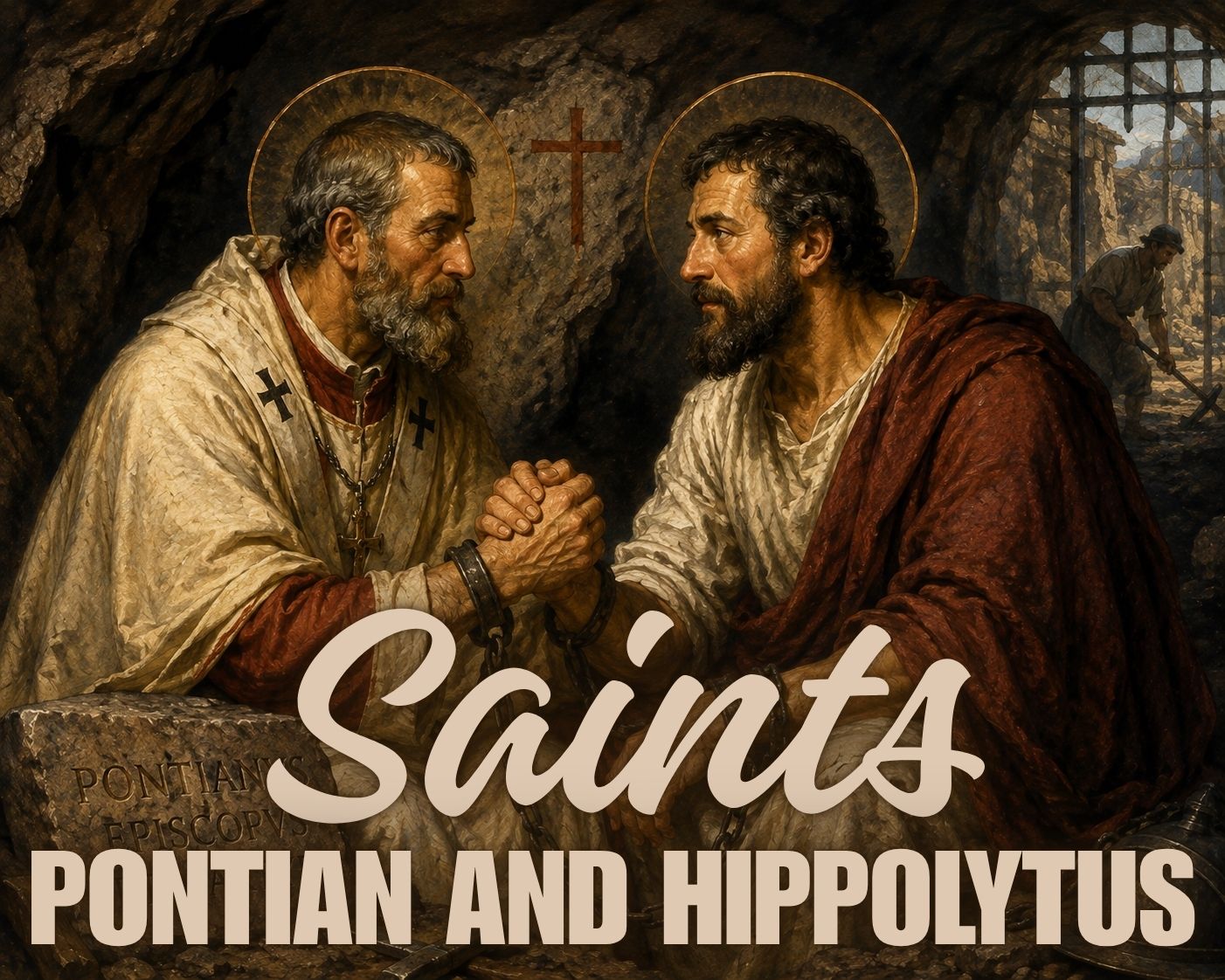
Saints Pontian and Hippolytus offer one of early Christianity’s most striking stories of reconciliation, since the two men spent years as bitter theological rivals before dying together as martyrs. One had served as the lawful Pope, while the other had actually declared himself a rival claimant to that same office. Their shared suffering in a brutal Roman mine ultimately healed a division that had split the Church for nearly two decades. Here, we trace their conflict, their exile and the reconciliation that defined their final days.
Saints Pontian and Hippolytus Are Honoured Every August 13
The Catholic Church celebrates the feast of Saints Pontian and Hippolytus every year on August 13, commemorating their martyrdom around 235. Their joint feast specifically celebrates not their earlier disagreements, but the unity they eventually found before death. Both men are honoured today as martyrs whose reconciliation carries as much significance as their suffering.
A Pope and a Rival Claimant
Pontian served as Pope from 230 to 235, leading the Roman Church during an increasingly tense period marked by persecution and internal theological disputes. During his papacy, he presided over a synod in Rome that confirmed the excommunication of the influential theologian Origen, following a similar decision reached earlier in Alexandria. Hippolytus, meanwhile, stood as one of the most respected theological writers in Rome at the time, yet he strongly objected to what he viewed as excessive leniency toward repentant sinners under Pope Callistus. That disagreement escalated until Hippolytus set himself up as a rival claimant to the papacy, a schism that persisted for roughly eighteen years across multiple pontificates.
Exile to the Mines of Sardinia
In 235, Roman Emperor Maximinus Thrax launched a fresh persecution against Christian leaders and swiftly arrested Pontian and Hippolytus.. Roman authorities sent them together to the mines of Sardinia, an island notorious throughout the empire for its brutal, unhealthy conditions. Recognizing that he could no longer effectively lead the Church from exile, Pontian made the unprecedented decision to resign his office, becoming the first pope in history to do so voluntarily. This resignation allowed Rome’s clergy to elect a successor while Pontian still lived.
Saints Pontian and Hippolytus Reconciled in Suffering
Forced to endure the same harsh labour side by side, the two former rivals gradually set aside their theological quarrels. According to long-standing Church tradition, the shared suffering of the mines softened Hippolytus’s resistance and he formally renounced his schism, reconciling fully with Pontian and the wider Church. This reconciliation ended one of early Christianity’s longest-running internal divisions, transforming two former opponents into companions united by faith. Both men died from the harsh conditions of exile that same year, after reconciling with each other before their deaths.
Honoured Together in Rome
Pope Fabian, who succeeded Pontian’s immediate successor within months, later arranged for both bodies to return to Rome for burial with full honours.
They buried Pontian in the papal crypt of the Catacomb of Callixtus. His tomb slab, bearing a Greek inscription identifying him as bishop and martyr, was rediscovered in 1909.
They buried Hippolytus separately in a cemetery along the Via Tiburtina. Romans later built a basilica over his tomb, showing how deeply they embraced his reconciliation with the Church.
Why Their Story Still Resonates
Saints Pontian and Hippolytus remind believers that humility and shared suffering can heal even the deepest divisions within the Church. Their example continues to speak powerfully to anyone struggling with conflict or estrangement from others. For more on the theological disputes of this era, New Advent’s Catholic Encyclopedia entry on Hippolytus offers additional background reading. Readers exploring nearby August feasts can browse the complete August Saints calendar for more, including the story of Saint Maximilian Kolbe, martyred just one day later on the calendar.


Leave a Reply