
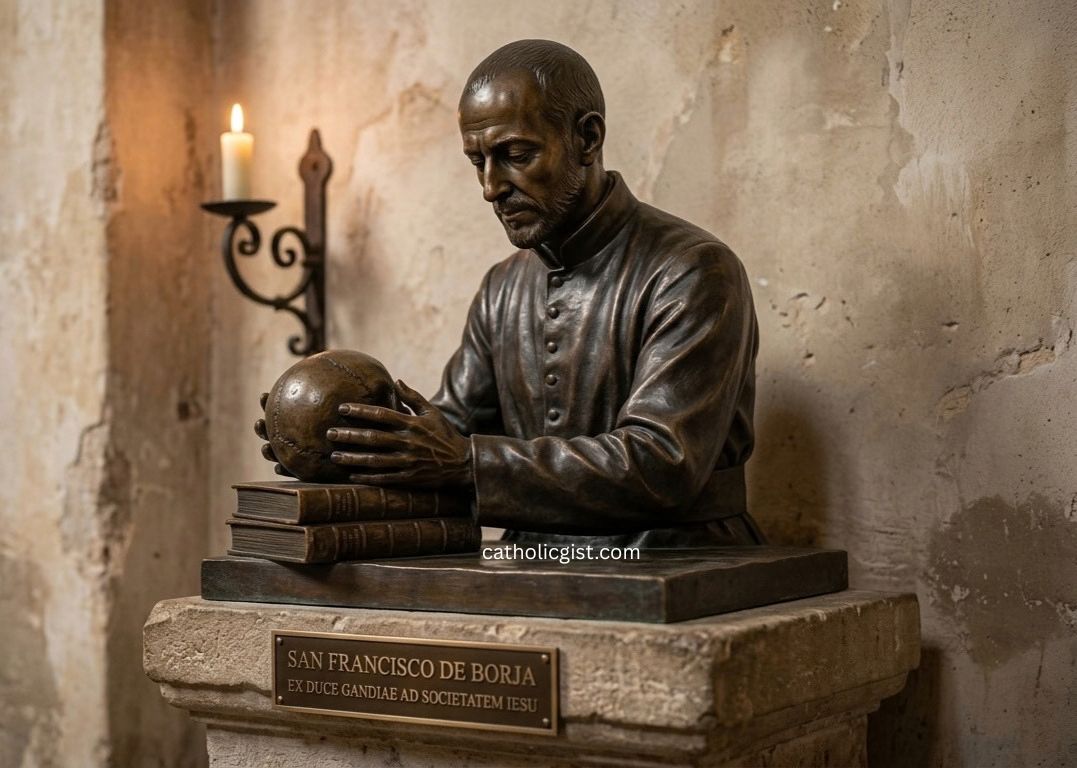
From Spanish Duke to Jesuit Leader
Catholics have long honoured Saint Francis Borgia on October 10. However, the Jesuits now keep his memorial on October 3. Either way, his story begins in a Palace and ends in a humble Cell. Moreover, he gave up wealth and power to serve God. Therefore, his life offers a bold lesson on what truly matters. In addition, many consider him the second founder of the Jesuits.
Francis was born on October 28, 1510, in Gandía, in the Kingdom of Valencia. His father, Juan Borgia, was the third Duke of Gandía, and his mother was Juana of Aragon. Moreover, he was a great-grandson of Pope Alexander VI. Thus, the Borgia name carried both fame and shame. Nevertheless, Francis grew up with a deep love for God.
Francis studied at Saragossa and later served at the imperial court. Around the age of twenty, he married Eleanor de Castro, a Portuguese noblewoman, and they had eight children. In addition, Emperor Charles V made him Marquess of Lombay and gave him places of honour at court. As a result, Francis enjoyed wealth, comfort and influence. Yet his heart still searched for something deeper.
A sudden event changed him in 1539. Empress Isabella died, and Francis escorted her body. There, he saw the remains of a once beautiful woman. Consequently, he understood how quickly earthly glory fades. He then asked God what to do with the rest of his life. From that moment, prayer became more important to him.
In 1543, his father died, and Francis became the Duke of Gandía. Three years later, his beloved wife Eleanor died. Soon he felt called to religious life. Over the next years, he arranged the future of his children. Meanwhile, he founded a Jesuit college in Gandía, which became a university by papal bull in 1547.
In 1550, Francis travelled to Rome, where Saint Ignatius Loyola welcomed him. Then he returned to Spain. He was ordained a priest on May 25, 1551. So many people came to his first Mass that the altar had to move outdoors. Yet he asked only for humble work. According to Catholic Online, he helped in the kitchen and carried wood.
A quiet life was not his destiny. In 1554, Ignatius named him commissary general of the Jesuits in Spain. Later, Diego Laynez died in January 1565, and the Jesuits elected Francis as their third Superior General. As a result, he led the order during a time of rapid growth. He sent missionaries across the world, including to Florida, Mexico and Peru. Furthermore, he strengthened Jesuit schools in Europe.
Francis died in Rome on September 30 or October 1, 1572. Afterwards, the Church recognised his holiness. Pope Clement X canonised him in 1671. In 1688, the Church added his feast to the General Roman Calendar for October 10. People invoke him against earthquakes, and he is a patron of Portugal. His relics rest in Madrid, where the Jesuits moved them in 1901. After a fire in 1931, the Jesuits recovered some of his ashes and placed them in a new church.
What can we learn from Saint Francis Borgia? First, grief can open the heart to God. Next, true greatness lies in humility, not rank. Furthermore, obedience can turn a quiet vocation into a mission for the whole Church. Therefore, we can ask him to help us hold earthly things lightly. We can also pray for all who lead with humility.
For more reading, visit Britannica, Catholic Online and Wikipedia.

Leave a Reply