
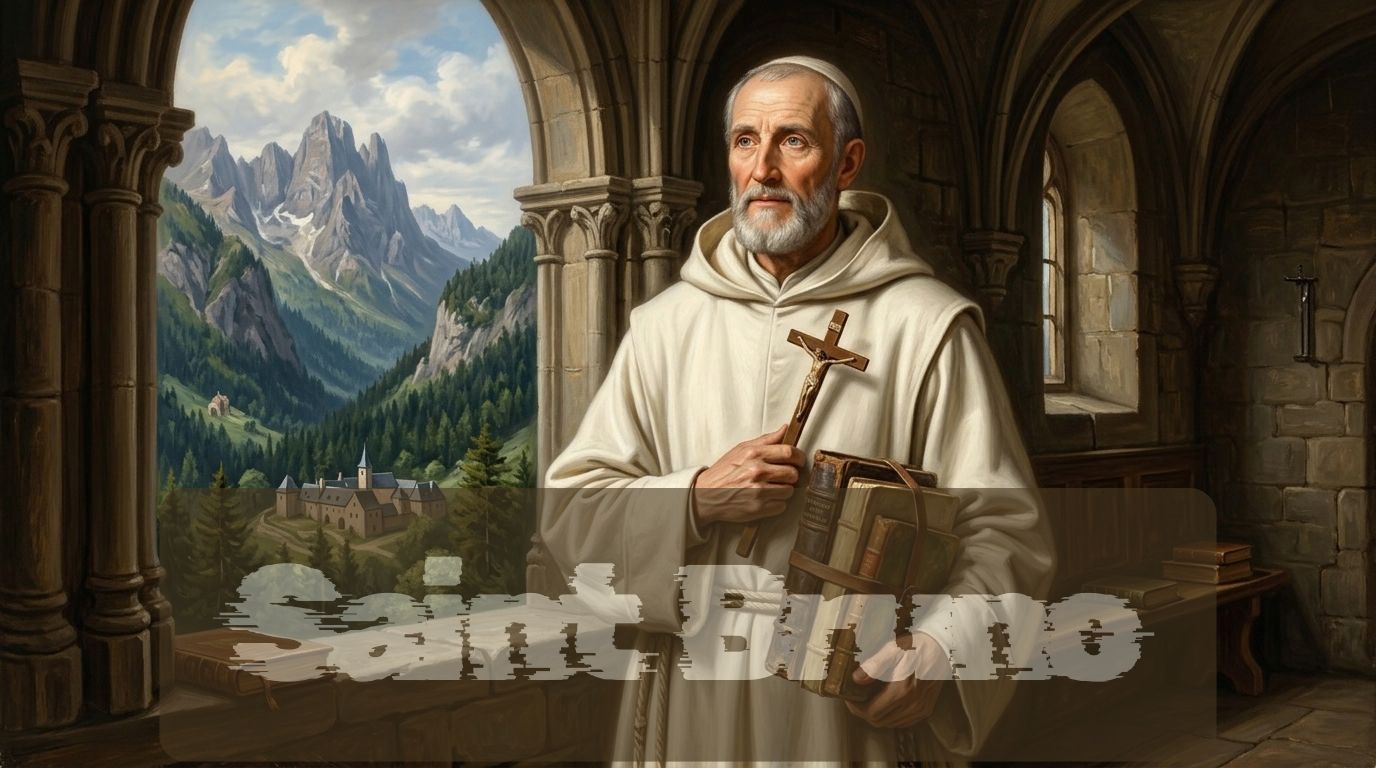
Founder of the Carthusians
Catholics celebrate the Feast of Saint Bruno of Cologne on October 6. He founded the Carthusians, one of the most austere and contemplative orders in the Church. Moreover, he died on October 6, 1101. Therefore, the date holds special meaning for the monks and nuns who follow his way of life. In addition, his story speaks to anyone who longs for quiet and a deeper bond with God.
Bruno was born in Cologne, Germany, around the year 1030. As a young man, he studied at the cathedral school in Reims, France. Later, he returned to Cologne, where he became a priest and a canon. Then he went back to Reims and led the cathedral school for nearly two decades. During that time, he earned a strong reputation as a philosopher and theologian. Indeed, one early description praised him as a wise man whose words carried great meaning. In 1075, he became chancellor of the archdiocese.
Yet worldly success did not satisfy him. He longed for a life of prayer and solitude. Therefore, he left his post and looked for a quiet place to serve God. As a result, he set out with a few companions to find it.
In 1084, Bruno moved south towards Grenoble with six companions, four clerics and two laymen. There, the local bishop, Saint Hugh, led the group high into the Alpine massif of the Grande Chartreuse. They settled at about 1,190 metres above sea level. Consequently, the first Carthusian hermitage began in that remote valley. The order takes its name from this place. Furthermore, it still follows the spirit of those first years.
Their daily life took shape around three things. Each monk lived in a cell and spent much of his time in personal prayer, reading and copying manuscripts. In addition, the community gathered for shared liturgies. They also did manual work. Thus, solitude and community lived side by side.
However, the quiet did not last. In 1090, Pope Urban II called Bruno to Rome as his adviser. The Pope had once been Bruno’s pupil. Reluctantly, Bruno left the Chartreuse. He stayed in Rome only a short time. He even refused an offer to become an archbishop. Instead, he begged to return to a life of solitude.
With the Pope’s blessing, he founded a new hermitage in the forests of Calabria, in southern Italy. There he spent his final years in prayer. He died on October 6, 1101, at Serra San Bruno. Afterwards, the Carthusians of Calabria followed a medieval custom. They sent a messenger carrying a scroll to announce his death to other communities.
Interestingly, Bruno never went through a formal canonisation process in the usual way. Nevertheless, the Church recognised his holiness early. Pope Leo X approved the celebration of his feast in the sixteenth century. Later, other popes extended it to the whole Church in the seventeenth century. As a result, Catholics around the world now keep his feast on October 6.
The Church honours Bruno as a patron of Calabria, Germany, Grenoble and the Carthusians. He is also invoked by people troubled by diabolic possession. His order has a striking motto: Stat crux dum volvitur orbis. It means that the Cross stands steady while the world turns. Moreover, humility marks Carthusian spirituality, and the order keeps its own liturgy. Today, 21 charterhouses exist, 16 for monks and five for nuns.
What can ordinary Catholics learn from Saint Bruno of Cologne? First, silence helps us listen to God. Next, daily prayer needs steady discipline. Moreover, humility keeps us close to Christ. Even busy families can set aside a few quiet minutes each day. For example, you can pray one decade of the Rosary in silence. You can also read more at Hozana and Wikipedia.

Leave a Reply