
The Twin Physicians Who Healed for Free
Saints Cosmas and Damian are honoured annually on September 26, remembering two remarkable twin physicians. Interestingly, Canada instead observes their feast on September 25, while the pre-1970 calendar once marked September 27 instead. Consequently, believers across different traditions all pause annually to honour these ancient, widely venerated healer-martyrs. Furthermore, their names appear directly within the Roman Canon, confirming their feast as genuinely one of Christianity’s oldest observances. Therefore, exploring their story reveals why medical professionals worldwide still claim them as patron saints today.
According to tradition, Cosmas and Damian were born as twins somewhere within Arabia, sometime during the third century. Some accounts specifically place their birthplace within Cyrrhus, located in present-day Syria, near the Turkish border. Their mother, a devout Christian, reportedly raised both sons faithfully, possibly alongside a Christian father as well. Consequently, the brothers grew up steeped within genuine Christian conviction, later pursuing formal medical training and education. Eventually, they relocated toward Aegea, situated along Cilicia’s coastline, within what is now modern Turkey.
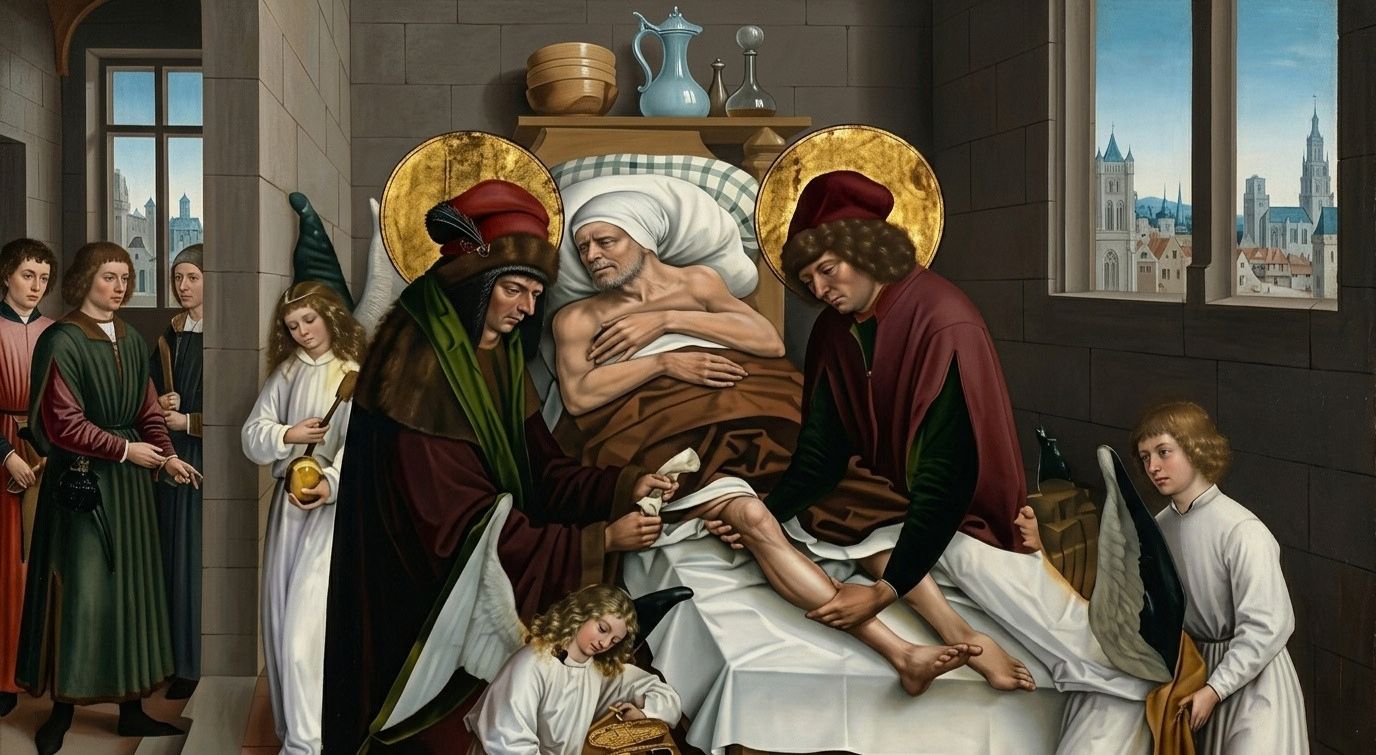
There, Cosmas and Damian practised medicine skilfully, yet they refused accepting any payment whatsoever for their services. Consequently, grateful patients nicknamed them “Anargyroi,” meaning literally “without silver” or “the moneyless ones.” This remarkably countercultural generosity attracted considerable attention, drawing many curious observers toward Christianity through their compassionate example. According to popular legend, the brothers even performed history’s first recorded leg transplant, grafting a limb onto an amputee. Artists frequently depicted this dramatic miracle throughout medieval and Renaissance religious artwork, cementing their reputation as remarkable healers.
Unfortunately, their prominent Christian faith made them obvious targets once persecution intensified under Emperor Diocletian. Around 303 AD, Lysias, the local governor of Cilicia, ordered their immediate arrest alongside three additional brothers. These companions, named Anthimus, Leontius and Euprepius, apparently shared both their family bond and their unwavering faith. Authorities demanded that all five brothers publicly renounce Christianity, yet each one steadfastly refused this demand. According to tradition, they endured various brutal tortures, including attempted drowning, burning and stoning, before eventually being beheaded together.
Despite scarce verified historical detail, devoition toward Cosmas and Damian spread remarkably quickly throughout both Eastern and Western Christianity. Emperor Justinian I, ruling between 527 and 565, reportedly experienced miraculous healing after seeking their intercession personally. Consequently, he later rebuilt their hometown of Cyrrhus entirely, honouring them gratefully for his own remarkable recovery. Furthermore, numerous churches soon appeared throughout the Roman Empire, dedicated specifically toward these two beloved physician-martyrs. Notably, the Basilica of Saints Cosmas and Damian still stands prominently within Rome’s ancient forum today.
This particular basilica occupies a repurposed Roman building, originally converted into a church around 527 AD. Consequently, it remains among the oldest surviving structures specifically dedicated toward these celebrated twin saints. Beyond Rome, devotion also flourished considerably within Renaissance Florence, particularly among the powerful Medici banking family. The Medici specifically adopted Cosmas and Damian as personal patrons, commissioning numerous artworks depicting their charitable medical ministry. Consequently, their images appear prominently throughout Florentine Renaissance art, reflecting this particular family’s genuine devotional attachment.
Today, believers continue invoking Cosmas and Damian across an impressively wide range of professional and medical concerns. Alongside Saint Luke, they remain patron saints of physicians, surgeons, pharmacists and dentists worldwide. Additionally, believers invoke them specifically against blindness, hernias, kidney stones and dangerous, widespread pestilence or illness. Furthermore, their patronage extends toward barbers, midwives, veterinarians and even confectioners, reflecting centuries of accumulated devotional tradition. Notably, identical twins themselves frequently claim these particular saints as their own special heavenly patrons.
Ultimately, Saints Cosmas and Damian’s enduring popularity demonstrates how genuine compassion can transcend even centuries of historical uncertainty. Although verified biographical detail remains genuinely scarce, their consistent legend emphasises charity, medical skill and unwavering religious conviction throughout persecution. Consequently, their feast day continues inspiring healthcare workers, particularly those who prioritise patient welfare above personal financial gain. Therefore, September 26 remains a fitting occasion for reflecting upon selfless service, medical vocation and steadfast faith under genuine pressure. For readers wishing to explore further martyrdom history, additional detail remains available through Loyola Press and Catholic Culture, alongside earlier articles published on this website concerning other celebrated early Church martyrs.


Leave a Reply