
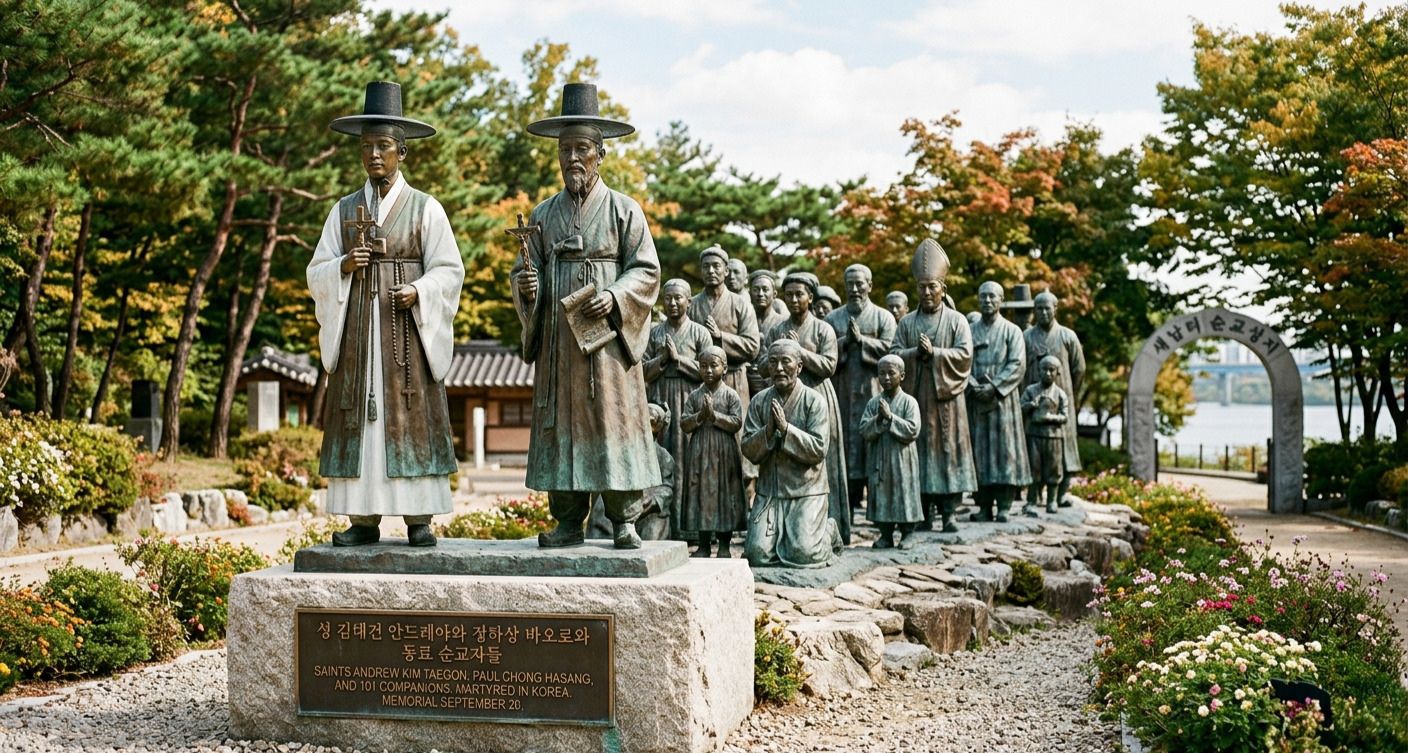
The Catholic Church honours Saints Andrew Kim Taegon, Paul Chong Hasang, and Companions every year on September 20. This joint feast commemorates one hundred and three Korean martyrs, killed across several brutal waves of persecution. Consequently, this single memorial captures an extraordinary chapter within Korea’s remarkable, largely lay-founded Catholic history. Furthermore, Pope John Paul the Second personally canonised these martyrs during his historic visit to Seoul in 1984. Therefore, their story deserves careful attention, since it began remarkably without any resident missionary priest whatsoever.
Catholicism arrived within Korea through an unusually unique path during the late eighteenth century. Rather than missionaries introducing the faith, Korean scholars first encountered Catholic texts while visiting Beijing on diplomatic missions. One such scholar, Yi Sung-hun, received baptism there in 1784 and later returned home to spread this new faith personally. Consequently, the Korean Church grew initially through lay evangelisation, entirely independent of ordained clergy or formal missionary support. Eventually, a Chinese priest, Father James Zhou Wenmo, entered Korea secretly in 1795, offering the community’s first recorded Mass. However, authorities martyred him in 1801, beginning a devastating pattern of persecution that would continue for decades.
Andrew Kim Taegon, born in 1821 near Dangjin, grew up within this dangerous yet deeply committed Christian community. His parents had converted to Catholicism, and his father, Ignatius Kim, was later martyred during the 1839 persecution. Baptised at just fifteen, Andrew travelled an astonishing thirteen hundred miles toward Macau, seeking formal seminary training. He later completed additional theological study in the Philippines, before finally being ordained in Shanghai during 1845. Consequently, he became the very first native Korean Catholic priest, returning home immediately to serve his persecuted community. Working alongside French Bishop Ferréol, Andrew secretly arranged safer water routes for smuggling additional missionaries into Korea.
Sadly, authorities arrested Andrew in 1846, subjecting him to severe torture before his eventual execution. He was beheaded near the Han River at Saenamteo, close to Seoul, on the sixteenth of September that same year. He died at just twenty-five years old, having served as an ordained priest for barely a single year. Nevertheless, his brief ministry left an indelible mark upon Korean Catholic identity, earning him lasting patronage over Korean clergy. Today, believers continue honouring his remarkable courage, particularly his insistence that genuine Christian faith requires visible, costly witness.
Paul Chong Hasang, meanwhile, followed a strikingly different yet equally courageous path toward eventual martyrdom. Born around 1794, he came from a family already deeply marked by persecution and personal sacrifice. Both his father and older brother died as martyrs while Paul was still only a young child. Despite this danger, Paul became a skilled government interpreter, a role that allowed him considerable freedom to travel toward China. Using these journeys strategically, he became an influential spokesman advocating for Korea’s isolated, priest-starved Catholic community. Remarkably, his persistent appeals to Rome eventually helped secure the establishment of Korea’s own apostolic vicariate in 1831.
As persecution intensified once again, Paul recognised that his own martyrdom had become increasingly likely and unavoidable. Nevertheless, he continued his dangerous advocacy work, refusing to abandon his fellow believers during their darkest hour. Authorities eventually arrested him during the severe 1839 persecution, subjecting him to torture before his execution. He was beheaded on the twenty-second of September that year, at approximately forty-four years old. Consequently, his life demonstrates that genuine holiness often emerges through quiet, persistent service rather than dramatic, singular gestures alone.
Beyond these two prominent figures, the remaining one hundred and one companion martyrs represented Korea’s entire Catholic community remarkably well. This diverse group included several bishops and priests, alongside considerably larger numbers of ordinary laypeople. Men and women, married and unmarried, children and elderly believers all suffered together across these repeated waves of persecution. Most martyrdoms occurred during three particularly devastating periods, specifically in 1839, 1846 and eventually 1866 or 1867. Consequently, this shared feast honours not merely individual heroism, but an entire community’s collective, sustained faithfulness toward Christ.
Pope John Paul the Second canonised all one hundred and three martyrs together during his historic 1984 apostolic visit toward Seoul. Notably, this ceremony coincided deliberately with the two-hundredth anniversary of Korean Catholicism’s own remarkable, lay-driven beginning. Today, Korea boasts millions of Catholic believers, representing extraordinary growth from those original, dangerously persecuted communities. Therefore, this feast day continues inspiring contemporary believers, particularly regarding courage, lay leadership and steadfast faith under genuine pressure. For readers wishing to explore further Church history, additional detail remains available through Vatican News and Franciscan Media, alongside earlier articles published on this website concerning other celebrated martyred saints.

Leave a Reply