
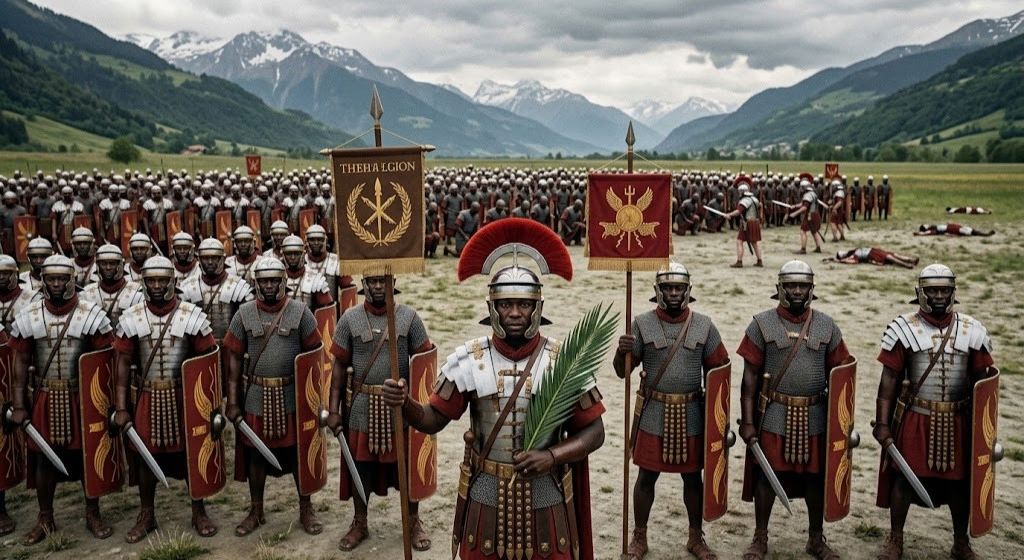
The Martyrs of the Theban Legion
The Catholic Church honours Saint Maurice and Companions every year on September 22, commemorating an entire martyred Roman legion. According to tradition, this remarkable group belonged to the Theban Legion, a military unit composed entirely of Egyptian Christian soldiers. Consequently, their shared feast represents one of Christianity’s most dramatic accounts of collective martyrdom under Roman persecution. Furthermore, their story has inspired devotion for over 16 centuries, spreading widely across Switzerland, Austria and northern Italy. Therefore, understanding their history reveals why this legend continues capturing imagination within military and religious circles alike.
Maurice, whose Latin name Mauritius means “African knight,” was reportedly born around 250 AD into a pagan Egyptian family. Thanks to his considerable courage and leadership abilities, he eventually rose toward commanding the Theban Legion stationed near Thebes, Egypt. This particular legion, traditionally numbered at 6,666 soldiers, consisted almost entirely of devout Christian believers. Emperor Maximian later ordered this legion transferred toward Gaul, hoping to suppress a growing rebellion within Burgundy. Additionally, some accounts suggest Maximian intended the legion to help persecute local Christian communities scattered throughout the region.
Upon reaching Octodurum, now called Martigny in modern Switzerland, the legion received troubling orders from their emperor. Maximian commanded every soldier to offer sacrifice toward pagan gods, honouring traditional Roman religious practice before continuing their military campaign. However, being devout Christians themselves, Maurice and his fellow soldiers firmly refused this direct imperial command. Consequently, they withdrew quietly toward nearby Agaunum, hoping simply to avoid direct confrontation while maintaining their religious convictions. Nevertheless, Maximian interpreted this peaceful withdrawal as outright rebellion, demanding immediate and severe punishment for their defiance.
Furious at this refusal, the emperor ordered decimation, a brutal Roman practice involving the execution of every tenth soldier. Remarkably, despite watching their comrades die, the surviving soldiers still refused to abandon their Christian faith or convictions. Consequently, Maximian ordered a second decimation, hoping this additional bloodshed might finally break their collective resolve. Throughout this horrifying ordeal, commanders Maurice, Exuperius and Candidus reportedly encouraged their remaining soldiers toward continued steadfastness and courage. Ultimately, when neither decimation succeeded, the emperor ordered the entire remaining legion executed, reportedly occurring around the year 286.
The earliest surviving written account comes from Bishop Eucherius of Lyon, composed sometime between 443 and 455 AD. Eucherius explained that he learned these details from Isaac, Bishop of Geneva, who had previously heard them from Theodore, Bishop of Octodurum. Theodore, living during the fourth century, reportedly discovered an ancient cemetery believed to contain the martyrs’ actual remains. Consequently, in 380 AD, these bones were transferred toward a newly constructed basilica built specifically at Agaunum. This location eventually became known as Saint-Maurice, situated within modern Switzerland’s Valais canton, remaining an important pilgrimage destination today.
Beyond Maurice himself, several individually named companions also receive specific veneration within this shared feast day. Exuperius served as the legion’s standard-bearer, while Candidus and Victor of Solothurn held additional command positions among the soldiers. Furthermore, siblings Felix and Regula are sometimes associated with this same legendary legion, having also suffered martyrdom nearby. Modern historians, however, have questioned certain historical details, suggesting the original account may have combined multiple separate martyrdom incidents together. Nevertheless, this scholarly debate has done little to diminish the powerful devotional tradition surrounding Maurice and his companions.
Around the original burial site, successive generations gradually constructed what became the Abbey of Saint-Maurice, among Western Europe’s oldest continuously functioning monasteries. Although the current church building dates only from the seventeenth century, devotion toward these martyrs has genuinely never waned significantly. Consequently, several chivalric military orders eventually adopted Maurice as their patron, reflecting his enduring status as a soldier-saint. Most notably, the Pontifical Swiss Guard, protecting the Pope himself, claims Maurice as their principal heavenly patron today. Additionally, believers invoke him against gout and cramps, alongside protecting soldiers, armourers and various textile craftspeople.
Artists traditionally depict Maurice as a soldier bearing both a military standard and a martyr’s palm branch. Interestingly, several historical portrayals specifically show him as a Sub-Saharan African knight, honouring his Egyptian and North African origins. This distinctive artistic tradition remains particularly significant within certain European regions, including notable depictions found throughout Germany and Austria. Ultimately, Saint Maurice and Companions offer believers a powerful example of collective courage, faithfulness and resistance against unjust religious persecution. For readers wishing to explore further martyrdom history, additional detail remains available through Britannica and the Vatican’s official saints archive, alongside earlier articles published on this website concerning other celebrated martyred saints.


Leave a Reply