
Saint Januarius: The Miracle of His Blood and His Enduring Feast Day
The Catholic Church honours Saint Januarius every year on September 19, marking the anniversary of his martyrdom. Neapolitans affectionately call him San Gennaro and he remains the beloved patron saint of Naples itself. Consequently, thousands gather annually within Naples Cathedral, hoping to witness his famous blood miracle unfold once again. Furthermore, his story stretches back more than seventeen hundred years, rooted firmly within the brutal persecutions of the Roman Empire. Therefore, understanding his enduring popularity requires exploring both his historical martyrdom and the mysterious relic connected with his name.
According to tradition, Januarius served as Bishop of Benevento during the late 3rd century. He lived through the fierce persecution ordered by Emperor Diocletian, who sought to eliminate christianity across the Empire entirely. Around the year 305, authorities arrested him near Pozzuoli, allegedly for visiting imprisoned Christians awaiting execution. Legend holds that guards initially threw him into a fiery furnace, yet he emerged completely unharmed. Afterwards, they reportedly cast him before wild Bears within the local Amphitheatre, though the animals refused to attack him. Eventually, frustrated authorities simply beheaded him instead, alongside several companions, including his deacon, Sossius.
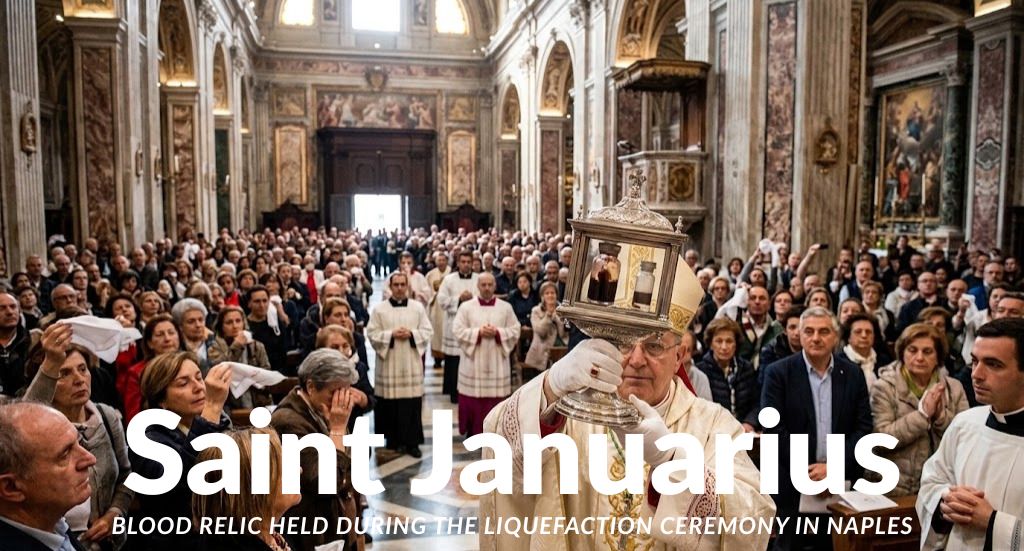
Following his execution, a devoted woman collected some of his blood, preserving it within two small glass vials. These relics eventually made their way to Naples, where they remain enshrined within the city’s cathedral today. Remarkably, the dried blood reportedly liquefies several times throughout each year, transforming from a solid mass into flowing liquid. This phenomenon typically occurs on three specific occasions: the Saturday before the first Sunday of May, his feast day on the 19th of September, and the 16th of December. Notably, the earliest written record of this liquefaction dates back to 1389, according to the chronicle of Giovanni Diacono.
During the ceremony itself, the Archbishop of Naples holds the sealed reliquary before the assembled congregation, turning it carefully to reveal its contents. Witnesses then watch anxiously as the solid, dark mass gradually reddens, bubbles gently and eventually liquefies completely. This transformation sometimes happens within mere minutes, though occasionally it takes considerably longer, stretching across several hours. Once confirmed, celebrants traditionally fire twenty-one ceremonial cannon shots from the nearby Castel dell’Ovo, announcing the news across the city. However, Neapolitan folklore also warns that failure to liquefy signals impending disaster, including war, famine or serious illness.
Scientists have studied this phenomenon repeatedly over recent decades, yet no definitive natural explanation has ever been fully established. Some researchers have proposed thixotropic properties within the substance, suggesting movement rather than genuine liquefaction might explain the effect. Nevertheless, believers generally regard the event as a genuine miracle, reaffirming their trust in Januarius’ continued heavenly intercession. Indeed, Neapolitans have long credited him with protecting their city during numerous eruptions of nearby Mount Vesuvius. Most famously, many attribute the city’s survival during the devastating 1631 eruption directly to his powerful intercession.
Beyond the widely publicised blood miracle, Saint Januarius holds considerable historical and cultural significance throughout southern Italy. His major Shrine remains Naples Cathedral, though devotion has also spread internationally, particularly among Italian-American communities. Notably, Manhattan’s Little Italy hosts an annual Feast of San Gennaro, drawing enormous crowds each September for 11 days of celebration. This vibrant street festival, featuring food, music and religious processions, demonstrates how far his devotion has travelled from Naples itself. Today, believers invoke him as patron of blood banks, volcanic eruptions and the city of Naples more broadly.
Archbishop Domenico Battaglia, who currently leads the Archdiocese of Naples, has consistently urged believers not to reduce this devotion to mere superstition. During recent celebrations, he emphasised that the deeper meaning lies within Januarius’ ultimate sacrifice for his Christian faith. Rather than fixating solely upon whether liquefaction occurs, Battaglia encourages reflection upon courage, fidelity and love stronger than death itself. This perspective helps modern believers appreciate Januarius beyond the sensational aspects surrounding his famous relic. Consequently, his feast day continues offering genuine spiritual meaning alongside its more mysterious, widely reported phenomenon.
Ultimately, Saint Januarius’ story combines historical martyrdom with centuries of enduring popular devotion across generations. Whether or not modern science ever fully explains the liquefaction, millions continue finding comfort and hope through this ancient tradition. Therefore, his feast day each September remains a genuinely significant date within the wider Catholic liturgical calendar. For readers wishing to explore further Church history, additional detail remains available through Britannica and the National Catholic Register, alongside earlier articles published on this website concerning other remarkable martyred saints.









Leave a Reply