
Life, Letters and Martyrdom
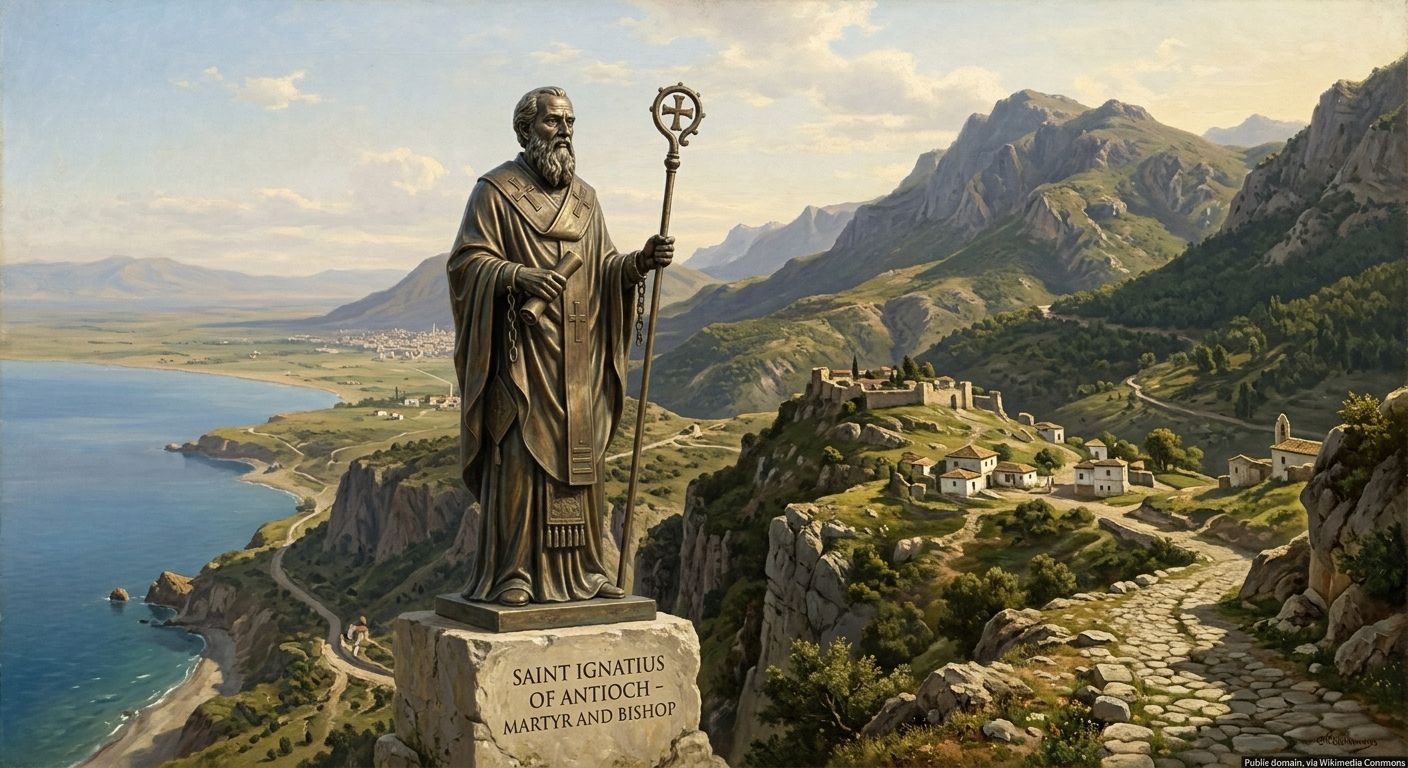
The Church honours Saint Ignatius of Antioch on October 17. Indeed, the day invites Catholics to remember a bishop who loved Christ to the very end. Moreover, Eastern Christians keep a separate commemoration on December 20. Therefore, this early Church Father unites believers from different traditions. Above all, his life shows what faithful witness truly costs.
Saint Ignatius of Antioch served as the third bishop of his city, from the year 70 until his martyrdom in 107, according to Pope Benedict XVI. Antioch lies in modern Turkey. Furthermore, the Acts of the Apostles records that the disciples first received the name Christians there. Because of this, the city held great importance. In fact, Rome, Alexandria and Antioch formed the three great centres of the Roman Empire. Tradition also names Ignatius “Theophorus”, which means God-bearer.
Later, the Roman authorities arrested him and ordered soldiers to bring him from Syria to Rome for execution. Tradition places these events in the reign of Emperor Trajan. However, Ignatius did not despair. Instead, he turned the long journey into a mission of encouragement. First, he stopped at Smyrna, where he met Bishop Polycarp. Then delegations from nearby Churches came to greet him. As a result, his journey became a pilgrimage of faith rather than a march of defeat.
During this journey, he wrote seven letters that still survive. The historian Eusebius explains that Ignatius wrote from Smyrna to the Churches of Ephesus, Magnesia and Tralles. In addition, he wrote to the Christians of Rome. Afterwards, from Troas, he sent letters to Philadelphia and Smyrna. Finally, he wrote a personal letter to Bishop Polycarp. Consequently, these texts give us a rare glimpse of a Church that still remembered the apostles.
The letters teach several lessons that remain urgent today. First, Ignatius insists that Christ truly became man, truly suffered and truly rose. At the time, some teachers claimed that Christ only seemed to suffer. Ignatius rejected this idea firmly. Second, he urges believers to stay united around their bishop, their priests and their deacons. Likewise, he treats the Eucharist as the centre of Christian life. Thus, he links true doctrine with loving communion.
Notably, Ignatius is also the earliest surviving writer to use the phrase “Catholic Church”. He wrote it in his letter to the Smyrnaeans. There he explains that the Church is present wherever Christ and the bishop are present. Therefore, the word “Catholic” has described the universal Church since the earliest days. Pope Benedict XVI called him a “doctor of unity“. Meanwhile, the same Pope described his teaching as a mysticism of unity, rooted in the unity of the Trinity.
His letter to the Romans reveals the depth of his courage. Surprisingly, he begged the Roman Christians not to rescue him. Instead, he longed to reach Jesus Christ through martyrdom. He compared himself to wheat that wild beasts would grind into pure bread for Christ. Consequently, his words have inspired martyrs and ordinary believers for nearly two thousand years. According to tradition, he died in Rome around the year 107, after facing wild animals in the Arena.
How can we honour him today? First, read his letters slowly, perhaps one each week. Second, pray for the unity of your parish, your family and the whole Church. In addition, remember Christians who still suffer for their faith. The Catholic Culture library contains a writeup by Pope Benedict XVI about the life of Saint Ignatius of Antioch
In conclusion, Saint Ignatius of Antioch remains a guide for every Catholic. He loved Christ without reserve, and he served the Church with humility. Likewise, he reminds us that unity is a gift that we must protect daily. Therefore, let us ask for his intercession on this memorial. May we, too, follow Christ with a courageous and undivided heart.


Leave a Reply