
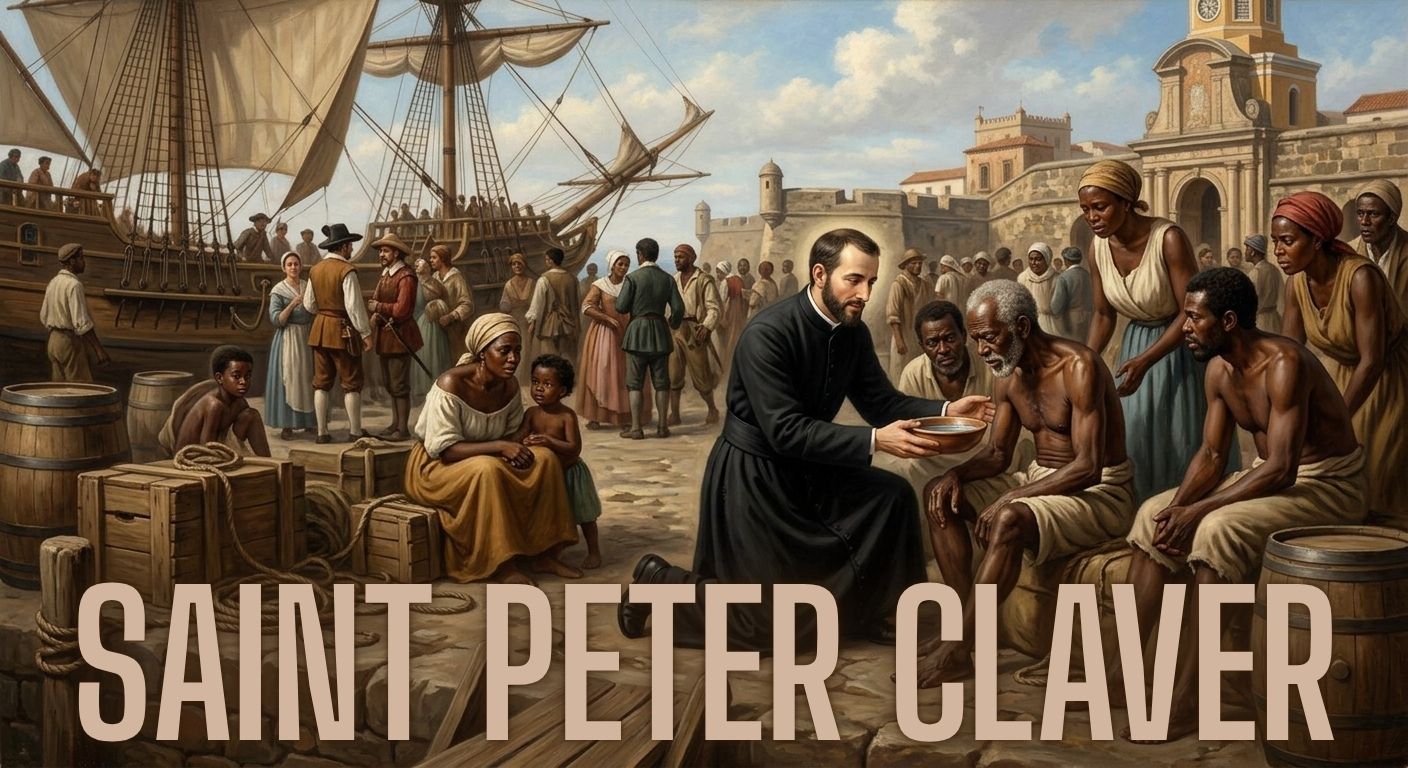
Saint Peter Claver: The Jesuit Who Served Enslaved Africans
Catholics honour Saint Peter Claver every year on 9 September. Born in 1580 in Verdú, Catalonia, he came from a modest yet devout farming family. Afterwards, he studied at the Jesuit college in Barcelona, where teachers noted his sharp intellect and quiet piety. In 1602, he entered the Jesuit novitiate at Tarragona and he professed his final vows in 1604. Later, while studying philosophy in Majorca, he met Saint Alphonsus Rodriguez, a humble lay-brother gifted with prophecy. Rodriguez firmly believed Claver was destined for missionary work in the New World. Consequently, the young Jesuit volunteered for the Spanish colonies, setting a course that would define his entire life.
Claver reached Cartagena, present-day Colombia, in the early 1610s. At that time, the port served as the largest slave market in the Americas. Thousands of enslaved Africans arrived there annually, many dying during the brutal Atlantic crossing. Understandably, Claver was deeply troubled by what he witnessed. Therefore, after his ordination in 1616, he vowed to dedicate his life entirely to their care.
For the next thirty-three years, Claver boarded incoming slave ships without hesitation. He brought food, water and basic medicine to those who had survived the voyage. Moreover, he tended the sick and comforted the dying, often before anyone else reached them. Working alongside translators, he taught the Catholic faith using simple gestures and memory aids. As a result, he baptised an estimated three hundred thousand people during his ministry.
Importantly, Claver’s compassion did not end once the ships were unloaded. Instead, he travelled to plantations across the region, visiting those he had once baptised. He encouraged them to live according to their faith and he urged plantation owners to treat their workers humanely. Meanwhile, he continued preaching in city squares, ministering to sailors, traders and even condemned prisoners. In fact, he became known locally as the Apostle of Cartagena, a title reflecting decades of selfless devotion.
Sadly, Claver’s final years brought considerable suffering. Illness confined him to his room for roughly four years. During this period, a caretaker mistreated him severely, yet he never complained. Instead, he accepted his suffering quietly, viewing it as penance. He died on 8 September 1654 and news of his passing spread rapidly through Cartagena. Consequently, mourners flocked to his room, eager to secure any relic connected to his memory.
Recognition came decades later. In 1888, Pope Leo XIII canonised Claver alongside Alphonsus Rodriguez, the very laybrother who had first encouraged his mission. Furthermore, in 1896, the Church named him patron of missionary work among African peoples worldwide. Today, he also serves as patron saint of Colombia and of seafarers everywhere. Notably, the Colombian Congress later declared September 9 a national day dedicated to human rights, honouring his legacy directly.
Since then, numerous organisations have carried his name forward. The Knights of Peter Claver, founded in Alabama, remains the largest African-American Catholic fraternal group in the United States. Similarly, the Missionary Sisters of Saint Peter Claver, established in Austria in 1894, continue serving vulnerable communities across Africa. Parishes and schools bearing his name exist across several continents, from Kentucky to Kenya.
However, modern historians have also examined his legacy more critically. Some scholars note that Claver personally held slaves and occasionally used physical punishment. Others argue he granted his own workers unusual freedom compared with contemporary norms. Either way, this debate adds important nuance to understanding his complex historical context.
Ultimately, Saint Peter Claver’s life demonstrates extraordinary dedication under difficult circumstances. His feast day invites reflection on mercy, justice and enduring human dignity.
For further reading, consult Catholic Online and Encyclopaedia Britannica.





Leave a Reply