
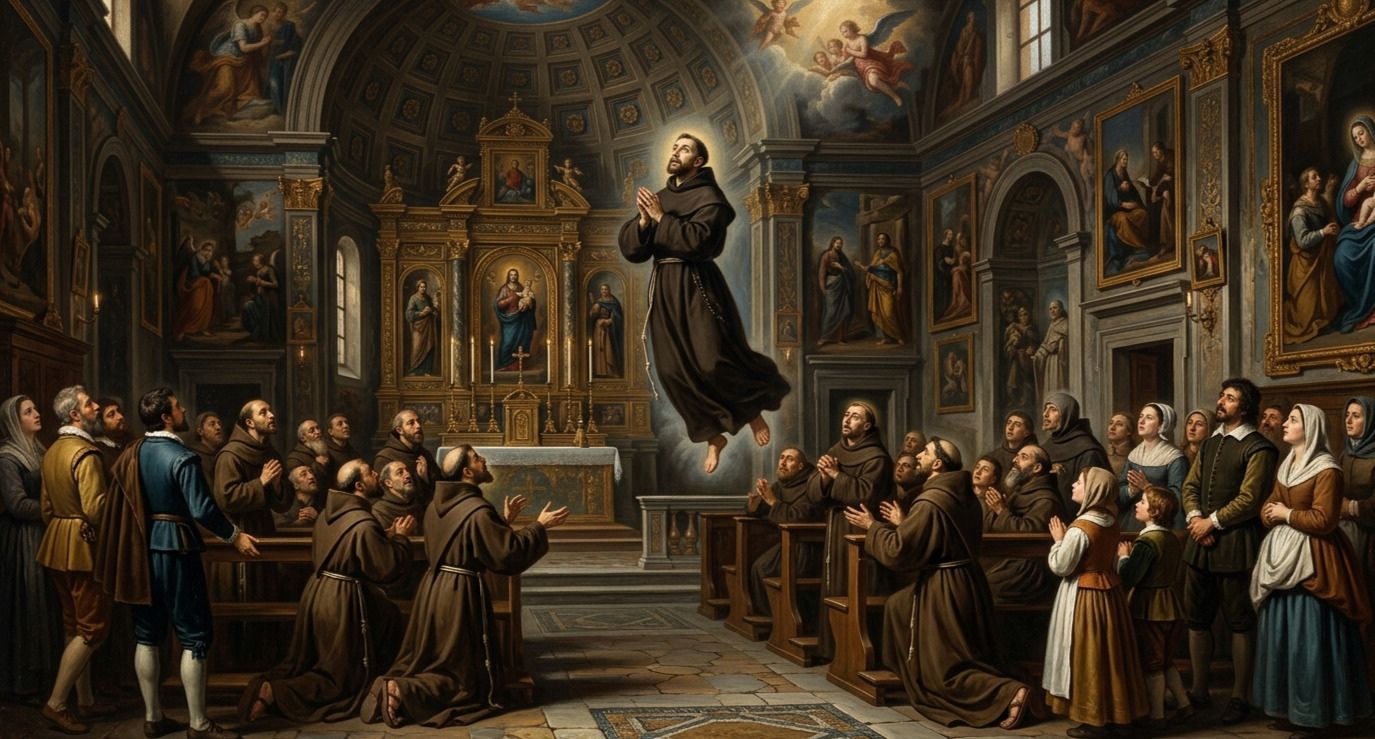
Saint Joseph of Cupertino: The Flying Friar’s Extraordinary Life
The Catholic Church honours Saint Joseph of Cupertino every year on September 18, marking the day of his death in 1663. Believers know him affectionately as the Flying Friar, since his life featured astonishing levitations witnessed by hundreds of people. Consequently, he became one of the most extraordinary mystics within the entire Franciscan tradition. Furthermore, his unlikely journey from a struggling, distracted child toward canonised sainthood offers genuine encouragement for anyone who feels overlooked. Therefore, his story deserves careful attention beyond simply the miraculous flights for which he remains famous.
Born Giuseppe Desa in 1603, within the small town of Copertino in southern Italy, Joseph faced hardship from his very first days. His father, Felice, a poor carpenter, died before his son’s birth, leaving the family in considerable debt. Consequently, his widowed mother, Francesca, raised him largely alone, amid genuine poverty and social difficulty. As a child, Joseph frequently drifted into trances, staring blankly during ordinary conversations with family and neighbours. His peers mockingly nicknamed him “the gaper,” while even his own mother grew frustrated, believing him simply lazy and slow.
Understandably, this reputation initially prevented Joseph from realising his deep desire to join religious life. The Capuchin friars accepted him briefly, yet dismissed him after only 8 months due to persistent clumsiness and distraction. Eventually, however, a Franciscan Conventual friary near Copertino accepted him as a humble stable servant instead. There, he cared patiently for Mules, gradually impressing the friars through his sincere humility and quiet devotion. Consequently, they finally admitted him fully into the Order in 1625, allowing him to begin formal studies.
Although academic study proved genuinely difficult for Joseph throughout his training, he persevered faithfully toward ordination. According to tradition, his examining bishop questioned him only on the single passage he happened to know well. This fortunate coincidence, repeated during a later examination, allowed Joseph to complete his path toward priesthood in 1628. Consequently, believers later adopted him as patron of students and anxious examination candidates everywhere. Meanwhile, his devoted prayer life continued deepening, setting the stage for the extraordinary phenomena that would soon follow.
In 1630, during a religious procession, Joseph experienced his very first documented levitation before startled onlookers. Word spread rapidly, and curious crowds soon began flocking toward wherever Joseph happened to be praying. Investigators later recorded at least seventy separate levitation incidents throughout his lifetime, witnessed by hundreds of credible observers. Remarkably, these witnesses included sceptics, scientists and even Pope Urban VIII himself, who reportedly saw Joseph levitate personally. During one particularly famous episode, Joseph soared toward a high altar while Christmas carols were being sung nearby.
However, this extraordinary gift carried significant personal cost throughout Joseph’s remaining years. Seventeenth-century authorities sometimes associated unexplained levitation with witchcraft, prompting suspicion from both Church officials and civil investigators. Consequently, his superiors repeatedly transferred him between different friaries, hoping to reduce the growing publicity surrounding him. For roughly fifteen years, he lived quietly at the sanctuary of Santa Maria della Grottella, which he later described as a genuinely happy period. Nevertheless, authorities eventually confined him more strictly, largely isolating him from public contact during his final years.
Despite this isolation, Joseph never expressed bitterness, choosing instead to embrace whatever obedience his superiors required of him. He practised considerable personal penance, including regular fasting and wearing iron chains beneath his habit. Franciscan historians generally emphasise that his true holiness rested upon humility and patience, rather than merely his dramatic levitations. Indeed, Joseph himself seemed to view his flights as an inconvenient distraction from genuine, deeper communion with God. Therefore, admirers today increasingly focus on his quiet virtue alongside the more sensational aspects of his story.
Joseph died on September 18, 1663, in the town of Osimo, following a sudden and severe fever. Pope Benedict XIV beatified him in 1753, before Pope Clement XIII formally canonised him in 1767. Today, believers invoke Saint Joseph of Cupertino as patron of aviators, pilots, astronauts and air travellers everywhere. Additionally, students, examination candidates and people facing learning difficulties also claim him as their heavenly protector. His remains now rest within the Basilica dedicated to him in Osimo, drawing pilgrims from across the world.
Ultimately, Saint Joseph of Cupertino’s story reminds believers that genuine holiness rarely depends upon worldly intelligence or social standing. Rather, his life demonstrates how humility, patience and persistent faith can transform even the most overlooked individual. Consequently, his example continues resonating particularly with students, travellers and anyone who has ever felt underestimated by others. For readers wishing to explore further Franciscan history, additional detail remains available through Franciscan Media.


Leave a Reply