
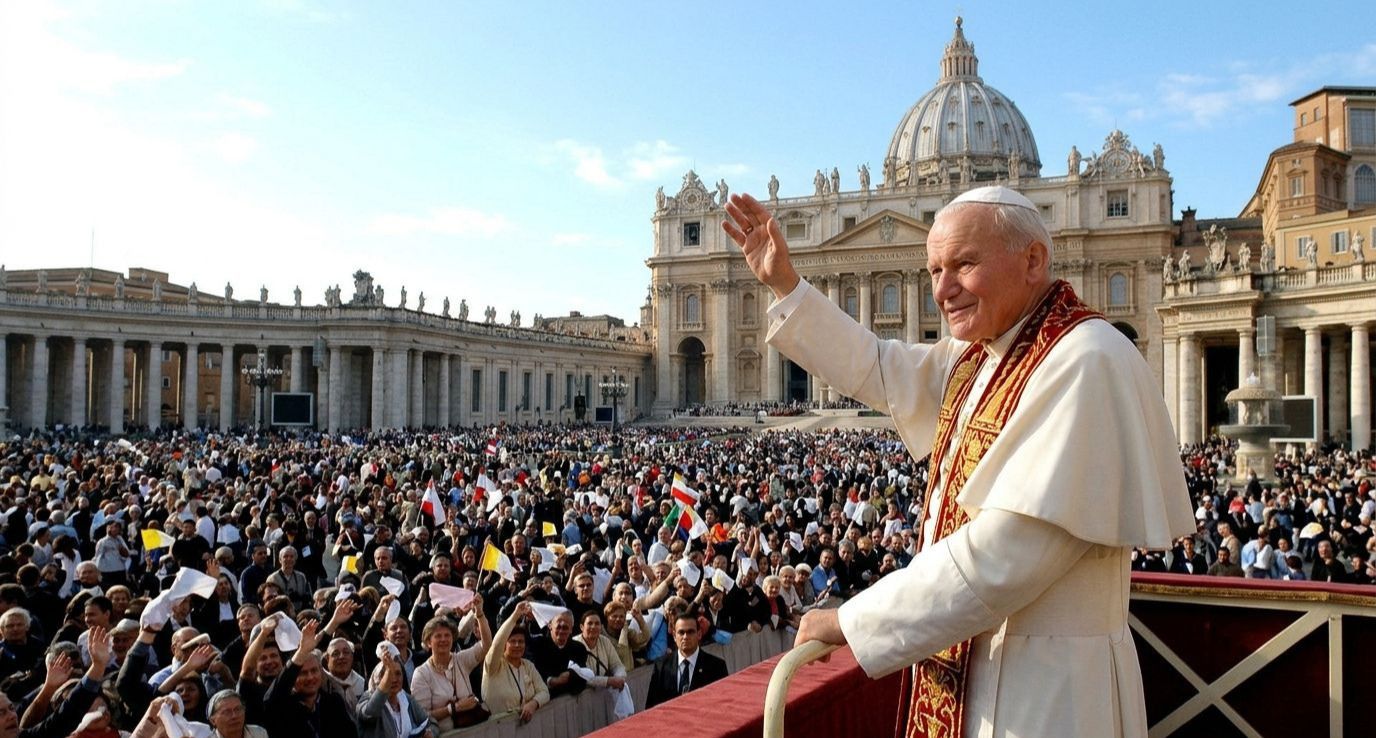
Saint John Paul II Called the World to Be Unafraid
The Church honours Saint John Paul II on October 22. Interestingly, the Church chose this date because it marks the start of his papal ministry in 1978. Most saints are remembered on the day they died. Moreover, this optional memorial invites Catholics to reflect on a pope who shaped modern history. Therefore, his story deserves a fresh look today.
Saint John Paul II was born Karol Józef Wojtyła on May 18, 1920, in Wadowice, Poland. He was the youngest of three children. However, tragedy marked his early years. His mother died when he was 9 and his brother followed when he was 12. Then his father died when Karol was 20. As a result, he faced the Second World War almost alone. Even so, he never lost his faith.
During the war, Karol worked in a quarry and a chemical factory. At the same time, he joined an underground seminary in Kraków. He received ordination as a priest on November 1, 1946. Afterwards, he studied in Rome and earned a doctorate in theology in 1948. His thesis explored the faith in the works of Saint John of the Cross. Later, he taught ethics in Lublin, where students admired his clarity and warmth.
His rise in the Church came steadily. In 1958, he became auxiliary bishop of Kraków, and in 1964 he became archbishop. Pope Paul VI made him a cardinal in 1967. Meanwhile, he attended all sessions of the Second Vatican Council. In particular, he helped to shape the document Gaudium et Spes, which addresses the Church in the modern world. Thus, he gained valuable experience before his election.
Then came a dramatic turn. Pope John Paul I died after only thirty-three days, so the cardinals met again. On October 16, 1978, they elected Cardinal Wojtyła. He became the first non-Italian pope in four hundred and fifty-five years. Furthermore, he took the name of his predecessor as a tribute. His first message to the crowd was simple: “Be not afraid!” His solemn ministry began on October 22.
His pontificate lasted nearly twenty-seven years, and it ranks among the longest in history. During that time, he travelled more than one million two hundred thousand kilometres. He visited well over one hundred and twenty countries and met more people than any pope before him. In addition, he founded World Youth Day and established Divine Mercy Sunday. He also promulgated the Code of Canon Law in 1983 and the Catechism of the Catholic Church in 1997. Consequently, he left a rich legacy of teaching.
Beyond the Church, his influence reached the political world. For example, he supported the Solidarity movement in his native Poland. Many historians credit him with helping to end Communist rule in Europe. Likewise, he worked to improve relations with Jews, Muslims and Orthodox Christians. He also proclaimed Saint Thérèse of Lisieux a Doctor of the Church. During his papacy, he canonised 482 saints and beatified 1,338 people.
His courage showed most clearly in suffering. In May 1981, a gunman shot him in Saint Peter’s Square. Surprisingly, the Pope later visited his attacker in prison and offered forgiveness. In his later years, Parkinson’s disease slowed him, yet he did not hide his weakness. Instead, he taught the world to see value in frailty. Finally, he died on April 2, 2005, at the age of eighty-four. Millions mourned him and the crowds called for his sainthood.
The Church acted quickly. Pope Benedict XVI beatified him on May 1, 2011. Then, on April 27, 2014, Pope Francis canonised him together with Saint John XXIII. His tomb lies in Saint Peter’s Basilica, near the altar of Saint Sebastian. His motto, Totus tuus, expresses his devotion to Mary. To read more, visit the Vatican biography.
In conclusion, Saint John Paul II shows that faith can meet every fear. He lost his family early, yet he built a global family of believers. Likewise, he reminds us that mercy and courage belong together. Therefore, let us ask for his prayers on this memorial. May we, too, welcome Christ without fear.

Leave a Reply