
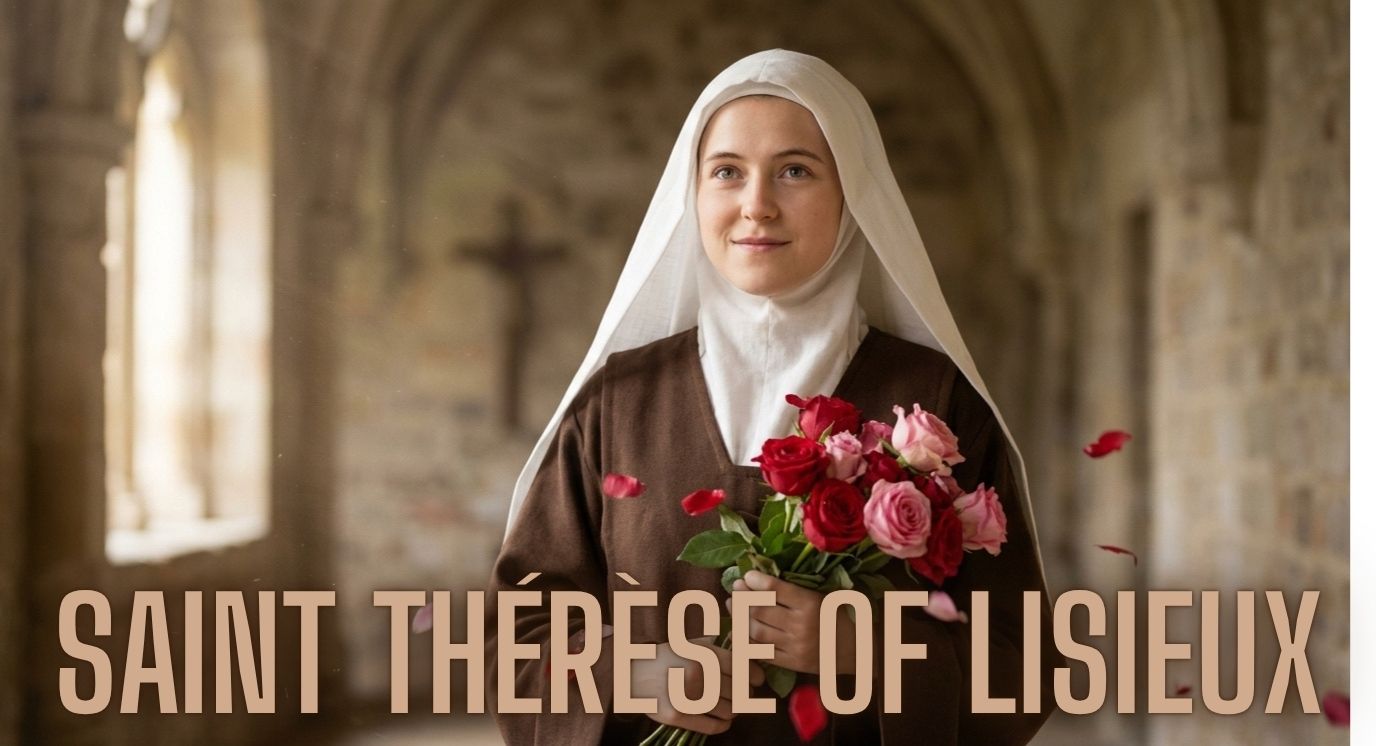
Saint Thérèse of Lisieux: The Little Flower’s Life and Little Way
The Catholic Church honours Saint Therese of Lisieux every year on October 1st, celebrating her short yet profoundly influential life. Believers affectionately call her the Little Flower, a nickname reflecting her gentle, humble approach toward holiness. Although she died at just 24, her spiritual teachings have since touched millions of ordinary believers worldwide. Furthermore, she became one of only four women ever declared a Doctor of the Church, alongside towering theological figures. Therefore, her enduring popularity offers genuine proof that sanctity rarely depends upon fame, age or dramatic achievement.
Born Marie Françoise Thérèse Martin in 1873, within the French town of Alençon, she arrived into a deeply devout Catholic household. Her parents, Louis and Zélie Martin, were themselves later canonised, becoming the Church’s first married couple honoured together as saints. Tragically, Thérèse lost her mother to breast cancer when she was merely 4 years old. Consequently, the close-knit Martin family relocated to Lisieux, drawing even nearer toward the Carmelite spirituality that would later define Thérèse’s path. Remarkably, four of her five surviving sisters eventually entered religious life themselves, with three joining the very same Carmelite convent.
At just fourteen, Thérèse experienced a pivotal moment while sitting quietly within her family’s garden alongside her father. He handed her a small white flower, gently explaining how God had lovingly cared for its entire growth. This tender image stayed with her permanently, eventually shaping the spiritual philosophy she would later call her Little Way. The following year, Thérèse felt an overwhelming call toward Carmelite life, though her young age initially concerned local Church authorities. Undeterred, she travelled to Rome and boldly petitioned Pope Leo XIII himself for special permission. Her persistence succeeded, and she formally entered the Lisieux Carmel at fifteen, professing her vows shortly afterwards in 1890.
Within the convent, Thérèse lived largely hidden from public recognition, performing ordinary domestic tasks with extraordinary tenderness and care. Her spiritual philosophy, later known as the Little Way, emphasised complete trust in God’s mercy over dramatic, self-driven achievement. Rather than pursuing visible sacrifices, she found genuine holiness within patience, small kindnesses and cheerful acceptance of life’s minor irritations. Her superiors eventually recognised something remarkable within her spiritual insight, directing her to record these reflections in writing. This obedience produced her now-famous autobiography, “The Story of a Soul,” composed gradually between 1895 and 1897.
During her final 18 months, Thérèse endured considerable physical suffering from advancing tuberculosis, alongside a profound spiritual darkness. Nevertheless, she continued teaching those around her that even suffering, when united with love, could hold genuine redemptive meaning. Shortly before dying, she reportedly promised to spend her heaven doing good upon the earth below. She specifically pledged to send a metaphorical “shower of roses” toward anyone who sought her intercession afterwards. Thérèse died on September 30, 1897, reportedly whispering her final words, “My God, I love you.”
Following her death, “The Story of a Soul” spread rapidly across the world, translated eventually into dozens of different languages. Consequently, devotion toward Thérèse grew remarkably quickly, leading Pope Pius XI to canonise her in 1925. He later named her co-patron of missions, alongside Saint Francis Xavier, despite her having never left her cloistered convent. In 1997, Pope John Paul II declared her a Doctor of the Church, honouring her profound theological insight. Today, believers also invoke her as patron of florists, aviators, France and those who have lost a parent.
Thérèse’s continuing appeal rests largely upon the refreshing accessibility of her spiritual message for ordinary believers. Unlike some saints celebrated primarily for dramatic miracles or visible heroism, she taught that small, hidden love matters enormously to God. Consequently, her Little Way has resonated deeply with people from wildly different backgrounds, professions and walks of life. Notable admirers have included Mother Teresa of Calcutta, alongside numerous popes who have championed her spirituality publicly. Moreover, relics associated with Thérèse have toured extensively across the globe, drawing enormous crowds wherever they travel.
Ultimately, Saint Therese of Lisieux’s brief life continues demonstrating that genuine holiness remains available within life’s smallest, quietest moments. Her Little Way invites believers toward childlike trust, patient love and quiet confidence in God’s boundless mercy. Therefore, her feast day each October offers a fitting moment for reflection, gratitude and renewed spiritual simplicity. For readers wishing to explore further Church history, additional biographical detail remains available through the Discaled Carmelites website.




Leave a Reply