
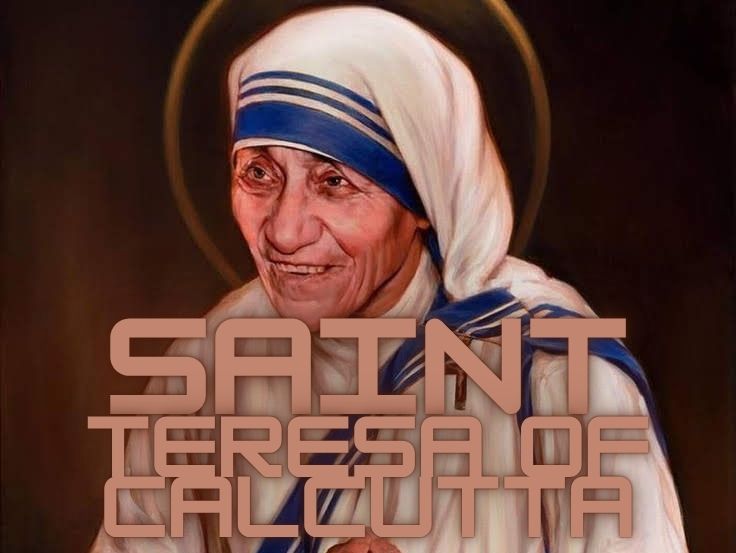
The Church celebrates the feast day of Saint Teresa of Calcutta every year on 5 September, marking the anniversary of her death in 1997. Known to the world simply as Mother Teresa, she remains one of the most recognisable figures in modern Catholic history. Her life, however, began far from the slums of India, in a small city in the Balkans and her path to sainthood involved decades of quiet service, hidden suffering and eventual global fame.
Born Anjezë Gonxhe Bojaxhiu on 26 August 1910 in Skopje, then part of the Ottoman Empire, she grew up in a devout Albanian Catholic family. Her father died when she was only eight years old and this loss left the family in financial hardship. Nevertheless, her mother raised her within a strong parish community and young Anjezë became fascinated early on by stories of missionaries serving in Bengal. By the age of twelve, she already felt drawn to religious life, and this conviction only grew stronger as she matured.
At eighteen, she left home for good and travelled to Ireland to join the Sisters of Loreto. There, she learned English before continuing on to Calcutta, India in January 1930. She took the name Sister Mary Teresa, honouring Thérèse of Lisieux and spent the next two decades teaching at Loreto schools. Eventually, she became headmistress of Saint Mary’s School and by all accounts, she found genuine happiness in this vocation.
Everything changed on September 10, 1946. While travelling by Train to Darjeeling for her annual retreat, Mother Teresa experienced what she later described as “the call within the call.” During this moment, she felt Christ asking her to leave the convent and serve him among the poorest of the poor. Consequently, she requested permission to depart from Loreto and after nearly two years of careful discernment, the Vatican granted her wish.
In August 1948, she put on a simple white sari with a blue border for the first time and walked out into the slums of Calcutta. She had almost no money and no institutional support. Still, she pressed on, tending to the sick, washing wounds and comforting the dying. Soon, her former students joined her, one by one, and this small group eventually became the Missionaries of Charity, officially established in October 1950.
From these humble beginnings, the congregation expanded rapidly across India and then around the world. By 1997, the order had grown to nearly 4,000 sisters working in 610 foundations spread across 123 countries. In addition to the original Sisters, Mother Teresa also founded the Missionaries of Charity Brothers, a contemplative branch and eventually the Missionaries of Charity Fathers, so that both religious and lay people could share in her mission.
Her work drew international attention and honours followed steadily. She received the Nobel Peace Prize in 1979 and rather than hold a lavish banquet, she asked that the funds go directly to the poor instead. Furthermore, she travelled widely throughout her later years, visiting conflict zones such as Beirut and disaster sites including Chernobyl and Armenia, always insisting that love mattered as much as material aid.
Interestingly, letters published after her death revealed a side of Mother Teresa that few people knew during her lifetime. For nearly fifty years, she privately experienced what she called “the darkness,” a painful sense of spiritual emptiness and distance from God. Despite this inner struggle, she continued her outward mission without pause and many theologians now view this hidden suffering as a profound share in the thirst of Christ she so often spoke about.
Saint Teresa of Calcutta died in Calcutta on September 5, 1997 and the Indian government honoured her with a state funeral. Pope John Paul II beatified her in October 2003 and after a second recognised miracle involving a Brazilian man cured of multiple tumours, Pope Francis canonised her on 4 September 2016 in Saint Peter’s Square. Consequently, her feast day now falls on 5 September, the anniversary of her death and the United Nations also marks this date as the International Day of Charity.
Today, she serves as patron of World Youth Day and co-patron of the Archdiocese of Calcutta alongside Saint Francis Xavier.
Her example continues to challenge believers everywhere. As she often reminded her audiences, holiness is not reserved for the few; rather, it remains a simple duty for every person. On her feast day, Catholics around the world remember her not merely as a historical figure, but as a living witness to compassion in action.

Leave a Reply