
Why the Church Remembers Saint Edmund the Martyr on November 20
The Church celebrates Saint Edmund the Martyr on November 20. Edmund was a young king of East Anglia who died for his faith in the ninth century. Moreover, the English honoured him for centuries as a national protector. Therefore, his feast offers a fine moment to recall his courage.
Edmund was probably born around 841. According to tradition, the nobles of East Anglia chose him as king on Christmas Day in 855, when he was only 14. He ruled for about 14 years. However, few reliable details survive about his reign. His first biographer, the French monk Abbo of Fleury, painted a portrait of a humble and devout ruler. Abbo wrote around 986 and he drew on a story that Saint Dunstan had heard from an eyewitness.
Meanwhile, a large army of Danish Vikings had landed in England and moved from kingdom to kingdom. In 869, the invaders marched back into East Anglia and captured Edmund. Thus, the young king faced the greatest test of his life.
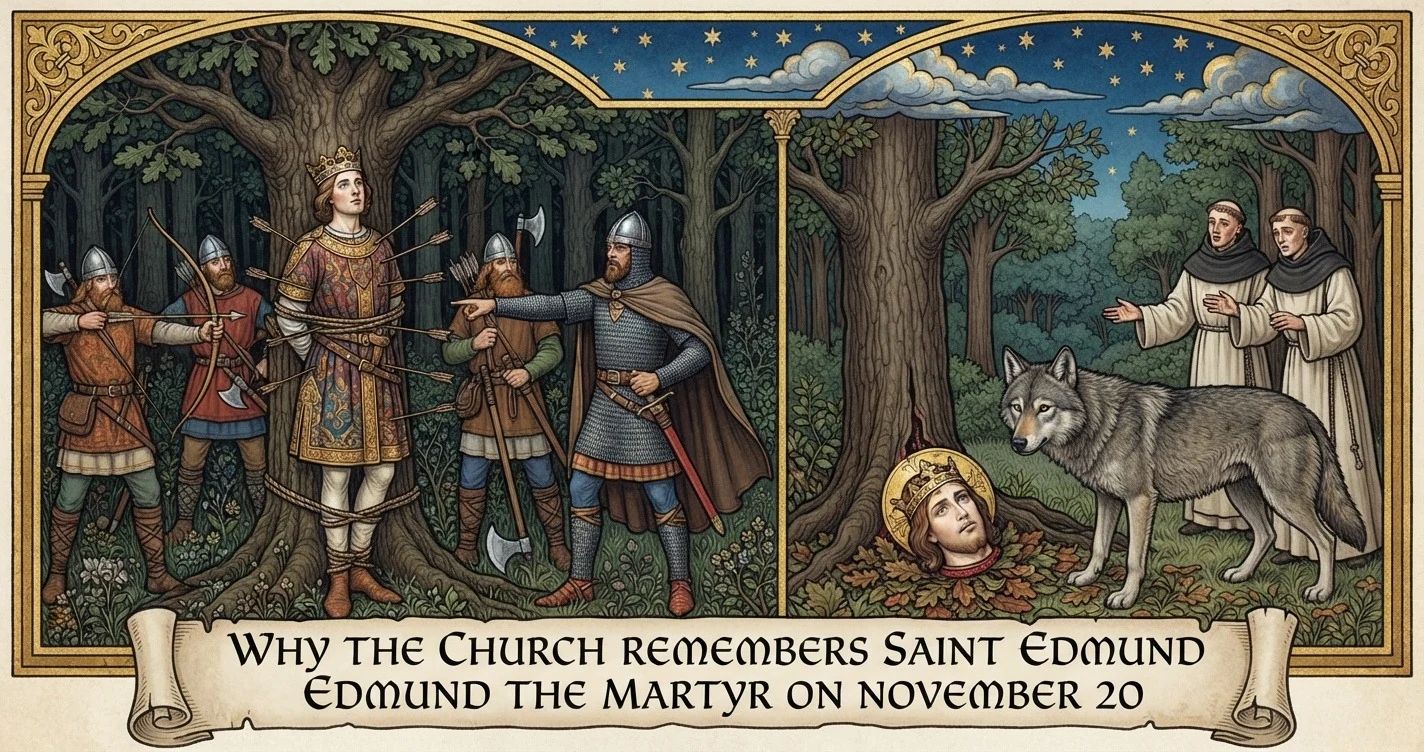
According to Abbo, the Danish leader demanded that Edmund share his kingdom and renounce Christ. Edmund refused. He answered that he would never bow to a pagan master. Consequently, the Danes bound him to a tree, shot him with arrows and then beheaded him. Abbo compared his wounds to those of Saint Sebastian. Tradition names Hoxne in Suffolk as the place. However, scholars cannot confirm the exact site. Even so, early sources agree on the date, November 20, 869.
The most famous legend follows the martyrdom. The Danes hurled Edmund’s head into dense woodland. Later, his followers searched the forest and called out to one another. Then, according to the story, the head itself answered with the words “Here, here, here.” They found it between the paws of a great wolf, which guarded it faithfully. Afterwards, the wolf returned to the woods. As a result, the wolf became a lasting symbol of the saint.
Meanwhile, the faithful buried the body and soon venerated Edmund as a martyr. In the tenth century, the remains moved to Beodricesworth, a place now called Bury St Edmunds. King Athelstan founded a religious community there in 925 to care for the shrine. Later, a great abbey grew around it. Pilgrims, kings and commoners all visited. Indeed, the town still carries the saint’s name and the motto “Shrine of a King, Cradle of the Law”.
Edmund served as a patron of England long before Saint George. Moreover, people prayed to him against plague, because of Abbo’s comparison with Saint Sebastian. By the 15th century, Saint George had taken over the national role, yet devotion to Edmund continued. The shrine ended with the Dissolution of the Monasteries in the 16th century, and only ruins remain. Nevertheless, Catholics, Anglicans and Orthodox Christians all venerate him today.
What can Catholics learn from Saint Edmund the Martyr? First, he shows that faith matters more than power. He lost his life, but he kept his integrity. Second, according to Abbo, he refused to answer violence with violence and followed the example of Christ. Third, he reminds rulers that leadership means service. Finally, his story encourages young people, since he began his reign at 14 and still stood firm.
Prayer to Saint Edmund the Martyr
Saint Edmund, faithful king and martyr, you chose Christ above your crown. Pray for us to stay loyal to the Lord in times of trial. Protect us from sickness and fear. Moreover, obtain for all leaders the grace to rule with justice and humility. Strengthen our young people with courage. Amen.
Readers who wish to learn more can read the Catholic Encyclopedia entry at New Advent, the Visit Suffolk article on King Edmund and the Historic UK feature on the original patron saint of England. Furthermore, our Saints of the Day section offers more stories like this.

Leave a Reply