
Apostle of Ethiopia and Father of Peace who Carried the Gospel from Slavery to a Kingdom
The Church remembers Saint Frumentius on October 27. He is known as the Apostle of Ethiopia and Ethiopian Christians call him Abba Salama, which means Father of Peace. Moreover, his story begins with a shipwreck and slavery, not with a mission. Therefore, it offers a striking example of how God uses unexpected paths to spread the Gospel.
Frumentius was born in the city of Tyre, in modern Lebanon, around the early 4th century. As a boy, he travelled with his brother Aedesius and their teacher, a Christian philosopher named Meropius. The three set out on a sea voyage that took them down the Red Sea. At first, the journey seemed ordinary. However, trouble struck when their ship stopped for water on the African coast. Local people attacked and most of the crew died.
The attackers spared the two boys and took them to the royal court of Aksum, a powerful kingdom in the Ethiopian highlands. There the king treated them kindly. Soon he made Aedesius his cupbearer and Frumentius his treasurer and secretary. Thus, two young captives gained real influence. Furthermore, both boys quietly kept their faith and they prayed in the Christian way. This small detail would change a nation.
When the king died, his widow asked the two men to stay and help raise her young son, Ezana. Frumentius took the lead in this task and effectively ran the kingdom during the boy’s childhood. Meanwhile, he looked for Christian merchants who lived in Aksum. He encouraged them to meet and pray openly, and he even helped them build places of worship. As a result, a small Christian community began to grow.
When Ezana came of age, the two brothers asked permission to go home. The queen and her son begged them to stay, but they eventually left. Aedesius returned to Tyre and he later became a priest. However, Frumentius travelled to Alexandria in Egypt. There he met Saint Athanasius, the great patriarch. He told him about the Christian presence in Aksum and asked him to send a bishop. According to the historian Rufinus, he also asked for missionaries.
Athanasius listened carefully. After consulting with his priests, he decided that no one suited the task better than Frumentius himself. Therefore, he consecrated him as the first bishop of Aksum. Sources give different dates for the consecration, from about 333 to about 350. Nevertheless, all agree on the outcome. Frumentius returned to Aksum as bishop and began a new chapter in the history of Africa.
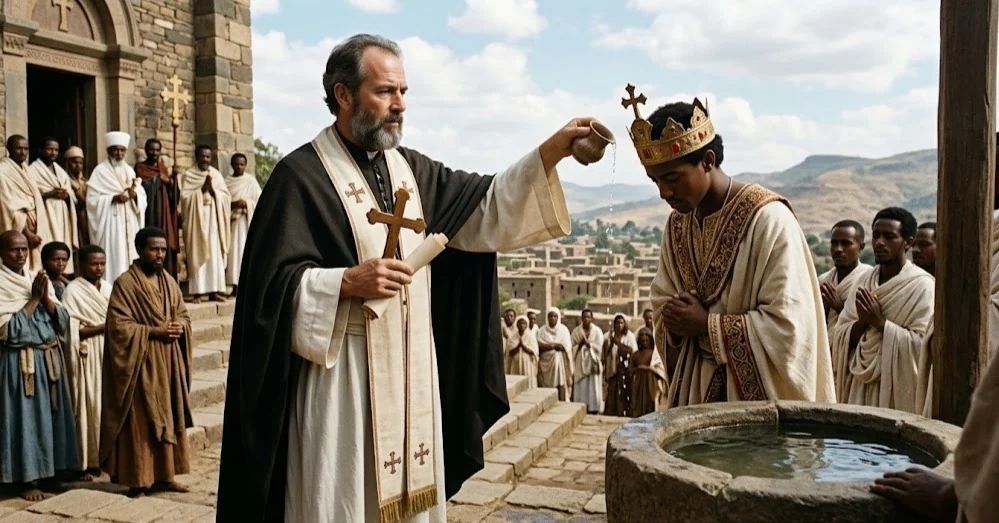
Back in Aksum, Frumentius baptised King Ezana. The king then declared Christianity the official faith of his realm and his coins soon bore the cross. In addition, Frumentius built many churches and appointed priests and deacons. Ethiopian tradition also credits him with the first translation of the New Testament into Ge’ez. Consequently, the people called him Kesate Birhan, the Revealer of Light. Over time, the title Abuna, meaning Our Father, became the name for the head of the Ethiopian Church.
The young Church soon faced pressure. Around 356, the Roman Emperor Constantius II wrote to Ezana and urged him to replace Frumentius with a bishop who supported Arianism. However, Ezana refused. Frumentius had stayed loyal to Athanasius and the teaching of the Council of Nicaea. Frumentius died around the year 380, though the exact date is uncertain. Today, the Church honours him as patron of Ethiopia and Eritrea. The Ethiopian, Coptic and Eastern Orthodox Churches also keep his memory on different days.
To learn more, read Britannica and America Needs Fatima.
In conclusion, Saint Frumentius shows that God can turn hardship into mission. He arrived as a captive, yet he left as a bishop. Likewise, his story reminds us that faith can grow quietly through patient service. Therefore, let us ask for his prayers on this memorial. May we, too, bring light and peace to the places where we live.



Leave a Reply