
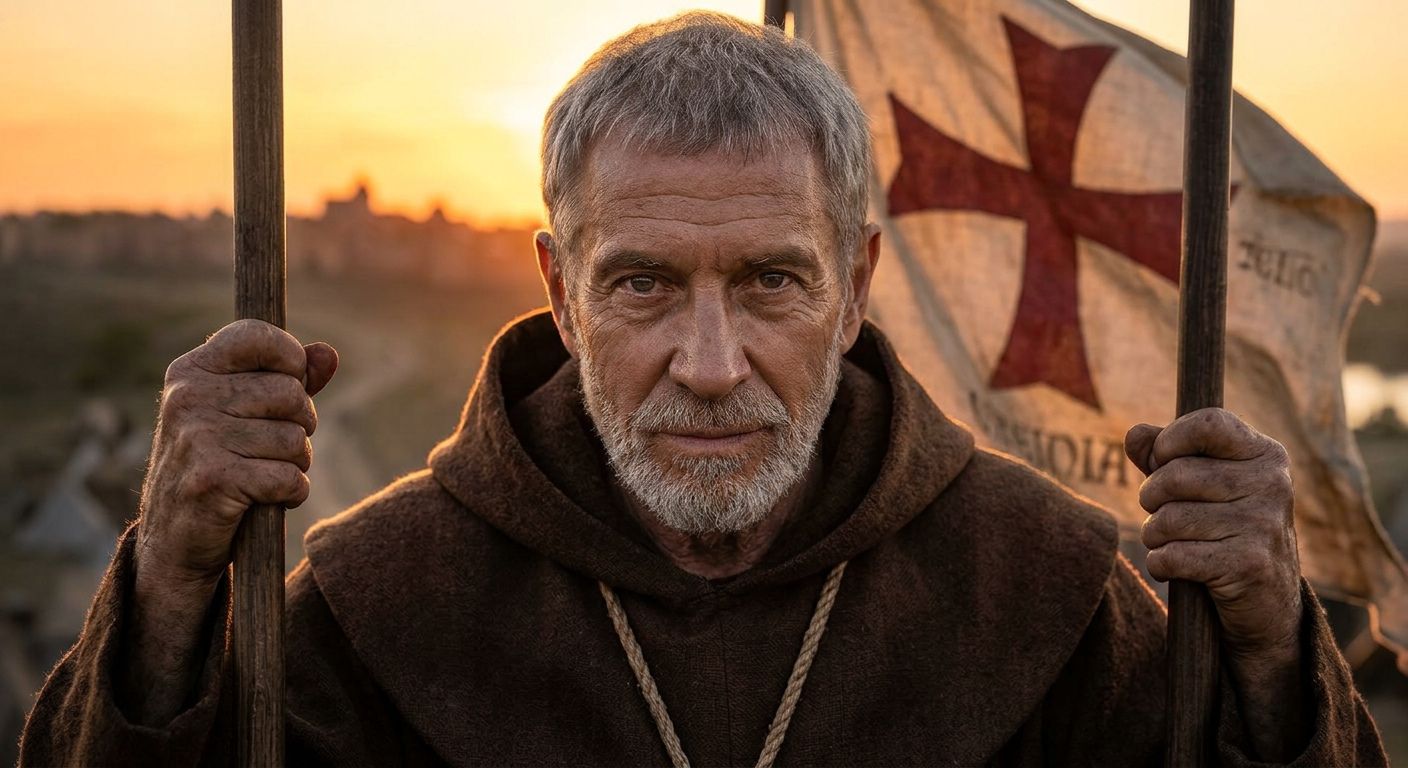
The Preacher Who Saved Belgrade And Turned a Worldly Career into Holy Service
The Church honours Saint John of Capistrano on October 23. Before 1969, the general calendar kept his feast on March 28. However, the Franciscans have long celebrated him on the anniversary of his death. Therefore, this is a fitting moment to remember a lawyer, governor and preacher who gave up everything for Christ.
Saint John of Capistrano was born on June 24, 1386, in Capistrano, a village in the Abruzzo region of Italy. At the time, the area belonged to the Kingdom of Naples. As a young man, he studied law at the University of Perugia. He proved so gifted that the king appointed him governor of the city. Moreover, he quickly gained a reputation for fairness. As a result, his future seemed bright and secure.
Then war changed everything. During a conflict between Perugia and a neighbouring lord, enemy soldiers captured John and held him prisoner. In captivity, he began to question his ambitions. Afterwards, tradition says that a vision of Saint Francis prompted him to change course. Once he gained his freedom, he left politics behind. Consequently, he entered the Franciscan Order at Perugia on October 4, 1416, which is the feast of Saint Francis.
His teacher was Saint Bernardine of Siena, the great Franciscan preacher. Under his guidance, John grew in prayer and discipline. He received ordination as a priest in about 1420. Meanwhile, he helped Bernardine to reform the order. Together, they supported the Observants, who wanted to live the rule of Saint Francis more strictly. Later, John served in several high offices, and the popes trusted him with delicate missions.
Above all, John became a famous preacher. He travelled across Italy, and then he journeyed through Austria, Germany, Bohemia, Poland and Hungary. Crowds gathered in public squares to hear him, even though many did not understand his language. In addition, he urged people to trust in the holy name of Jesus. Through his sermons, many believers returned to the sacraments. Moreover, he founded new Franciscan communities and encouraged reform in existing ones.
However, his story also includes difficult chapters. As an inquisitor, he pursued groups that the Church considered heretical. In addition, he preached harshly against Jews. Historians today criticise these actions, and the Church does not praise them. Nevertheless, the Church honours him for his faith, his courage and his zeal. Thus, a fair account must hold both truths together.
The great crisis came in 1453, when the Ottoman Turks captured Constantinople. Afterwards, Pope Callixtus III asked John to preach a crusade to defend Christian Europe. Despite his age, he travelled widely and gathered thousands of volunteers. Then he joined the Hungarian general John Hunyadi at Belgrade. In July 1456, the Ottoman army, led by Sultan Mehmed II, besieged the city. Finally, on July 22, the Christian forces won a decisive victory.
John was 70 years old at the time of the battle. According to tradition, he carried a cross and cried out the name of Jesus as the fighting raged. His prayer and example encouraged the troops. As a result, the Ottomans withdrew, and the threat to central Europe eased for decades. Later, Pope Callixtus III extended the Feast of the Transfiguration to the whole Church, in memory of this victory. Sadly, plague broke out after the battle.
John fell ill soon after the victory. He died on October 23, 1456, in Ilok, in present-day Croatia, at the age of 70. Pope Alexander VIII canonised him in 1690 and a formal bull followed in 1724. Today, the Church invokes him as a patron of jurists, military chaplains, Belgrade and Hungary. In California, the city and mission of San Juan Capistrano bear his name. Visitors there still watch the famous swallows return each year. To read more, visit the Britannica biography.
In conclusion, Saint John of Capistrano shows that God can redirect any life. He left a promising legal career, and he served the Church with great energy. Likewise, his story reminds us that even saints need honest judgement. Therefore, let us ask for his prayers on this memorial. May we, too, serve Christ with courage and humility.
Leave a Reply