
Saint Bernardine of Siena: The Apostle of Italy Who Preached the Holy Name of Jesus
Saint Bernardine of Siena transformed the religious landscape of 15th-century Italy. He was a Franciscan missionary who preached for hours to massive crowds, an economist who defended the entrepreneur centuries before Adam Smith, a reformer who founded or reformed at least three hundred convents and a man of contradictions. His sermons inspired millions. They also incited violence against minorities. Pope Pius II called him a second Paul. History calls him the Apostle of Italy. His feast day is May 20.
A Noble Orphan in Plague-Ravaged Siena
Bernardino degli Albizzeschi was born on September 8, 1380, in Massa Marittima, Tuscany. His father, Albertollo degli Albizzeschi, served as governor of the comun. The family belonged to the noble Albizzeschi line. Bernardino was orphaned at six. A pious aunt raised him in Siena.
The year 1400 brought catastrophe. A plague ravaged the city. Twenty people died daily in the largest hospital alone. The sick overwhelmed the staff. Many caregivers fell ill and died. Bernardino was twenty. He did not flee. He gathered young men like himself. They went to the hospital door. They offered not new patients, but new nurses.
For four months, Bernardine and his companions worked day and night. They comforted the dying. They organized the chaos. They cleaned the wards. Only when the plague ended did Bernardine himself collapse. Exhaustion, not infection, felled him. He recovered. Then he returned to caring for the sick. This time, he tended one person: an invalid aunt. For fourteen months, she received his full attention.
Bernardine treated one person with the same energy he gave to hundreds. This pattern defined his entire life.
The Slap That Changed Everything
Bernardine’s character revealed itself early. He hated indecent talk. He would blush at the slightest impropriety. Schoolmates learned to spare his discomfort. One adult citizen thought this sensitivity was a joke. He stopped Bernardine in a public marketplace, spoke to him shamefully, expected amusement but, got a slap in the face.
Bernardine struck him hard. The man slunk away. The crowd witnessed his humiliation. The incident marked Bernardine’s intolerance for corruption of any kind.
He came to Siena to study civil and canon law. In 1397, he joined the Confraternity of Our Lady attached to the hospital of Santa Maria della Scala. The plague experience deepened his spiritual search. He threw himself into prayer and fasting. He wanted to know God’s will.
From Weak Voice to Thundering Preacher
In 1403, Bernardine joined the Observant branch of the Franciscan Order. This strict reform movement demanded rigorous adherence to St. Francis’s Rule. He was ordained a priest in 1404. The Franciscans were known as missionary preachers. Bernardine seemed ill-suited for this role. His voice was weak and hoarse. He remained in the background for twelve years. His energies went to prayer and spiritual preparation.
Then came the mission to Milan. He rose to preach. His voice emerged strong and commanding. His words gripped the crowd. They would not let him leave. They demanded his return. Thus began the missionary career of a man who would crisscross Italy on foot for over thirty years.
Bernardine preached for hours at a time. He preached several times a day, spoke on punishment for sin and reward for virtue. He always ended with the mercy of Jesus and the love of Mary. His style was simple and populist. He used familiar imagery. He spoke the colloquial Italian of ordinary people. Towns often invite him through civil authorities rather than church officials. The crowds brought revenue.
Women comprised the majority of his listeners. The size of the crowd varied by day, time, and topic. In Ferrara in 1424, he preached against luxury and immodest apparel. In Bologna, he attacked gambling. The card manufacturers and sellers were not pleased. Returning to Siena in April 1425, he preached for fifty consecutive days.
Bonfires of the Vanities
Bernardine’s most dramatic innovation was the “bonfire of the vanities.” At his sermon sites, people threw objects into the flames. Mirrors, high-heeled shoes, perfumes, and locks of false hair burned. Cards, dice, chess pieces, and other frivolities followed. Bernardine enjoined his listeners to abstain from blasphemy, indecent conversation, and games of chance. He urged them to observe feast days.
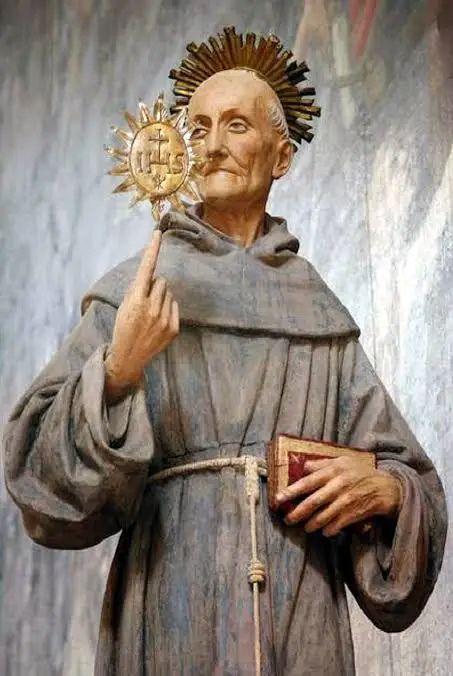
His special devotion was to the Holy Name of Jesus. He used the symbol IHS—the first three Greek letters of Jesus’s name—in Gothic letters on a blazing sun. This symbol was meant to displace the insignia of political factions. The Guelphs and Ghibellines had torn Italy apart. Bernardine offered a unifying alternative. The devotion spread rapidly. The symbol appeared in churches, homes, and public buildings.
Opponents called it dangerous innovation. In 1426, Bernardine was summoned to Rome. He stood trial for heresy. Theologians including Paul of Venice examined his teachings. He was found innocent. Pope Martin V was so impressed that he requested Bernardine preach in Rome. Bernardine preached every day for eighty days.
Bishoprics Refused, Reform Embraced
Bernardine declined multiple bishoprics. Siena wanted him. Ferrara wanted him in 1431. Urbino wanted him in 1435. He refused them all. He would not abandon his monastic and evangelical calling. Yet he could not avoid one appointment. He became Vicar General of the Observant Franciscans in Italy in 1438.
His impact on the order was staggering. When he joined, Italy had about one hundred thirty Observant friars. Shortly before his death, the number exceeded four thousand. He founded or reformed at least three hundred convents, sent missionaries to Asia and helped bring schismatic nations to the Council of Florence. There, he addressed the assembled Fathers in Greek.
In 1442, he persuaded the Pope to accept his resignation as Vicar General. He wanted to preach undividedly. Pope Eugene IV’s 1443 bull, Illius qui se pro divini, charged him to preach the Crusade indulgence against the Turks. No record shows he did so. In 1444, despite increasing infirmity, he set out for the Kingdom of Naples. He wanted no part of Italy left without his voice.
Death and Canonization
Bernardine died at L’Aquila in Abruzzo in 1444. He was almost sixty-four. He is buried in the Basilica of San Bernardino. Tradition says his grave leaked blood until two city factions achieved reconciliation.
Reports of miracles multiplied rapidly. Pope Nicholas V canonized him in 1450. Only six years had passed since his death. His feast day is May 20.
Economist, Reformer, Controversial Figure
Bernardine was the first theologian after Peter John Olivi to write an entire work on Scholastic economics. His book On Contracts and Usury, written 1431-1433, discussed private property, trade ethics, value and price determination, and usury. He defended the entrepreneur as performing a useful social function. Murray Rothbard noted that Bernardine’s insight on just value prefigured the Jevons/Austrian analysis by over five centuries. He developed a theory of the “just wage” based on labor demand and supply.
His legacy is not without darkness. His sermons targeted Jews, Muslims, women accused of witchcraft, and homosexuals. He urged banishment and isolation of Jewish communities. He attributed floods, plague, and population decline to sodomy. After one Siena sermon, four men attempted to beat him with clubs. Historian Franco Mormando concluded that despite moments of empathy, Bernardine wanted women to remain in their “traditional cage” under male guardianship.
Veneration and Iconography
Bernardine is the patron saint of advertising, communications, compulsive gambling, respiratory problems, and chest ailments. He is patron of Carpi, Italy; San Bernardino, California; and Siena College in New York. The Alpine pass Il Passo di San Bernardino bears his name.
Artists depict him as small and emaciated, with three mitres at his feet representing the bishoprics he rejected. He holds the IHS monogram with rays emanating from it. He may be the first saint in Church history with an indisputably authentic portrait, based on his death mask. Pinturicchio painted a famous fresco cycle of his life in the Bufalini Chapel of Santa Maria in Aracoeli, Rome.
On May 20, the Church remembers this complex figure. Catholics seeking courage in preaching find his model. Those struggling with gambling addiction invoke his aid. And every believer who has ever spoken the Holy Name of Jesus with devotion walks in the path he cleared across Renaissance Italy.
Leave a Reply