
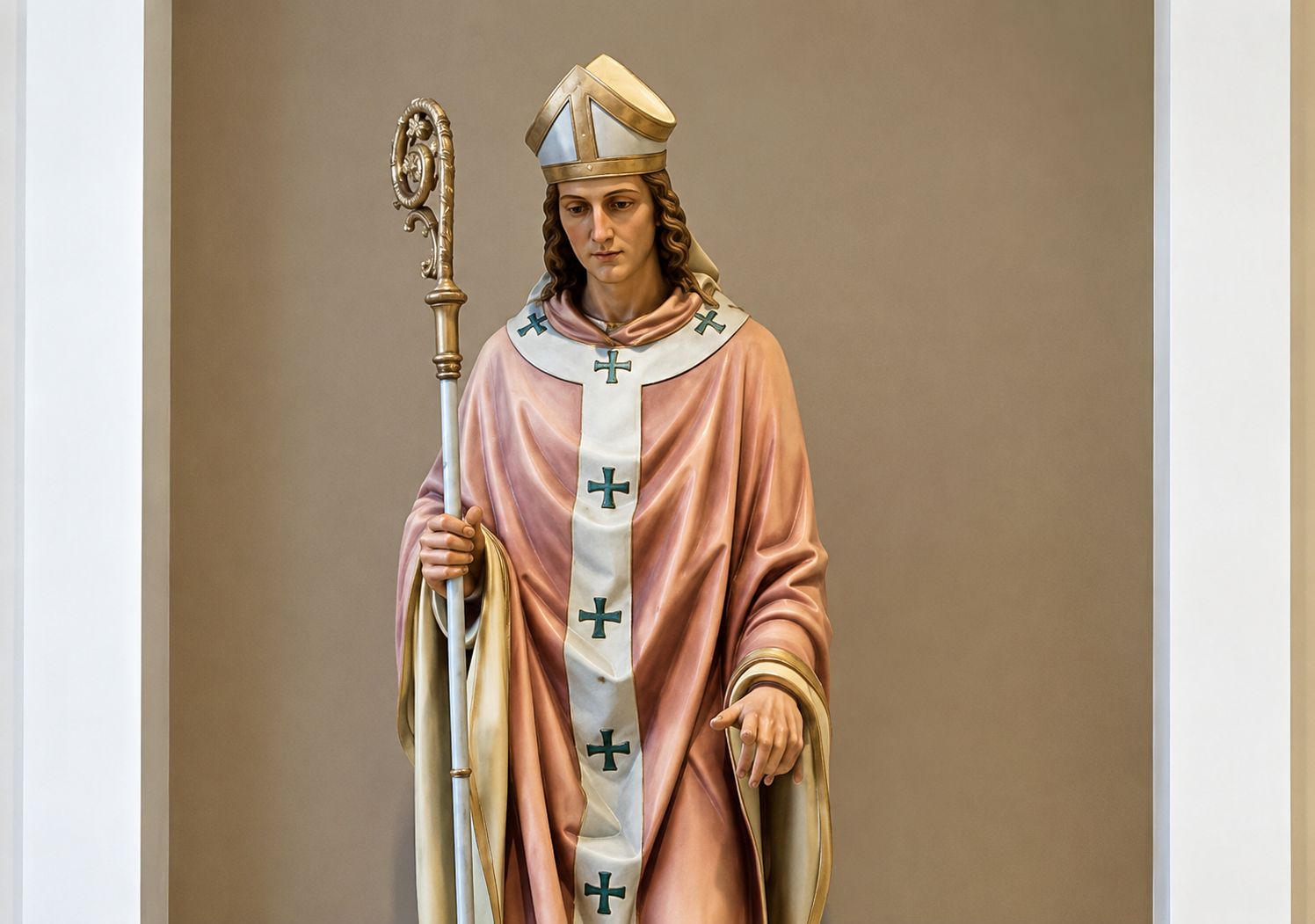
Saint Kilian: The Irish Bishop-Martyr Who Evangelized Franconia
The Feast Day of Saint Kilian
Every year on July 8, the Catholic Church celebrates the feast day of Saint Kilian, an Irish missionary bishop who became known as the Apostle of Franconia. Born around 640 AD, this courageous saint traveled from the emerald isle to the heart of Germany, where he ultimately laid down his life for the faith. Moreover, he remains the patron saint for those who suffer from rheumatism, offering spiritual comfort to countless people across the centuries.
Early Life and Formation in Ireland
Kilian, whose name also appears as Cillian, Killian, or Cillín in its original Gaelic form Ceallach, was born to noble parents in approximately 640 AD. His birthplace was Cloughballybeg, near Mullagh in what is now County Cavan, Ireland. Consequently, he grew up in a land already rich with Christian monastic tradition.
According to Irish sources, Kilian began his education at the School of Ross in Rosscarbery, County Cork. Thereafter, he completed his studies in Tuosist, County Kerry, a place that would later claim him as its own patron. Some records indicate that he served as a monk at Hy, an early name for the celebrated monastery of Iona. During these formative years, Kilian developed both the spiritual depth and intellectual preparation that would sustain his future missionary endeavors.
The Journey to Rome and Missionary Mandate
In the summer of 686, Kilian gathered eleven companions and set out on an extraordinary journey. They traveled through Gaul and onward to Rome, arriving in late autumn. Their purpose was clear: to receive missionary faculties directly from the Pope. Pope Conon granted them permission to evangelize Franconia, a region encompassing modern-day Baden and Bavaria in Germany.
After receiving papal blessing, the group continued their travels. However, the original company eventually separated, with some members departing to seek other fields of missionary work. Kilian remained in Würzburg with two faithful companions: Colmán, a priest, and Totnan, a deacon. Together, these three men would transform the spiritual landscape of East Franconia.
Evangelizing the Duke and His People
Würzburg was then governed by Duke Gozbert, an East Frankish ruler whose people still practiced paganism. Nevertheless, Kilian made this town the foundation of his apostolic work, and his influence steadily expanded across East Franconia and Thuringia. Through persistent preaching and witness, he succeeded in converting Duke Gozbert along with a large portion of his subjects to Christianity.
Kilian’s mission bore remarkable fruit. The once-pagan duke embraced the new faith, and the region began its transformation into a Christian stronghold. Furthermore, the saint established Würzburg as his base of operations, from which he directed an ever-growing network of evangelization.
A Fatal Confrontation Over Marriage
The turning point in Kilian’s story came when he addressed a sensitive matter concerning Duke Gozbert’s personal life. The duke had married Geilana, his own brother’s widow. According to sacred scripture and Church teaching, this union violated divine law. Therefore, Kilian confronted the duke directly, informing him that the marriage was forbidden.
While Gozbert was away on a military expedition, Geilana learned of Kilian’s words against her marriage. Since the missionary had failed to convert her to Christianity, she harbored no spiritual restraint. Instead, she flew into a rage. In her husband’s absence, she dispatched soldiers to the main square of Würzburg, where Kilian and his two companions were preaching. There, the soldiers seized the three missionaries and beheaded them on the spot.
Thus, around 689 AD, Saint Kilian, along with Saints Colmán and Totnan, met their martyrdom. Their blood watered the seeds of faith they had planted in Franconian soil.
Veneration and Enduring Legacy
The memory of these martyrs was preserved from the earliest days. An 8th-century necrology at Würzburg records their names, and the martyrology of Hrabanus Maurus also mentions them. Burchard, whom Saint Boniface appointed as the first bishop of Würzburg, built a cathedral on the very spot where the martyrs died. He had their relics unearthed and placed within a vault inside that church.
Their skulls, beautifully inlaid with precious stones, have survived to the present day. Every year on Saint Kilian’s Day, a glass case containing these three skulls is removed from the cathedral crypt. It is then paraded through the streets before large crowds and displayed in Würzburg Cathedral, which is dedicated to Kilian himself. Additionally, statues of these three saints line the famous Saints’ Bridge across the river Main.
Patronage and Modern Devotion
Saint Kilian serves as one of the patron saints for sufferers of rheumatism, offering hope to those afflicted with this painful condition. He is also the patron saint of Tuosist, near Kenmare in County Kerry, where he is believed to have lived before departing for Germany. A church and holy well bear his name there, and locals traditionally celebrate his feast day with a pattern: crowds visit the well for prayers, followed by evening social gatherings.
Furthermore, Kilian is the patron saint of Paderborn, Germany. In iconography, artists usually portray him wearing a bishop’s mitre and holding a sword, the very instrument of his martyrdom. This imagery appears prominently in his statue at Würzburg.
The Kiliani-Volksfest, which runs for two weeks every July, stands as the main civil and religious festival in the region around Würzburg. This celebration keeps alive the memory of the Irish bishop who crossed seas and mountains to bring the Gospel to the German people. Through his sacrifice, Saint Kilian reminds us that fidelity to truth sometimes demands the ultimate price, yet the fruits of such witness endure for generations.


Leave a Reply