
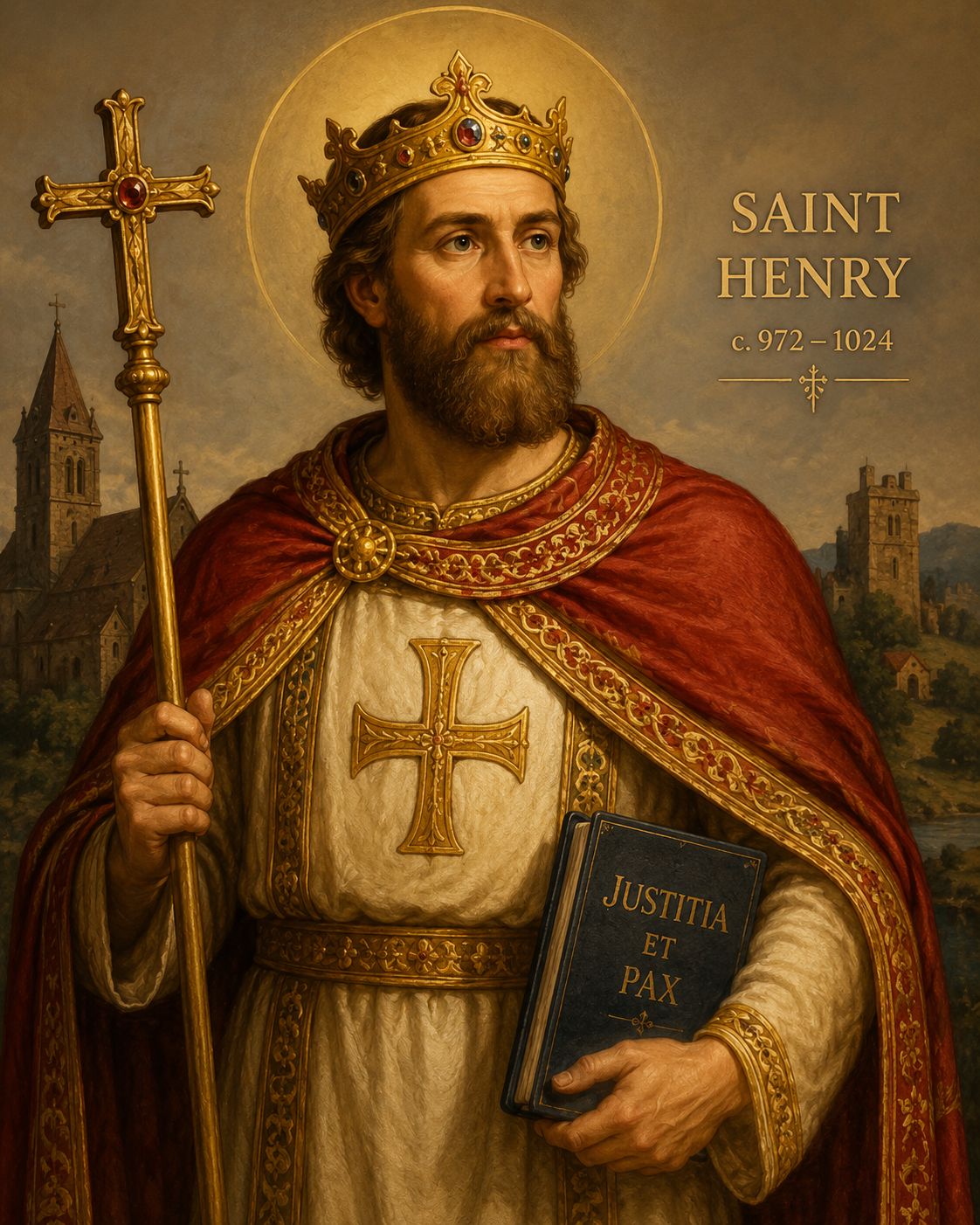
Saint Henry: The Holy Roman Emperor and Patron of the Childless
The Feast Day of Saint Henry
Every year on July 13, the Catholic Church celebrates the feast day of Saint Henry, the only medieval German monarch ever honoured with canonization. Born in May 973, he ascended from Duke of Bavaria to King of Germany and ultimately to Holy Roman Emperor, yet he remained deeply humble throughout his reign. Moreover, he serves as patron saint of the childless, of Dukes, of the handicapped, and of those rejected by religious Orders, offering spiritual companionship to countless faithful across the centuries.
Early Life and Education Amid Exile
Henry was born into the Bavarian branch of the powerful Ottonian dynasty. His father, Duke Henry II of Bavaria, and his mother, Gisela of Burgundy, provided him with noble lineage stretching back to King Henry the Fowler. However, his childhood was marked by political turmoil. Because his father had rebelled against two previous Emperors, the younger Henry spent long periods in exile. During these difficult years, he turned to Christianity at an early age, first finding refuge with Bishop Abraham of Freising and later receiving education at the cathedral school in Hildesheim.
Saint Wolfgang of Regensburg served as his spiritual mentor, providing an excellent foundation in faith and virtue. Consequently, Henry developed the deep piety that would characterize his entire life. In 995, he succeeded his father as Duke of Bavaria. Meanwhile, his cousin Emperor Otto III ruled from Rome, and Henry initially supported the imperial cause.
Ascension to the German Throne
In 1002, Otto III died suddenly at age twenty-one without leaving any heir. This unexpected death triggered a succession crisis, since the Bavarian line of the Ottonians had no automatic claim to the Saxon throne. Several rival candidates, including Margrave Eckard of Meissen and Duke Herman II of Swabia, fiercely contested Henry’s right to rule.
Determined to secure his position, Henry took the unprecedented step of having himself anointed King of Germany by Archbishop Willigis of Mainz on July 9, 1002. This marked the first time since Otto I that a German king was not crowned at Aachen Cathedral. Nevertheless, Henry gradually won support across the realm. After defeating Duke Herman II near Strasbourg in October 1002, the Swabian noble submitted to his authority. Henry allowed him to retain his ducal title until his death the following year.
Consolidating Power and Founding Bamberg
Henry spent his early reign consolidating authority throughout the German lands. In 1003, Margrave Henry of Schweinfurt revolted after Henry refused to honour a promise to make him Duke of Bavaria. The king swiftly crushed this rebellion, deposed the margrave, and abolished the March of Nordgau entirely.
In 1007, Henry made a momentous decision that would shape his legacy forever. He established the Diocese of Bamberg, transferring secular authority over the former Nordgau territory to this new ecclesiastical jurisdiction. He held a synod in Frankfurt to secure approval from the empire’s bishops and appointed his Imperial Chancellor, Eberhard, as the first bishop. Henry endowed the new diocese with lavish gifts and territories from across Franconia, Saxony, Carinthia, and Swabia, ensuring its solid foundation. Today, Bamberg Cathedral stands as a testament to his vision and devotion.
Imperial Coronation and Italian Campaigns
On May 15, 1004, Henry was anointed King of Italy in Pavia. A decade later, on February 14, 1014, Pope Benedict VIII crowned him Holy Roman Emperor in Saint Peter’s Basilica. During this visit to Rome, Henry confirmed the donation of sovereignty over Rome and the exarchate of Ravenna to the papacy, a gift originally made by his predecessors.
Henry led several military expeditions into Italy to enforce his imperial claims and counter Byzantine influence in the south. In 1017, he supported the Lombard noble Melus of Bari against Byzantine rule, though the rebellion ultimately failed. His third Italian campaign in 1022 aimed to capture the Byzantine fortress of Troia, but disease and stubborn resistance forced him to retreat. Despite these setbacks, Henry maintained his imperial dignity and continued to promote Church interests throughout his realm.
A Reign of Piety and Reform
Henry’s rule was distinguished by profound religious commitment. He and his wife, Cunigunde of Luxembourg, whom he married in 999, lived in perpetual chastity by mutual vow. Both would eventually be canonized—Henry in 1147 by Pope Eugenius III, and Cunigunde in 1200 by Pope Innocent III.
The emperor strongly enforced clerical celibacy and promoted monastic reform across the empire. He expanded the Ottonian practice of appointing clerics to secular governance, creating a non-hereditary counterbalance to the powerful German Dukes. Through extensive donations to monasteries and dioceses, he strengthened imperial rule while increasing influence over ecclesiastical affairs. No other Holy Roman sovereign appears as frequently in memorial records of Church benefactions.
Henry also supported missionary work among the pagan Slavs. In 1004, he reestablished the Diocese of Merseburg, which had been abandoned after a major Slavic revolt in 983, and appointed the chronicler Thietmar as its bishop. Furthermore, he persuaded Pope Benedict VIII to include the word “Filioque” in the Nicene Creed, affirming that the Holy Spirit proceeds from both the Father and the Son—a doctrine that would later contribute to the Great Schism of 1054.
Humility and the Desire for Monastic Life
Despite his imperial power, Henry harbored a deep desire for the monastic life. He once approached the Abbot of Verdun, asking to be received as a monk. The abbot responded by ordering him, in virtue of his imperial vows, to continue governing the empire. Henry accepted this duty with humility, believing that God had entrusted him with temporal authority for the good of his people.
On one occasion, he publicly cast himself at the feet of Herbert, Bishop of Cologne, begging pardon for having treated him coldly due to a misunderstanding. Such acts revealed a ruler who placed spiritual integrity above royal pride.
Final Years and Holy Death
Henry’s later years were shadowed by chronic conflict with Bolesław I of Poland, which lasted from 1004 to 1018. The Peace of Bautzen in 1018 finally ended this protracted struggle, though Henry had to accept Polish retention of the contested marches of Lusatia and Meissen.
In 1019, even the once-loyal Duke Bernard II of Saxony rebelled against him, frustrated by Henry’s lack of respect for secular nobility. Nevertheless, the emperor maintained his authority through the steadfast support of the clergy.
After returning from southern Italy in 1024, Henry fell ill in Bamberg. He suffered from a chronic, painful urinary infection that gradually weakened him. He died on July 13, 1024, at his imperial palace in Göttingen, at the age of fifty-one. Because his marriage had produced no children, the Ottonian dynasty ended with him. The German nobles elected Conrad II of the Salian dynasty as his successor.
Empress Cunigunde arranged for Henry to be interred at Bamberg Cathedral, the church he had lovingly built. His relics were later carried on campaigns against heretics in the 1160s, and his cult spread throughout the German-speaking world.
Legacy of a Saintly Emperor
Saint Henry remains unique among medieval rulers—a monarch who wielded absolute power yet sought only the greater glory of God. His feast day, originally inserted into the General Roman Calendar in 1631, was moved to July 15 in 1668, then restored to July 13 in 1969 as an optional memorial. He is venerated as a patron saint of Basel, Switzerland, and of Benedictine oblates, having lived as an oblate of the Order of Saint Benedict.
Through his foundations, his reforms, and his personal holiness, Saint Henry demonstrates that even the highest earthly authority can be exercised with humility, justice, and unwavering devotion to the Church.







Leave a Reply