
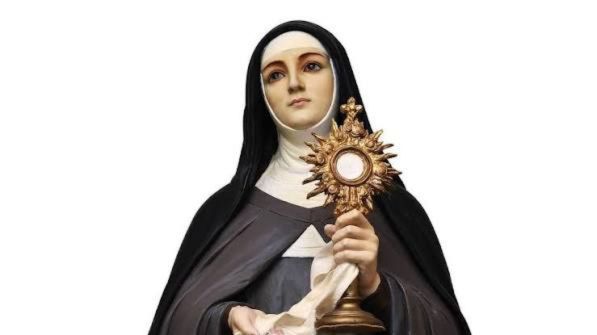
Image Credit: America Needs Fatima
Saint Clare of Assisi: Feast Day, Life, and Legacy
Saint Clare of Assisi walked away from wealth and nobility to found one of the most demanding religious orders in Church history. Inspired by Francis of Assisi, she built a community defined entirely by poverty, prayer, and quiet joy. Her Rule became the first set of monastic guidelines ever written by a woman. Let us talk about her escape from an arranged marriage, her founding of the Poor Clares and the courage that later became legendary throughout Assisi.
Saint Clare of Assisi’s Feast Day Falls on August 11
The Catholic Church honours Saint Clare of Assisi every year on August 11, the anniversary of her death in 1253. Her feast originally sat on August 12, since Saints Tiburtius and Susanna already held August 11 on the calendar. The 1969 calendar revision removed that older feast and moved Clare’s memorial to her true death date instead.
A Noble Birth and an Early Calling
Clare was born Chiara Offreduccio in Assisi on July 16, 1194, the eldest daughter of Count Favorino Sciffi and his devout wife, Ortolana. Her mother had made pilgrimages to Rome, Santiago de Compostela and the Holy Land and she instilled that same faith in her children from an early age. When Clare turned twelve, her parents wanted her married, but she insisted on waiting until eighteen instead. As a teenager, she heard Francis of Assisi preach during a Lenten service, and his words convinced her to seek a life shaped entirely by the Gospel.
Saint Clare of Assisi Leaves Her Father’s House
On the evening of Palm Sunday in 1212, Clare left her family home and traveled to the chapel of the Porziuncula to meet Francis. There, her hair was cut and her rich gown was exchanged for a plain robe and veil. Francis placed her at a Benedictine convent near Bastia, where her family soon arrived hoping to bring her home. When wealth and privilege failed to sway her, relatives tried force instead, only to watch Clare cling to the Altar and reveal her cropped hair as proof of her decision. Days later, Francis moved her to another monastery for greater solitude, where her sister Catarina soon joined her and took the name Agnes.
Founding the Poor Ladies of San Damiano
The sisters eventually settled beside the church of San Damiano, which Francis himself had once repaired. Other women joined them there, and together they became known as the Poor Ladies of San Damiano. Following the Rule Francis gave them, the sisters lived barefoot, ate no meat, and observed near-total silence, dividing their days between manual labour and prayer. Clare reluctantly accepted the role of abbess in 1216, though she preferred humbler titles like servant or handmaid instead. Her devotion to Francis ran so deep that others began calling her “alter Franciscus,” meaning another Francis.
A Fierce Defense of Radical Poverty
After Francis died, Clare spent years defending her order’s commitment to strict poverty against Church officials who wanted her to adopt a more conventional monastic rule. She pursued a special papal privilege allowing her sisters to own nothing at all. When Pope Gregory IX once offered to release her from that vow out of concern for her sisters’ health, Clare firmly refused, insisting she never wished to be excused from following Christ. Her persistence paid off, and she later became the first woman in history to write her own approved monastic Rule.
Saint Clare of Assisi Defends Her Convent
In 1224, soldiers under Emperor Frederick II marched toward Assisi, and Clare, though seriously ill, carried the Blessed Sacrament to the convent wall and knelt in prayer for protection. According to tradition, the attackers fled in sudden fear without harming anyone in the town. Similar attacks in 1240 and 1241 were reportedly turned back the same way, cementing her reputation as a fierce spiritual protector of her community.
Death and a Swift Path to Sainthood
Saint Clare of Assisi died on August 11, 1253, at fifty-nine years old, just two days after Pope Innocent IV approved her Rule as the governing law of her order. Her reported final words gave thanks to God for having created her. Pope Innocent IV took the unusual step of ordering the Office for Virgin Saints at her funeral rather than the customary Office for the Dead, effectively fast-tracking her cause. The full canonization process took only two years, and Pope Alexander IV formally declared her a saint on September 26, 1255.
A Lasting Legacy Around the World
Saint Clare’s remains were transferred to the newly completed Basilica of Saint Clare in 1260 and her order was officially renamed in her honour three years later. In 1958, Pope Pius XII named her patron saint of television, based on a tradition that she once saw and heard Mass on her wall while too ill to attend in person. She remains patroness of eye disease, goldsmiths, and laundry as well. Her name lives on globally, from Santa Clara, California, to Michigan’s Lake St. Clair. Readers exploring August feasts can browse the full August Saints calendar.



Leave a Reply