
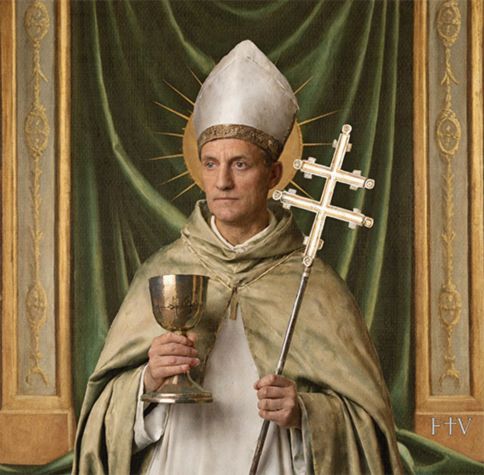
Image Credit: Public domain via Wikimedia Commons / Catholic Online
St. Norbert of Xanten: The Courtier Struck Down by Lightning
A Comfortable Life Suddenly Interrupted
Saint Norbert Xanten had arranged everything perfectly. Born around 1080 at Xanten in the Rhineland, he was the third son of a noble family. In medieval Europe, that meant one thing: the Church. His parents ensured he received excellent education, then secured him a comfortable position as canon at St. Victor’s church in Xanten. He took minor orders as subdeacon, collected benefices, and enjoyed the financial perks of ecclesiastical status without the burdens of actual priesthood.
Emperor Henry V noticed him. The young courtier was charming, capable, and useful. He appointed Norbert almoner, a position that mixed charity with political access. Norbert embraced the role—and everything that came with it. He moved easily from noble family to pleasure-loving court, sampling every enjoyment available. He had no qualms about accepting holy orders for worldly advancement, though he carefully avoided priesthood and its implied responsibilities.
Then God intervened with theatrical force.
The Lightning Bolt That Changed Everything
The storm boiled up suddenly. Norbert was out riding, his fashionable coif and fine clothes marking him as a man of status. High winds tore at his garments. Rain slashed down. Dark clouds pressed night against his light thoughts.
A flash of lightning split the darkness. His horse bucked wildly, throwing him to the ground.
For nearly an hour, Norbert lay unconscious in the mud. Rain soaked his expensive clothes. Thunder howled overhead. Nothing roused him—neither the storm’s fury nor the cold soaking through his finery.
When he finally opened his eyes, his first words were: “Lord, what do you want me to do?” The same words Saul spoke on the road to Damascus. And in his heart, he heard the response: “Turn from evil and do good. Seek peace and pursue it.”
Everything changed. Immediately.
From Hypocrite to Itinerant Preacher
Norbert returned to Xanten, his birthplace, and threw himself into prayer and penance. He finally embraced the priesthood he had long avoided, receiving ordination in 1115. His complete transformation looked suspicious to those who had known his former life. Some denounced him as a hypocrite, playing at holiness for show.
His response was characteristically radical. He sold everything he owned and gave the proceeds to the poor. Then he traveled to Pope Gelasius II for permission to preach. With the papal commission secured, he became an itinerant preacher, traveling through Europe with two companions.
His penance was extreme—almost dangerously so. He chose to walk barefoot through snow and ice in the dead of winter. The two companions who followed him died from exposure. Norbert survived, his zeal seemingly making him impervious to cold that killed others.
The bishop of Laon noticed this strange, compelling figure. He wanted Norbert to reform the canons in his diocese. The canons wanted nothing to do with Norbert’s severity. The bishop, unwilling to lose this holy man entirely, offered him land to start his own community.
The Valley of Prémontré
In a lonely valley called Prémontré, Norbert established his community with thirteen canons. The date was Christmas Day, 1120. The location was remote—about ten miles from Laon in the Forest of Coucy, granted by Bishop Barthélemy de Jur.
For their rule, Norbert chose the Rule of St. Augustine, common among communities of priests. But he adapted Cistercian customs too, creating something unique: canons regular who were both active preachers and contemplative monks. The idea was revolutionary. His priests needed an ascetic haven, a place of prayer and discipline that would fuel their public ministry.
The first thirteen disciples included Hugh of Fosses, Evermode of Ratzeburg, Antony of Nivelles, seven students from Anselm’s celebrated school, and Ralph of Laon. They lived initially in wooden huts arranged like a camp around a chapel dedicated to St. John the Baptist. Within a year, the community grew to forty. They built a larger church and monastery as increasing numbers joined.
Pope Honorius II approved the constitution in 1125/6. The Canons Regular of Prémontré—later called Premonstratensians or Norbertines—were officially born.
The First Third Order and a Surprising Decision
Norbert’s vision extended beyond cloister walls. Count Theobald II of Champagne wanted to join the order. Norbert recognized something Theobald himself couldn’t see: this man wasn’t called to holy orders or monastic life. He was called to marriage and worldly duties.
Rather than rejecting him entirely, Norbert created something new. He gave Theobald a rule, specific devotions, and a white scapular to identify him as connected to the community. In 1122, the Third Order of St. Norbert was born—the first evidence of lay affiliation with a religious order in Church history.
This trip accompanying Theobald to his marriage would have unexpected consequences. Emperor Lothair spotted Norbert and decided he was the man for a difficult job.
Archbishop of Magdeburg and Near-Assassination
In 1126, Pope Honorius II appointed Norbert Archbishop of Magdeburg. The position was challenging. The diocese needed reform, and Norbert brought the same zeal that had transformed Prémontré.
Several assassination attempts followed as he imposed discipline. The citizens of Magdeburg were attached to their old ways and resented this outsider forcing change. Disgusted with their resistance, Norbert left the city.
He didn’t stay away long. The emperor and pope pressured Magdeburg to recall him. They needed his reforming energy, even if the locals didn’t appreciate it.
Norbert also became involved in the great political crisis of his era. When Pope Honorius II died in 1130, two rival popes were elected: Innocent II and Anacletus II. Norbert supported Innocent, the first elected, and persuaded Emperor Lothair to back him as well. In 1133, he convinced Lothair to lead an army to Rome to restore Innocent to the papacy.
In his final years, Norbert served as chancellor and adviser to Lothair III. Then, in 1134, he was made archbishop—though some sources suggest this was an earlier appointment. He died soon after, on June 6, 1134, at age 53.
Veneration and a Stolen Body
Norbert’s death sparked immediate controversy. Both the cathedral canons at Magdeburg and the canons at St. Mary’s Abbey claimed his body. Emperor Lothair III intervened, decreeing burial at the Norbertine Abbey.
But history wasn’t finished moving him.
In 1524, Martin Luther preached in Magdeburg, and the city turned Protestant. The Abbey of Strahov in Prague spent centuries trying to retrieve Norbert’s remains. After several military defeats at Emperor Ferdinand II’s hands, the Strahov abbot finally succeeded. On May 2, 1627, Norbert’s body arrived in Prague, where it remains today in a glass-fronted tomb—an auto-icon displayed for veneration.
Pope Gregory XIII canonized him in 1582. His statue now appears above the Piazza colonnade of St. Peter’s Basilica in Rome, alongside other founders of religious orders. Statues of Norbert, Wenceslaus, and Sigismund stand together on Prague’s Charles Bridge.
The Norbertine Legacy Today
The Premonstratensian Order—Norbertines—continues across Europe, the United States, Canada, the United Kingdom, South America, Zaire, South Africa, India, and Australia. Their work spans education, parish ministry, university chaplaincy, and youth outreach.
St. Norbert College in De Pere, Wisconsin, represents the order’s first institution of higher education. The college also houses the Center for Norbertine Studies, a collaborative partnership between the institution and the Premonstratensian order.
What Norbert Teaches Us
His story is almost embarrassingly dramatic. Struck by lightning. Thrown from a horse. Lying unconscious in a storm. The medieval equivalent of a near-death experience that forces complete reevaluation.
Yet the details after his conversion matter more than the theatrical beginning. Norbert didn’t retreat into private holiness. He became a public preacher, walking barefoot through winter, losing companions to the cold, persisting despite death. He didn’t just reform himself; he built institutions that would reform others.
His handling of Count Theobald reveals pastoral wisdom. He could have accepted a noble recruit, boosting his order’s prestige. Instead, he recognized Theobald’s true vocation and invented the Third Order to accommodate it. This wasn’t rigid adherence to rules; it was creative fidelity to God’s call in each person.
As archbishop, he nearly died for reform. The assassination attempts weren’t abstract threats. They were real violence from people who preferred comfortable corruption to demanding holiness. Norbert’s disgust and departure, followed by his reluctant return under pressure, show that even saints need institutional support to sustain difficult work.
His final political maneuvering—supporting Innocent II, persuading Lothair to march on Rome—demonstrates that sanctity doesn’t require political withdrawal. Norbert engaged the messy realities of his era, using his influence for ecclesiastical unity rather than personal advancement.
St. Norbert of Xanten, founder of the Premonstratensians, pray for us. Pray for those who need dramatic conversion, for reformers who face resistance. Pray for the courage to walk barefoot through winter when God asks it. And pray for wisdom to recognize that some are called to monastery, some to marriage, and all to holiness in their particular state.
Leave a Reply