
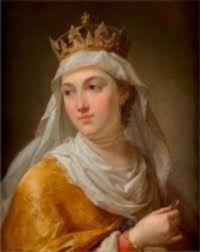
Image Credit: We are Catholic (Facebook Group)
Blessed Jolenta of Poland: The Princess Who Gave Everything Away
Royal Blood and Early Piety
Jolenta was born around 1230 into one of Europe’s most powerful families. Her father was King Béla IV of Hungary, the monarch who rebuilt his kingdom after the Mongol devastation. Her mother was Maria Laskarina, a Byzantine princess connected to the imperial court of Constantinople. Jolenta’s sisters included St. Kinga of Poland and Blessed Salomea of Poland, making holiness something of a family trait.
From childhood, Jolenta showed unusual seriousness. While other noble children played at court politics, she prayed. While her sisters planned marriages, she planned service. Her parents, recognizing her temperament, arranged her education carefully. She learned not just the accomplishments expected of a princess but the spiritual disciplines that would shape her future.
In 1246, at about 16 years old, Jolenta married Bolesław the Pious, Duke of Greater Poland. The marriage was politically strategic, uniting Hungarian and Polish interests. But it was also personally happy. Bolesław shared Jolenta’s piety, and together they built a life that balanced ducal responsibilities with spiritual devotion.
A Partnership in Charity
Jolenta and Bolesław had three daughters: Elisabeth, Jadwiga, and Anna. They also shared a remarkable commitment to the poor. While many nobles gave alms as public display, Jolenta and her husband practiced charity as personal duty. They visited the sick, fed the hungry, and treated servants with unusual kindness.
Bolesław’s death in 1279 changed everything. Jolenta was about 49, still vigorous, still capable of remarriage or political maneuvering. Instead, she chose a path that shocked her contemporaries. She would renounce her position, her wealth, and her comfort to become a Poor Clare nun.
The Poor Clares were the female branch of the Franciscan family, founded by St. Clare of Assisi. Their life was one of radical poverty, enclosure, and prayer. For a dowager duchess to join them was almost unheard of. Jolenta didn’t hesitate.
The Foundation at Gniezno
Jolenta entered the Poor Clare monastery in Stary Sącz, where her sister Kinga had already established a convent. But she didn’t remain there long. She felt called to found a new house in Gniezno, the historic capital of Poland and seat of its archbishop.
The foundation was challenging. Jolenta brought her daughters with her—all three eventually joined religious life. Elisabeth became a Poor Clare, Jadwiga entered the Benedictines, and Anna also chose the consecrated life. The family that had ruled Poland was now praying for it.
Jolenta’s leadership at Gniezno was marked by the same generosity that had characterized her married life. She gave away everything she had brought, distributing her remaining wealth to the poor. She embraced the Poor Clare discipline fully: fasting, manual labor, long hours of prayer, and complete enclosure.
Her reputation for holiness spread quickly. People sought her counsel. Miracles were attributed to her intercession. She became known not as the former duchess but as a mother to the spiritually needy, a woman whose prayers carried weight with God.
The Final Years and Beatification
Jolenta died on June 11, 1298, at Gniezno. She was about 68 years old. Her death was peaceful, surrounded by her daughters and her community. The Poor Clares mourned her as a founder and a saint.
Her cult developed locally and persisted through centuries. Pope Pius VII confirmed her beatification in 1807, formally recognizing what the Polish Church had long known: Jolenta was among the blessed. Her feast day is celebrated on June 11, though some calendars may vary.
What Jolenta Teaches Us
Her story challenges our assumptions about vocation. We often think religious life is for the young, the unmarried, those without worldly attachments. Jolenta was middle-aged, widowed, a mother of three, deeply embedded in political and familial responsibilities. Yet she heard God’s call and responded completely.
Her renunciation was total. She didn’t keep a private income, maintain noble privileges, or expect special treatment. She entered as a beginner, worked as a servant, and died as a poor nun. This wasn’t performative humility. It was genuine conversion from one way of life to another.
Her family pattern is striking too. Three sisters, all holy. Three daughters, all consecrated. Holiness isn’t individualistic. It spreads through families, through example, through the quiet influence of those who pray. Jolenta’s mother Maria, her sisters Kinga and Salomea, her daughters Elisabeth, Jadwiga, and Anna—this was a family transformed by faith.
Her political context matters. She lived through the Mongol invasion’s aftermath, the rebuilding of Hungary, the consolidation of Poland. She knew power intimately and chose to leave it. This wasn’t ignorance of politics. It was informed rejection of what power without God becomes.
Blessed Jolenta of Poland, pray for us. Pray for widows discerning their next chapter, for parents whose children follow them into religious life, for the wealthy; that they may recognize poverty’s freedom and pray for Poland, Hungary, and all lands where your family once ruled, that they may be ruled now by Christ’s peace.



Leave a Reply