
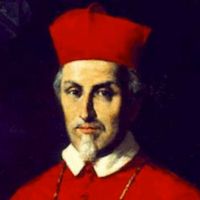
Image Credit: Catholic.net
Feast Day – June 18
Saint Gregory Barbarigo: The Diplomat Who Became a Shepherd
Born into Power, Drawn to Service
Gregorio Giovanni Gaspare Barbarigo arrived in Venice on September 16, 1625, with pedigree that opened every door. His family was among the Republic’s most distinguished, counting two doges among his ancestors. His father, Senator Giovanni Francesco Barbarigo, ensured he received the finest education: philosophy, mathematics, Latin, Greek, and music from private tutors.
Yet tragedy struck early. His mother Lucrezia died of plague in 1631, when Gregory was only six. His father brought a cousin, Franchesina Lippomani, to raise the children. Despite this loss, Gregory thrived intellectually. By 1643, at age 18, he had already embarked on a career that would shape European history.
He accompanied Venetian Ambassador Aloise Contarini to Münster as secretary for the negotiations that would produce the Peace of Westphalia. There, he met Archbishop Fabio Chigi, the papal nuncio to Cologne. This connection would prove decisive. The two men recognized something in each other: intellectual depth, diplomatic skill, and something more—a shared sense that politics should serve higher purposes.
After Münster, Gregory traveled through Holland, Flanders, and Paris. He returned to Venice in July 1648, then continued studies at Padua. In 1650, he joined the Collegio dei Savi, Venice’s governing council, launching his political career. However, he quickly discovered that politics alone couldn’t satisfy him.
From Diplomat to Priest
In the winter of 1653, Gregory went to Rome seeking Cardinal Chigi’s counsel. Should he retreat as a hermit? Chigi offered different advice: pursue an ecclesiastical career, obtain a doctorate in law. Gregory followed this guidance with characteristic thoroughness.
On September 25, 1655, he earned his doctorate in both canon and civil law. On December 21, 1655, Cardinal Patriarch Gianfrancesco Morosini ordained him to the priesthood. He left for Rome in February 1656, where Chigi—now Pope Alexander VII—initiated him into papal service.
His first assignment revealed his true character. In 1656, at the pope’s request, he organized assistance for Romans stricken by plague in the Trastevere district. He nursed the sick, buried the dead, and comforted the frightened. This wasn’t aristocratic patronage. It was hands-on, risky, personal service to the suffering.
On July 9, 1657, Alexander VII appointed him Bishop of Bergamo. Before accepting, Gregory celebrated Mass to discern God’s will. During that Mass, he felt the concrete call to accept. He took possession through procurators on September 2, 1657, then arrived personally on March 27, 1658. What followed was extraordinary: he inspected all 279 parishes in his diocese personally.
Cardinal, Reformer, and Nearly Pope
On April 5, 1660, Alexander VII elevated Gregory to the cardinalate at the Quirinale Palace. He became Cardinal-Priest of San Tommaso in Parione on June 21, 1660, later opting for San Marco on September 13, 1677. In 1664, he became Bishop of Padua, entering his new diocese on June 22 after his procurator took possession on April 24.
In Padua, Gregory modeled himself on St. Charles Borromeo, the great reforming bishop of Milan. He made the seminaries of both Bergamo and Padua substantially larger, added a library and printing press in Padua, wrote the Regulae Studiorum in 1690 for ecclesial studies. He celebrated a diocesan synod from September 1–3, 1683. And he visited all 320 parishes in his diocese.
His support for the Council of Trent wasn’t theoretical. He implemented its reforms practically, ensuring proper formation for clergy, adequate resources for parishes, and genuine pastoral care for faithful. He also fostered catechetical instruction, traveling to villages personally to teach and preach.
One episode reveals both his era’s limitations and his personal fairness. In 1678, he learned that Elena Cornaro Piscopia was pursuing theological studies. He refused this because she was a woman—an unfortunate reflection of 17th-century assumptions. However, he allowed her to obtain a philosophical degree, which she successfully completed. Even within constraints, Gregory sought reasonable accommodation.
The Conclaves That Almost Made Him Pope
Gregory participated in papal conclaves in 1667, 1676, 1689, and 1691. He skipped the 1669–70 conclave. In 1689, he emerged as a potential contender, though Cardinal Flavio Chigi blocked his candidacy. Cardinal Francesco Maria de’ Medici had actually proposed Gregory’s name as part of an elaborate ruse, never intending his election. The conclave chose Pietro Vito Ottoboni as Alexander VIII instead.
By 1691, Gregory’s status had shifted. He gained greater ground and almost succeeded. Cardinal d’Estrées included him among potential candidates. Cardinal Leandro Colloredo actively supported him. Even Chigi, who had blocked him in 1689, now advocated for him. However, the French opposed Gregory as a “creature” of Alexander VII, who had been tough on French interests. Cardinals Pietro Ottoboni and Paluzzo Paluzzi Altieri also resisted. The conclave elected Antonio Pignatelli as Innocent XII instead.
Gregory accepted this with characteristic grace. He hadn’t sought power for its own sake. He had simply been available when others thought him suitable.
Compassion and Death
Gregory’s compassion for the poor was legendary. He gave his household goods and clothes to those in need. On one occasion, he even sold his bed to help someone. This wasn’t calculated generosity for public display. It was personal sacrifice that left him occasionally uncomfortable.
After Pope Innocent XI’s election in 1676, Gregory remained in Rome until 1679 as counselor. The pope entrusted him with Rome’s education and reunification of Eastern Churches. Among his episcopal acts, he consecrated Niels Stensen as bishop on September 19, 1677, and ordained convert Thomas Nicholson as priest in Padua.
He died after a brief illness on June 18, 1697, in Padua, where he was interred in the diocesan cathedral. His end was peaceful, fitting for a man who had spent four decades serving the Church with energy and intelligence.
Veneration and a Curious Canonization
The faithful quickly recognized Gregory’s holiness. Miracles were attributed to him. The informative phase of his canonization process ended on July 11, 1716. Pope Innocent XIII formally introduced the cause on July 3, 1723.
His remains were exhumed on May 25, 1725. Popular opinion declared them incorrupt. His nephew, Bishop Giovanni Francesco Barbarigo, led the initiative. However, the physicians’ report was more cautious. Medical professionalism prevented them from declaring incorruption outright. They described the body’s condition as “wondrous”—a distinction largely lost on an eager public. For practical purposes, Gregory was considered incorrupt.
Pope Benedict XIV beatified him on September 20, 1751. The future Pope John XXIII, then a simple priest, signed a petition in 1911 asking Pope Pius X to advance the cause. Pius X issued the decree on February 28, 1912. John XXIII, who hailed from Bergamo, felt deep kinship with Gregory and fostered devotion to him throughout his life.
John XXIII canonized Gregory in 1960, including him in the General Roman Calendar with a feast on June 17 (since June 18 was already assigned). The 1969 calendar revision moved his feast to June 18, where it remains. The Church of San Gregorio Barbarigo alle Tre Fontane in Rome honors his memory.
What Gregory Barbarigo Teaches Us
His story bridges worlds that modern Catholics often separate: intellect and action, politics and prayer, aristocracy and service. Gregory moved seamlessly from diplomatic negotiations to plague nursing, from doctoral studies to parish visitation, from cardinalatial dignity to selling his bed for the poor.
His near-election as pope reminds us that holiness and leadership aren’t opposed. The Church needs saints in high places, not despite their positions but because of them. Gregory’s reforming work as bishop—seminaries, libraries, printing presses, parish visitations—shows what happens when competent administrators also possess genuine pastoral hearts.
His handling of Elena Cornaro Piscopia, while imperfect by modern standards, reveals someone trying to be fair within unjust constraints. He couldn’t overcome his era’s assumptions about women in theology. Yet he found a way to honor Piscopia’s intellectual gifts within available structures. This isn’t heroic virtue. It’s ordinary decency from someone who could have been simply authoritarian.
Saint Gregory Barbarigo, pray for us. Pray for bishops who balance administration with pastoral care, for politicians who seek ecclesiastical wisdom, for the poor who need not just our surplus but our sacrifice and pray for the Church, that she may always produce leaders who serve rather than merely rule.
Leave a Reply