
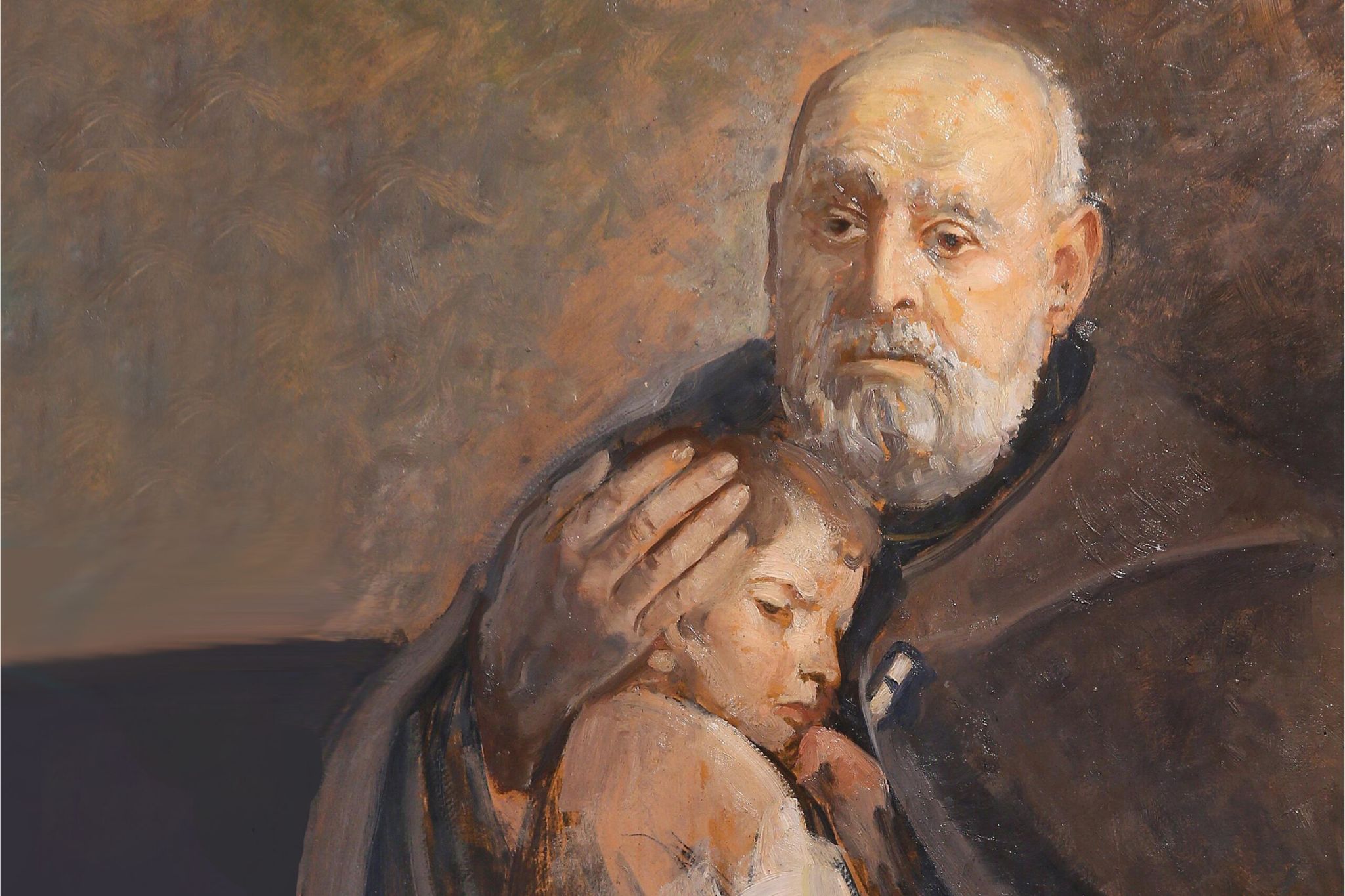
Image Credit: Catholics for Catholics
Feast Day – June 17
Saint Albert Chmielowski: The Painter Who Gave Up Art to Serve the Poor
A Privileged Boy in Turbulent Times
Adam Hilary Bernard Chmielowski entered the world on August 20, 1845, in Igołomia, just outside Kraków. His family belonged to the szlachta—the Polish nobility—which meant comfort, education, and social standing. Yet Poland itself was disappearing, partitioned between Russia, Prussia, and Austria. Comfort coexisted with national tragedy.
His father died when Adam was only eight. Ten years later, his mother followed. An aunt, Petronela, took charge of the orphaned children. Despite these losses, Adam received an excellent education. He studied agroforestry at the Puławy Polytechnic Institute, preparing to manage his parents’ estate. The future looked predictable: landowner, gentleman, perhaps minor political involvement.
Then history intervened.
The Uprising That Cost Him a Leg
In 1863, Adam joined the January Uprising against Russian rule. This wasn’t abstract patriotism. It was armed rebellion, guerrilla warfare, and desperate courage against an empire. On October 1, 1863, a Russian grenade killed his horse and shattered his leg so severely that amputation became necessary.
The operation happened without anesthesia in a woodman’s cabin. Finnish soldiers allied with Russia found him. Their captain recognized Adam—rumors had circulated that he was invincible, evading every bullet. The captain told him the leg must come off. Adam’s response was characteristically calm: “Give me a cigar—that will help me pass the time.”
He endured the excruciating pain by offering it to God, for Polish independence, for something larger than himself. Then, remarkably, he escaped. Accomplices smuggled him from the hospital hidden in a coffin. Eventually, he received a wooden prosthesis. He would limp for the rest of his life, a permanent reminder of sacrifice.
The uprising’s brutal suppression forced him abroad. He landed in Ghent, Belgium, where he resumed engineering studies. During this exile, however, he discovered a different talent.
A Celebrated Artist Emerges
Adam began painting. Despite family trustees’ objections, he pursued this new passion with characteristic intensity. In 1870, he entered the Munich Art Academy, where celebrated Polish artists befriended him: Stanisław Witkiewicz, Józef Chełmoński, Aleksander Gierymski, Leon Wyczółkowski.
His output was impressive: 61 oils, 22 watercolors, 15 drawings. He sent works to Polish exhibitions and gained popularity. His subjects ranged from landscapes to portraits to political pieces. “After the Duel,” “Little Girl with a Dog,” “Cemetery,” “Sunset,” “The Amazon”—these works established his reputation.
Religious themes began appearing. His “St. Margaret’s Vision” showed spiritual concerns emerging. Then came his masterpiece: “Ecce Homo,” depicting the scourged Christ. It currently hangs in the chapel of the Albertine Sisters in Kraków, a painting that would outlast its creator’s artistic career.
By 1874, Adam was well-known in Kraków. He worked as a painter until 1875, publishing an article asserting that art should be “the friend of man.” He lived in Warsaw briefly before settling in Kraków. Yet fame brought depression. He disliked the attention his works generated. More significantly, his political convictions and growing compassion drew him toward the suffering poor.
The Vocation That Changed Everything
While working on an image of Christ, Adam perceived a religious vocation. On September 24, 1880, he entered the Jesuit novitiate at Stara Wieś. The experience proved traumatic. During a retreat, anxiety overwhelmed him. He fell ill. His brother Stanisław retrieved him.
The Jesuit path wasn’t his. However, he discovered the Rule of St. Francis of Assisi, which resonated deeply. A Lazarist priest served as his spiritual director during this discernment. On August 25, 1887, Adam joined the Third Order of St. Francis, taking the religious name Albert. He made his first profession before Cardinal Archbishop Albin Dunajewski of Kraków.
Immediately, he moved into the public shelter where he had been volunteering. In 1888, he took perpetual vows. On August 25, 1888, he founded the Servants of the Poor—the Albertine Brothers. On January 15, 1891, alongside Maria Jabłońska, he established the Albertine Sisters, a parallel women’s congregation. Both groups dedicated themselves to food, shelter, and service for the homeless and destitute.
He briefly stayed at a Carmelite monastery, where he encountered St. John of the Cross’s writings. These became his favorites. He also met Carmelite superior Raphael Kalinowski, who suggested Albert might become a Carmelite. Albert declined. His path was Franciscan, active among the poor rather than contemplative in cloister.
“Our God’s Brother”
Albert’s new life was radical. He lived among the homeless, dressed in a gray habit, begged for food and supplies. People called him “Brat Albert”—Brother Albert. Others, recognizing his holiness, gave him extraordinary titles: “Brother of Our Lord,” “Brother of Our God,” and most movingly, “Our God’s Brother.”
This wasn’t sentimental flattery. It reflected how completely Albert had identified with Christ in the poor. Where others saw filth, he saw the face of God. Where others saw inconvenience, he saw invitation. His wooden leg, his artistic past, his noble birth—all were offered up, transformed into instruments of mercy.
He died at noon on December 25, 1916, from stomach cancer, in the shelter he had established. He received the Anointing of the Sick on December 23, when his condition worsened. His burial at Rakowicki Cemetery was temporary. His remains were exhumed on September 15, 1932, placed in a metal coffin, then moved again on May 31, 1949, to a Discalced Carmelite church.
A Saint Who Shaped a Pope
Albert’s influence extended far beyond his death. In 1938, he received the Order of Polonia Restituta posthumously. More significantly, a young Polish priest named Karol Wojtyła wrote a play about him in 1949. Titled Brat naszego Boga (Our God’s Brother), it explored Albert’s transformation from artist to servant of the poor.
Wojtyła later became Pope John Paul II. He frequently cited Albert as crucial to his own vocational discernment. The saint’s example of leaving art for radical religious commitment provided spiritual support when Wojtyła faced his own choices between academic life and pastoral service.
The canonization process began in 1966 under Pope Paul VI. Cardinal Karol Wojtyła oversaw the apostolic process from 1967 to 1968. Paul VI declared Albert Venerable in 1977. John Paul II, now pope, beatified him in Kraków on June 22, 1983, during his historic visit to Poland. On November 12, 1989, in Saint Peter’s Square, John Paul II canonized the man who had shaped his vocation.
Albert’s liturgical feast is June 17—not his death date, since December 25 is already Christmas.
What Albert Chmielowski Teaches Us
His story resists easy categorization. He was patriot and pacifist, artist and ascetic, nobleman and beggar. Each phase built upon the previous, yet each represented genuine transformation rather than mere evolution.
His artistic abandonment troubles modern sensibilities. We value creativity, self-expression, cultural contribution. Albert gave up a successful career, genuine talent, and public recognition to wash the feet of homeless men. Was this waste? Albert would say the opposite. Art served man; therefore, serving man directly was art’s fulfillment.
His disability shaped his ministry. The wooden leg, the limp, the chronic pain—these weren’t obstacles to overcome but bridges to the suffering. Albert understood physical limitation from the inside. He knew what it meant to depend on others, to be vulnerable, to need help. This empathy made him effective among those society discarded.
His relationship with John Paul II reveals holiness’s generational reach. Albert died in 1916, long before Karol Wojtyła was born. Yet his example, preserved in memory and writing, shaped one of history’s most consequential popes. Holiness isn’t confined to its era. It radiates across time, influencing people who never met the saint personally.
St. Albert Chmielowski, “Our God’s Brother,” pray for us. Pray for artists discerning their vocation, for the disabled, that they may see their limitations as gifts. Pray for the homeless, that they may be seen and served. And pray for Poland, for Kraków, and for all who serve the poor in your spirit.

Leave a Reply