
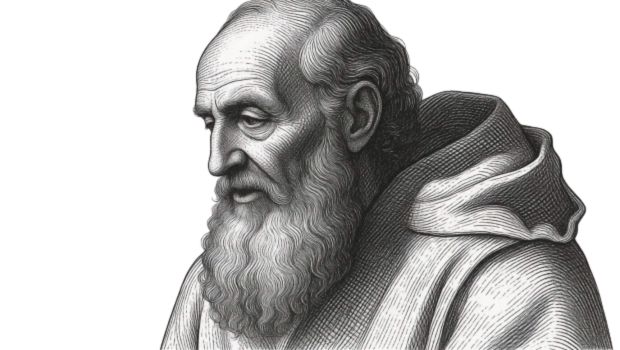
Image Credit: Aleteia
Saint Romuald: The Nobleman Who Founded a New Way of Monk
Feast Day: June 19
The Church celebrates St. Romuald on June 19, honoring a man who transformed a family tragedy into one of medieval Europe’s most influential spiritual movements. Born around 951 in Ravenna, Italy, he died around 1027 at Val di Castro, having spent thirty years founding and reforming monasteries across Italy.
A Father’s Crime That Changed Everything
Romuald was born into the aristocratic Onesti family of Ravenna. His father, Sergius degli Onesti, moved in the circles of power and violence typical of 10th-century Italian nobility. Young Romuald indulged in the pleasures and sins common to his class. The world was his oyster, and he consumed it eagerly.
Then came the day that shattered everything.
At age 20, Romuald served as second to his father in a duel. The dispute concerned property. The outcome was death. Sergius killed a relative. Romuald watched his father slay his adversary, and the crime made an impression so deep that it would redirect his entire life.
He determined to expiate this sin for forty days, as though it were entirely his own. This wasn’t calculated piety. It was genuine horror at violence, genuine recognition that his world was broken. He retired to the Benedictine monastery of Sant’Apollinare in Classe, near Ravenna, to do penance.
After some indecision, he became a monk there. The monastery had recently been reformed by St. Mayeul of Cluny Abbey. However, it still wasn’t strict enough for Romuald’s awakened conscience. His attempts to correct the less zealous aroused such enmity that he applied for permission to leave. It was readily granted.
Venice, a Hermit, and a Doge’s Conversion
Romuald went to Venice and placed himself under Marinus, a hermit who lived a life of extraordinary severity. This was Romuald’s first encounter with genuine eremitical asceticism, and it shaped everything that followed.
Around 978, something remarkable happened. Pietro I Orseolo, Doge of Venice, had obtained his office through complicity in his predecessor’s murder. Remorse began tormenting him. On the advice of Guarinus, Abbot of Saint-Michel-de-Cuxa in Catalonia, and of Marinus and Romuald, the Doge abandoned everything. He fled to Cuxa, took the Benedictine habit, and began a new life.
Romuald and Marinus erected a hermitage near the monastery. Romuald lived there for about ten years, taking advantage of Cuxa’s library to refine his monastic vision. He was studying, praying, and preparing something new.
Thirty Years of Founding and Reforming
Romuald spent the next three decades traversing Italy, founding and reforming monasteries and hermitages. His reputation reached Emperor Otto III’s advisors, who persuaded him to become abbot at Sant’Apollinare. The monks, however, resisted his reforms. After a year of frustration, Romuald resigned dramatically, hurling his abbot’s staff at Otto’s feet. He withdrew again to the eremitical life.
In 1012, he arrived at the Diocese of Arezzo. A man named Maldolus, who had seen a vision of monks in white garments ascending into heaven, granted him land. This became the Campus Maldoli, or Camaldoli. Romuald built five cells for hermits there. Two years later, he added the monastery at Fontebuono. Together, these formed the mother-house of the Camaldolese Order.
Romuald’s daunting charisma awed Rainier of Tuscany, who could neither face him nor send him away. He founded several more monasteries, including Val di Castro in the Marquisate of Ancona, where he died around 1027.
The Camaldolese Vision
Romuald integrated three major Western monastic traditions he had encountered. Sant’Apollinare represented traditional Benedictine monasticism under Cluniac influence. Marinus embodied the harsher, solitary Irish eremitical tradition. Guarinus at Cuxa drew on Iberian reform movements. Romuald combined these into something unique.
His rule is strikingly direct:
“Sit in your cell as in paradise. Put the whole world behind you and forget it. Watch your thoughts like a good fisherman watching for fish. The path you must follow is in the Psalms — never leave it.”
He addressed newcomers with pastoral realism:
“If you have just come to the monastery, and in spite of your good will you cannot accomplish what you want, take every opportunity you can to sing the Psalms in your heart and to understand them with your mind. And if your mind wanders as you read, do not give up; hurry back and apply your mind to the words once more.”
Archbishop Cosmo Francesco Ruppi summarized Camaldolese spirituality’s pillars: “Interiorization of the spiritual dimension, the primacy of solitude and contemplation, slow penetration of the Word of God and calm meditation on the Psalms.”
Romuald’s structural innovation was equally significant. He provided a framework accommodating both eremitic and cenobitic life—hermits living in individual cells near a central monastery, gathering for certain prayers and meals while maintaining solitary contemplation. This wasn’t rejection of community but reconfiguration of it around silence.
Battles With Devils, Men, and Himself
Like all saints, Romuald fought lifelong battles. Early in his spiritual life, numerous temptations assaulted him. He conquered them through vigilance and prayer. More than one attempt was made on his life, yet Divine Providence enabled escape. He also became victim to calumny, which he bore with patience and silence.
In old age, he increased his austerities rather than diminishing them. This wasn’t masochism. It was recognition that the interior journey deepens with age, that the soul’s appetite for God grows rather than shrinks.
Veneration and Calendar Wanderings
Romuald’s feast day has moved around. The Tridentine calendar didn’t include it. Pope Clement VIII added it in 1594 for June 19, then transferred it to February 7 in 1595—the anniversary of his relics’ translation to Fabriano in 1481. Pope Paul VI moved it back to June 19 in 1969, where it remains.
His statue stands in St. Peter’s Square colonnade, among the founders of religious orders. The Camaldolese continue today, maintaining their distinctive combination of solitude and community.
What Romuald Teaches Us
His story begins with violence and ends with peace. A father’s crime, a son’s horror, a lifetime of penance and prayer. Romuald didn’t minimize the evil he witnessed. He metabolized it, transformed it, offered it back to God as fuel for holiness.
His integration of traditions is instructive. He didn’t simply reject Benedictinism for eremitism, or eremitism for community. He discerned what each offered and created something new. This requires spiritual maturity—the ability to appreciate without idolizing, to criticize without despising.
His rule’s emphasis on interiority speaks to our distracted age. “Sit in your cell as in paradise. Put the whole world behind you and forget it.” Most of us can’t literally enter monastic cells. But we can create interior spaces, moments of deliberate silence, practices of attention that resist constant stimulation.
His patience with wandering minds is pastoral gold. “If your mind wanders as you read, do not give up; hurry back and apply your mind to the words once more.” This isn’t harsh self-discipline. It’s gentle persistence. The spiritual life isn’t about perfect concentration. It’s about returning, again and again, to what matters.
St. Romuald, founder of the Camaldolese, pray for us. Pray for those shattered by family violence, for monks and hermits seeking God in silence. Pray for the distracted, that we may learn to watch our thoughts like fishermen watching for fish. And pray for the Church, that she may always make room for those who need solitude to find you.
Leave a Reply