
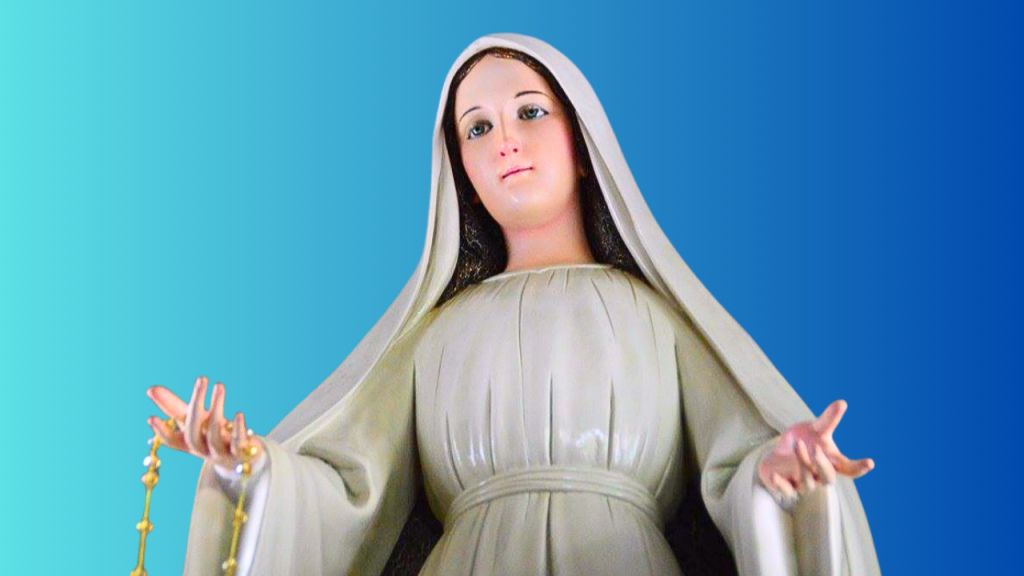
Image Credit: Our Lady Mediatrix of All Graces, Dijon City
Our Lady of Mediatrix of All Graces: The Mother Who Withholds Nothing
Mediatrix of All Graces – A Title That Says Everything
Some titles of Mary are poetic, others are geographical, only a few are so comprehensive that they stop you in your tracks.
Our Lady Mediatrix of All Graces is one of those. It doesn’t describe where she appeared or what she wore. It describes what she does—and what she does is everything that grace requires.
This devotion has deep roots in Catholic tradition, though it gained particular prominence through the work of St. Louis de Montfort and the Marian movements of the 20th century. The feast day is celebrated on June 9, but various local calendars may observe it differently. The core conviction is simple yet staggering: Mary is the channel through which all graces flow from Christ to humanity.
That isn’t pious exaggeration. It’s theological precision.
The Scriptural Foundation
The title rests on solid biblical ground. At the Annunciation, the angel Gabriel greeted Mary with words that would reshape history: “Hail, full of grace” (kecharitomene in Greek). This wasn’t a description of something Mary possessed. It was a statement of who she was—completely, perfectly, uniquely filled with divine favor.
This fullness of grace wasn’t for her alone. It was for mission. Mary’s “yes” at the Annunciation opened the door for the Incarnation. Without her consent, the Word wouldn’t have become flesh. With it, salvation history pivoted.
At Cana, we see this grace-distribution in action. The wine ran out. Mary noticed. She told Jesus. And though his hour had not yet come, he acted—transforming water into wine, launching his public ministry, revealing his glory. “Do whatever he tells you,” Mary instructed the servants. She’s been giving the same instruction ever since.
At the Cross, Jesus entrusted Mary to John with the words, “Behold your mother.” The Church has always understood this as more than personal arrangement. Mary became mother of all disciples, mother of the Church, mother of everyone who would receive grace through her Son’s sacrifice.
The Theological Depth
St. Louis de Montfort, the great 18th-century Marian apostle, developed this theology most fully. In his Treatise on True Devotion to Mary, he taught that God established Mary as the “treasurer of all his graces.” Not because God needed a treasurer—he could distribute directly—but because he chose to honor his mother by making her the channel.
This isn’t idolatry. It’s instrumentality. Just as Christ chose to become man, to suffer, to die, to rise—rather than simply decreeing salvation from heaven—so he chooses to involve his mother in grace’s distribution. The source remains Christ. The channel is Mary.
De Montfort was blunt about this: “God the Son wishes to form himself, and in a manner of speaking, to incarnate himself every day by his dear Mother in his members.” The graces that transform sinners into saints, that sustain the Church, that enable every good work—Mary is intimately involved in their transmission.
Pope Pius XII, in his encyclical Ad Caeli Reginam, affirmed this role: “From her heavenly abode, she begins her role as Mother of all graces.” Pope John Paul II, whose motto Totus Tuus (“Totally Yours”) was drawn directly from de Montfort, repeatedly emphasized Mary’s maternal mediation.
The Devotion in Practice
How do Catholics live this devotion? Through consecration, primarily. De Montfort’s Total Consecration to Jesus through Mary remains the most popular form—33 days of preparation culminating in entrustment of oneself entirely to Mary, who then leads the soul to her Son.
The Miraculous Medal, revealed to St. Catherine Labouré in 1830, bears the inscription: “O Mary, conceived without sin, pray for us who have recourse to thee.” The medal shows Mary standing on a globe, crushing a serpent, with rays of light streaming from her hands. The rays represent the graces she dispenses to those who ask. Some rays don’t shine—Catherine was told these represent graces people could have received but didn’t request.
The Rosary, of course, is the fundamental prayer of Our Lady of All Graces. Each decade is a request for grace through Mary’s intercession. The Hail Mary itself asks her to pray for us “now and at the hour of our death”—covering our entire lives with her maternal advocacy.
A Feast for Our Needy Times
The feast of Our Lady of All Graces arrives at a fitting moment. June follows May, the month of Mary, and precedes the summer’s ordinary time. It’s a moment to pause and recognize that we don’t earn grace. We receive it. And Mary, more than anyone, wants us to receive it fully.
Our age is peculiarly grace-starved—not because God withholds it, but because we don’t ask. We are self-sufficient, self-reliant and self-made. The very idea of depending on a heavenly mother seems weak, regressive and unenlightened. Yet the saints tell a different story. They attribute their conversions, their perseverance, their heroic virtue to Mary’s intervention. St. Maximilian Kolbe, St. Teresa of Calcutta, St. John Paul II—all consecrated themselves to Mary and credited her with grace they couldn’t have attained alone.
The title “Mediatrix of All Graces” is comprehensive. It covers sanctifying grace, the life of God in the soul, covers actual graces, the specific helps for particular moments, sacramental grace, received through the Church’s liturgy and charismatic graces, the Spirit’s gifts for building up the Body. Mary is involved in all of it, not as source but as channel, not as origin but as distributor, not as replacement for Christ but as the one who never fails to lead us to him.
What Mediatrix of All Graces Means for Us Today
In a culture of scarcity, Our Lady Mediatrix of All Graces proclaims abundance. Grace is not limited, but God’s mercy is not rationed. Mary’s maternal heart is not closed to anyone who asks. The only limitation is our own failure to request, to receive, to cooperate.
This devotion also corrects our individualism. We don’t approach God alone, as isolated souls negotiating private deals. We approach through the Church, through the communion of saints, and preeminently through Mary. She is the mother who gathers us, presents us to her Son and ensures our prayers are heard.
Finally, this title offers hope for the hopeless, those who feel they have exhausted their spiritual resources and tried everything but failed, and can’t imagine God still caring—these are precisely the ones Mary seeks. “Recourse to thee” is the only condition. Come to her. Ask. She will not refuse.
Our Lady of All Graces, pray for us. Pray that we recognize our need for grace, that we ask boldly, receive humbly, and share generously. Pray that we never forget: every good thing comes from your Son, through your hands, to our hearts. And pray that we, like you, become channels of grace for a world that desperately needs it.

Leave a Reply