
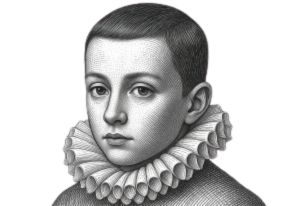
Image Credit: Angelus, modified in Canva
Saint Aloysius Gonzaga: The Prince Who Chose Heaven Over a Kingdom
Feast Day: June 21
The Church celebrates Saint Aloysius Gonzaga on June 21, the anniversary of his death in 1591. He lived only 23 years, yet his impact on Catholic spirituality—particularly for young people—has endured across four centuries. Pope Benedict XIII declared him patron of youth and students in 1729, and Pope Pius XI extended this to all Christian youth in 1926.
Born into Power, Drawn to Prayer
Luigi Gonzaga was born on March 9, 1568, at his family’s castle in Castiglione delle Stiviere, between Brescia and Mantua in northern Italy. He was the eldest of eight children, born into a cadet branch of the illustrious House of Gonzaga. His father, Ferrante Gonzaga, was Marquess of Castiglione. His mother, Donna Marta Tana di Santena, served as lady-in-waiting to Isabel, wife of Philip II of Spain.
As firstborn son, Luigi was destined to inherit his father’s title and status. His father assumed he would become a soldier, as was customary for aristocratic sons. At age four, Luigi received miniature Guns and accompanied his father on military training expeditions. At five, he was sent to a military camp. His father beamed watching his son march at the head of a platoon. His mother and tutor were less enthusiastic about the vocabulary he acquired there.
Yet even in this violent environment, something different was stirring. The first words Luigi spoke were the Holy Names of Jesus and Mary. By age nine, he had decided on a religious life and made a vow of perpetual virginity. To safeguard himself from temptation, he kept his eyes persistently downcast in the presence of women.
Illness, Conversion, and a Cardinal’s Influence
In 1576, at age eight, Luigi was sent to Florence with his younger brother Rodolfo to serve at the court of Grand Duke Francesco I de’ Medici. There, he fell ill with a kidney disease that would trouble him throughout his life. This illness, however, became a blessing in disguise. Confined from full social participation, he spent his time reading about the saints and praying.
In November 1579, the brothers moved to the Duke of Mantua’s court. Luigi was shocked by the violent, frivolous lifestyle he encountered. He returned to Castiglione and met Cardinal Charles Borromeo, from whom he received First Communion on July 22, 1580. This encounter was formative. Borromeo’s holiness and reforming energy inspired Luigi deeply.
After reading about Jesuit missionaries in India, Luigi felt a strong missionary call. He began teaching catechism to young boys in Castiglione during summers. He visited Capuchin and Barnabite houses repeatedly, adopting an increasingly ascetic lifestyle.
Family Resistance and Final Victory
In 1581, the family was called to Spain to assist Maria of Austria, Holy Roman Empress. They arrived in Madrid in March 1582, where Luigi and Rodolfo became pages for the young Infante Diego. Luigi began thinking seriously about joining a religious order. He had considered the Capuchins, but his Jesuit confessor in Madrid directed him toward the Society of Jesus.
His mother agreed. His father was furious and prevented him.
In July 1584, a year and a half after Infante Diego’s death, the family returned to Italy. Luigi’s resolve had only strengthened. Family members tried every persuasion: change your mind, become a secular priest, we’ll arrange a bishopric for you. If he became a Jesuit, he would renounce all inheritance and social status. None of this moved him. He was not interested in higher office. He wanted to become a missionary.
In November 1585, he formally renounced all rights of inheritance, confirmed by the emperor. He traveled to Rome and, because of his noble birth, gained an audience with Pope Sixtus V. After a brief stay at his cousin Cardinal Scipione Gonzaga’s palace, he was accepted into the Society of Jesus on November 25, 1585.
His superiors asked him to moderate his asceticism and be more social with fellow novices. This was new territory for someone who had spent years rigorously disciplining himself.
Jesuit Life and the Plague
Gonzaga’s health remained fragile. He was sent to Milan for studies but returned to Rome because of illness. On November 25, 1587, he took the three vows of chastity, poverty, and obedience. In 1588, he received minor orders and began theology studies. In 1589, he mediated a family dispute between his brother Rodolfo and the Duke of Mantua.
It is said that later in 1590, he had a vision in which the Archangel Gabriel told him he would die within a year.
In 1591, plague broke out in Rome. The Jesuits opened a hospital for the stricken, and Gonzaga volunteered immediately. He begged alms for victims, then worked directly with the sick—carrying the dying from streets into the hospital, washing them, feeding them, preparing them for sacraments.
Privately, he confessed to his spiritual director, Robert Bellarmine, that his constitution was revolted by the sights and smells. He had to work hard to overcome physical repulsion. This wasn’t callousness. It was honest struggle, making his service more remarkable.
Many younger Jesuits became infected. His superiors forbade him from returning. Gonzaga—long accustomed to paternal refusal—persisted and requested permission. Eventually, he was allowed to care for the sick at Our Lady of Consolation hospital, where contagious diseases were not admitted. Even there, he contracted the plague.
Death and Last Words
By March 3, 1591, a few days before his 23rd birthday, Gonzaga was bedridden. His decline stretched across weeks. He received Extreme Unction. He spoke several times with Robert Bellarmine, who would later write his biography.
Gonzaga told several people he would die on the Octave of Corpus Christi. On that day, June 21, 1591, as weakness overcame him, Bellarmine administered the last rites. He died just before midnight. His last word was the Holy Name of Jesus.
He was buried in the Church of the Most Holy Annunciation, later renamed Sant’Ignazio in Rome. His remains now rest in an urn of lapis lazuli in the Lancellotti Chapel. His head was translated to the basilica bearing his name in Castiglione delle Stiviere, elevated to Minor Basilica by Pope Paul VI in 1964.
Rapid Canonization and Enduring Patronage
Gonzaga was beatified by Pope Paul V on October 19, 1605—only fourteen years after his death. He was canonized with fellow Jesuit novice Stanislaus Kostka by Pope Benedict XIII on December 31, 1726.
His purity was his most notable virtue. The Carmelite mystic Mary Magdalene de’ Pazzi claimed a vision of him on April 4, 1600, describing him as radiant in glory because of his “interior works”—a hidden martyr for his great love of God.
His patronage has expanded with changing times. Beyond youth and students, he has become patron of plague victims and, since the 1990s, of AIDS patients and their caregivers. This extension reflects his manner of death—compassionate service to those suffering from incurable, stigmatized disease.
Numerous schools and colleges bear his name: Gonzaga University in Spokane, Washington; Mount Aloysius College in Cresson, Pennsylvania; Regis High School in New York City; and countless others worldwide. James Joyce, educated at Jesuit Clongowes Wood College, chose Aloysius as his confirmation saint. Wolfgang Amadeus Mozart also recorded him in lesser-known writings.
In the Philippines, the town of San Luis in Pampanga bears his name. Its parish church, erected in 1734, features a unique facade with twin belfries and a third between them. The annual Fiestang Balen on June 21 draws thousands.
What Aloysius Teaches Us
His story is almost painfully pure. A young man who never really sinned, who resisted every temptation, who died before compromise could touch him. This can feel inaccessible, even discouraging, to ordinary Christians who struggle daily.
Yet Aloysius’s struggle with physical repulsion during plague service reveals something relatable. He wasn’t naturally suited to nursing the dying. He was aristocratic, fastidious, constitutionally delicate. His service was chosen, not easy. His purity wasn’t absence of temptation but triumph over it.
Many young people face parental opposition to religious vocation. Aloysius endured years of refusal, manipulation, and alternative offers before his father’s final capitulation. His patience wasn’t passive resignation. It was active persistence in God’s call despite obstacles.
His early death raises questions about wasted potential. What might he have accomplished with more years? Yet his brief life produced centuries of influence. The patron of youth, the model for students, the intercessor for plague and AIDS victims—these roles emerged from 23 years lived with total generosity.
St. Aloysius Gonzaga, patron of youth, pray for us. Pray for young people discerning their vocation, for students struggling with purity, for those serving the sick, especially those with stigmatized diseases and pray for the courage to choose heaven over every competing kingdom.
Leave a Reply