
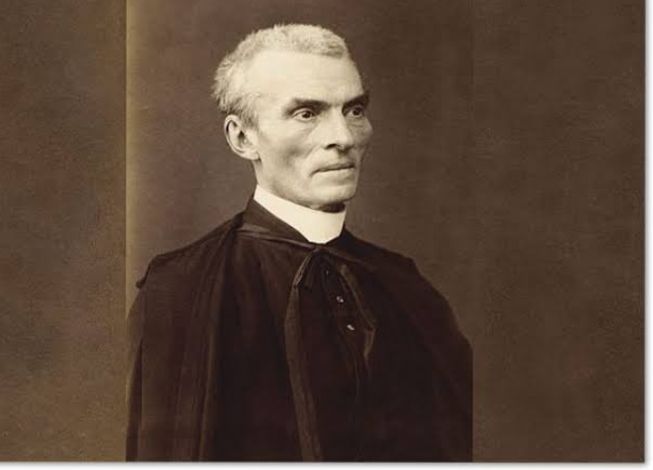
Image Credit: Heralds of the Gospel
Saint Peter Julian Eymard: Feast Day, Life, and Legacy of the Apostle of the Eucharist
Saint Peter Julian Eymard spent his life pulling the Eucharist out of the background of Catholic devotion and placing it at the very center. Born to a blacksmith’s family in the French Alps, he overcame poor health and institutional resistance to found two lasting religious congregations. Pope John Paul II later honoured him with a title that captures his entire mission: the Apostle of the Eucharist.
Saint Peter Julian Eymard’s Feast Day Falls on August 2
The Catholic Church honours Saint Peter Julian Eymard every year on August 2, the day after his death in 1868. Pope Pius XI beatified him in 1926, and Pope John XXIII canonized him in 1962. In 1995, the Church formally inserted his feast into the General Roman Calendar as an optional memorial, cementing his place among recognized saints.
An Early Devotion to Mary and the Eucharist
Eymard was born on February 4, 1811, in La Mure, a town in the French Alps, to a blacksmith and his second wife. Even as a child, he showed deep devotion to the Virgin Mary, once walking on foot to the shrine of Notre-Dame du Laus before his First Communion in 1823. After his mother died in 1828, he resolved to enter religious life, joining the Oblates of Mary Immaculate the following year despite his father’s strong opposition. Poor health interrupted his first attempt at seminary, and he struggled throughout his life with weak lungs and frequent migraines.
Saint Peter Julian Eymard’s Path to the Priesthood
Following his father’s death in 1831, Eymard gained admission to the major seminary of Grenoble with help from a former superior. He was ordained a priest on July 20, 1834, and served first as an assistant pastor before taking charge of the struggling parish of Monteynard. There, he revitalized a poor farming community that had gone without a resident pastor, aided by his two devoted sisters, who moved into the rectory to support him. Despite this success, Eymard felt drawn toward a different calling and joined the Marists in 1837.
A Growing Passion for Eucharistic Adoration
As a Marist, Eymard rose to become Provincial at Lyon in 1844, overseeing lay groups devoted to Mary and encouraging frequent Eucharistic worship. During a visit to Paris in 1849, he encountered members of the Association of Nocturnal Adorers, who maintained perpetual adoration at the Basilica of Our Lady of Victories. That encounter changed the direction of his life. After praying at the shrine of Our Lady of Fourvière in 1851, Eymard resolved to establish a community centered entirely on Eucharistic adoration, a vision his Marist superiors did not share.
Founding the Congregation of the Blessed Sacrament
When his superiors transferred him rather than support his plan, Eymard eventually left the Marists alongside fellow priest Raymond de Cuers. Paris bishops approved his new Society of the Blessed Sacrament in May 1856, and the two priests established public exposition of the Blessed Sacrament in a run-down Paris building the following January. The new congregation prepared children for First Communion and welcomed lapsed Catholics back to the sacraments. Additional communities soon followed in Marseille and Angers, and Pope Pius IX formally approved the congregation in 1863. Notably, the sculptor Auguste Rodin briefly joined the congregation as a lay brother in 1862, and Eymard personally encouraged him to return to his artistic vocation, a decision Rodin later honoured by sculpting Eymard’s bust.
Saint Peter Julian Eymard and the Servants of the Blessed Sacrament
In 1858, Eymard partnered with Marguerite Guillot to found the Servants of the Blessed Sacrament, a contemplative congregation for women devoted to Eucharistic prayer. He famously taught that believers receive Communion in order to grow in holiness, not because they have already achieved it. Throughout his ministry, Eymard remained close friends with several other future saints of his era, including John Vianney, Peter Chanel, and Marcellin Champagnat.
Death and Lasting Recognition
Saint Peter Julian Eymard died from complications of a brain hemorrhage on August 1, 1868, at fifty-seven years old, in his hometown of La Mure. His remains were later moved to the Congregation’s Corpus Christi Chapel in Paris in 1877. Pope Pius XI beatified him in 1926, and Pope John XXIII canonized him in 1962 alongside two other saints. Pope John Paul II later gave him the title “Apostle of the Eucharist,” recognizing how thoroughly his life’s work reshaped Eucharistic devotion within the modern Church.
Why Saint Peter Julian Eymard Still Matters
Saint Peter Julian Eymard remains a major influence on nineteenth-century French spirituality and both congregations he founded continue their Eucharistic mission today. His relics remain venerated in churches across the world, including a reliquary in New York City containing part of his arm bone. Readers exploring nearby August feasts can browse the complete August Saints calendar for more.



Leave a Reply