
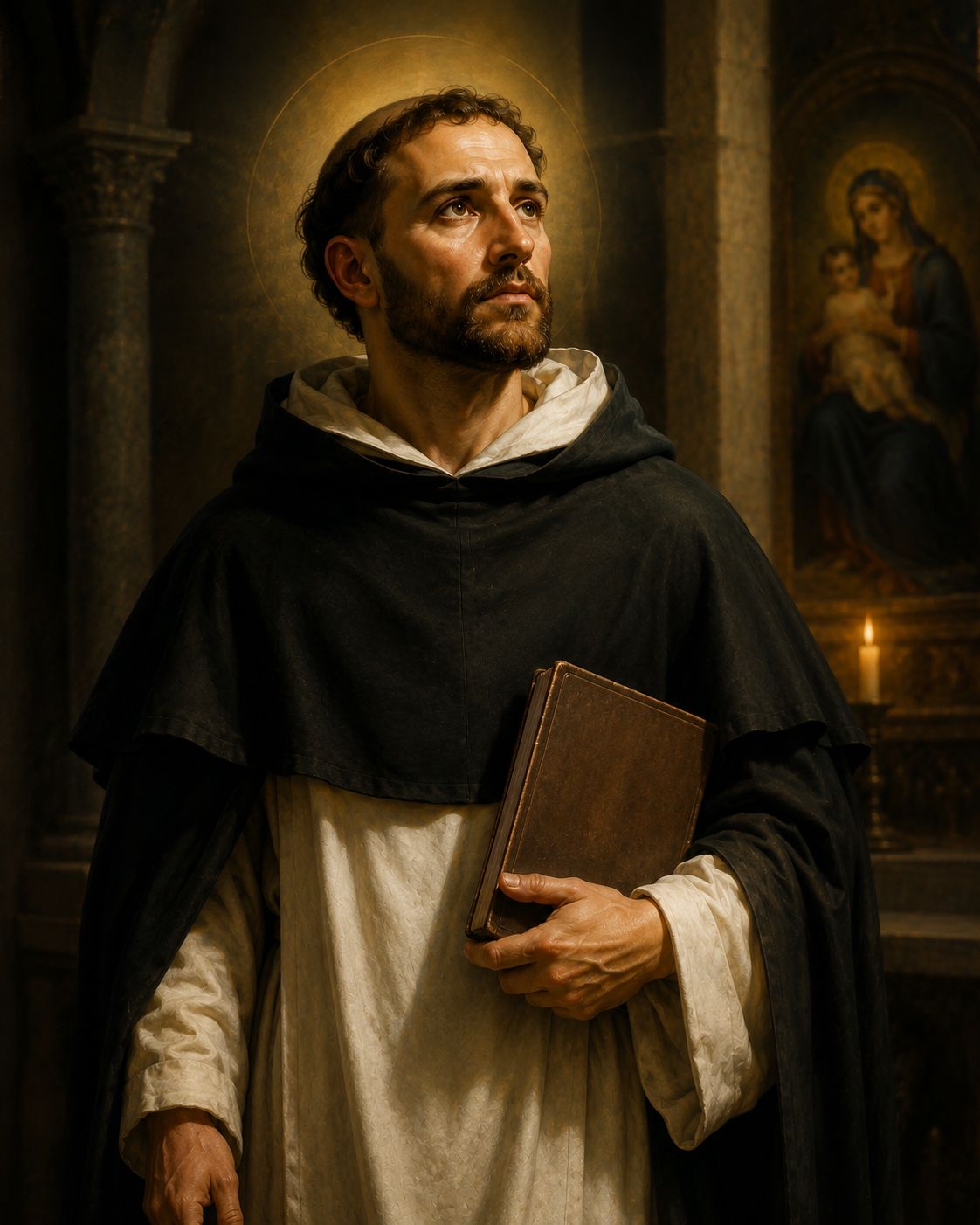
Saint Dominic: Feast Day, Life, and Legacy
Saint Dominic built one of the Church’s most influential religious orders from almost nothing, starting with just six companions in southern France. Born into Spanish nobility, he gave up comfort repeatedly to serve the poor and combat one of medieval Christianity’s most dangerous heresies. His legacy still shapes Catholic preaching, education, and devotion today. Today, we will trace his early life, his mission against heresy, and the founding of the Dominican order.
Saint Dominic’s Feast Day Falls on August 8
The Catholic Church celebrates Saint Dominic every year on August 8. Pope Gregory IX canonized him on July 13, 1234, only thirteen years after his death. Today, the Church honours him as patron of Astronomers, the Dominican Republic and people who have been falsely accused of crimes.
A Noble Birth Wrapped in Legend
Saint Dominic was born in Caleruega, Spain, in 1170, to noble parents connected to the ruling family. His father, Felix Guzman, served as the village’s royal warden, while his mother, Blessed Joan of Aza, was known for her own holiness. According to legend, Joan once dreamed of a dog leaping from her womb carrying a blazing torch, an image believed to have inspired her son’s name, since Dominic echoes the Latin phrase for “the Lord’s dog.” Historians note a simpler explanation may also be true, since he may have simply been named after an earlier Spanish monk, Saint Dominic de Silos.
Saint Dominic’s Education and Radical Generosity
Dominic studied theology and the arts for a decade in Palencia, earning praise from his professors along the way. When famine struck Spain in 1191, he sold his furniture, clothing, and even his required study manuscripts to buy food for the starving. Asked why he would sell such essential books, he reportedly replied that he could not study from dead skins while people died of hunger. On two separate occasions, he even offered to sell himself into slavery to secure freedom for others.
From Osma to the Fight Against Heresy
In 1194, Dominic joined the Canons Regular at Osma, becoming prior of the community by 1201. Two years later, he accompanied his bishop, Diego de Acebo, on a diplomatic trip to Denmark to help arrange a royal marriage, though the plan collapsed after the bride-to-be died. That unexpected freedom led the pair to Rome in 1204, where Pope Innocent III redirected their missionary ambitions toward southern France instead. There, the Albigensian heresy was spreading rapidly, wrongly teaching that the human body itself was inherently evil. Where earlier Cistercian monks had struggled to counter the heresy, Dominic and Diego’s personal austerity resonated deeply with people the movement had misled.
Founding Prouille and Facing the Albigensian Crusade
Recognizing the need for a lasting institution, Dominic established a convent at Prouille in 1206, now regarded as the first Dominican house. When French nobility launched a military crusade against the Albigensians in 1208, following the murder of a papal legate, Dominic consistently pleaded for mercy toward the heretics caught in the violence. Historians still debate two popular legends from this period: that Dominic served as the first Inquisitor, and that he received the Rosary directly from the Virgin Mary in a 1214 vision at Prouille. Neither claim has solid documentation, though the Rosary’s rapid popularity afterward has kept that legend alive.
Establishing the Order of Preachers
Despite being asked at least three times to become a bishop, Dominic refused every offer, preferring his mission over promotion. In July 1215, he received permission to found his own religious order, joined initially by just six followers committed to prayer, penance, and preaching. The order gained formal confirmation on December 22, 1216, and Pope Honorius III officially named the group the “Order of Preachers” in 1217. That summer, Dominic sent seventeen followers out across Europe, a bold decision that helped the order grow rapidly. In 1218, the pope elevated him to “Master of the Sacred Palace,” a title Dominican preachers have held ever since, while also asking him to help reform lax religious communities of women in Rome. After completing that difficult task, Dominic received the Basilica of Santa Sabina, which remains the Dominican order’s headquarters today.
A Life of Deliberate Poverty
Those who knew Saint Dominic described his lifestyle as remarkably meager, since he refused to sleep on a bed and often walked barefoot into towns regardless of the terrain. He carried only a small bundle containing the Gospel of Matthew and the Epistles of Saint Paul, which he read repeatedly during his travels. Between 1220 and 1221, he also helped establish a formal constitution for his order, introducing limited-term elected leadership and a strong commitment to alms-based support.
Death and Lasting Legacy
Saint Dominic fell ill with fever in July 1221 while in Bologna, and he died there on August 6, refusing a bed even in his final days, at just fifty-one years old. His body rested in a humble sarcophagus until 1267, when it moved to a more formal shrine. Today, believers often depict him alongside a dog, lilies, or a book, always bearing his distinctive tonsure. For more on his order’s history, the Dominican Order’s official site offers further reading, and readers exploring other August feasts can browse the full August Saints calendar.
Leave a Reply