
Saint Robert Bellarmine: Life, Feast Day and Legacy of the Doctor of the Church
The Catholic Church honours Saint Robert Bellarmine every year on the seventeenth of September, marking the day of his death in 1621. Interestingly, he was born on October 4, 1542, which happens to be the feast day of Saint Francis of Assisi. Consequently, this small coincidence carries added meaning, since Bellarmine held a lifelong devotion toward that beloved saint. Furthermore, he died on the anniversary of Francis receiving the stigmata, a detail many biographers consider deeply fitting. Therefore, his story blends scholarly brilliance with genuine humility throughout its entire span.
Robert Bellarmine was born in Montepulciano, Tuscany, into a noble yet financially struggling family. His father, Vincenzo Bellarmino, hoped his intelligent son might pursue medicine or a political career instead. However, his mother, Cinzia Cervini, related to Pope Marcellus II, encouraged him strongly toward religious life. Consequently, young Robert entered the Jesuit novitiate in Rome in the Year 1560, despite his father’s earlier reservations. Although his health remained fragile throughout much of his youth, his intellectual gifts became obvious almost immediately. He studied successively in Florence, Mondovì, Padua and finally Leuven, where he was eventually ordained a priest.
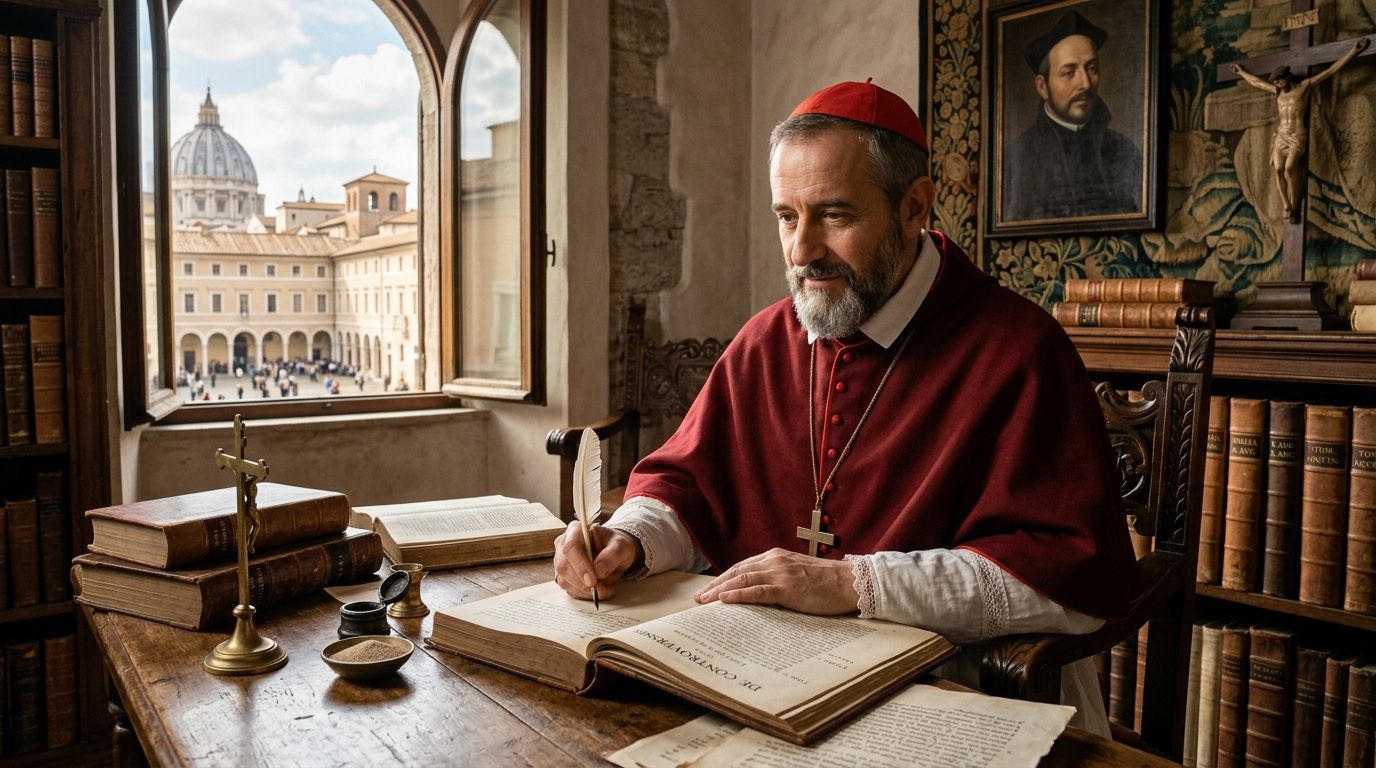
While teaching in Leuven, Bellarmine gained considerable fame for his eloquent Latin sermons and rigorous theological teaching. In 1576, Pope Gregory XIII invited him back to Rome, appointing him to teach polemical theology at the newly founded Roman College. There, his systematic lectures evolved into a monumental three-volume work titled De Controversiis. This influential text addressed seventeen major controversies arising from the Protestant Reformation, covering scripture, the sacraments, grace and papal authority. Consequently, it quickly became the standard reference for defending Catholic doctrine across the whole of Europe.
Bellarmine’s rising influence soon carried him into weightier ecclesiastical responsibilities. In 1595, he became Jesuit Provincial of Naples, before Pope Clement VIII elevated him to cardinal in 1599. Despite this prestigious new rank, he continued living simply, earning the affectionate nickname “the Jesuit clad in red.” He later served the Congregation of the Index and the Holy Office, while also authoring a widely used catechism for ordinary believers. In 1602, he became Archbishop of Capua, where he ministered attentively until 1605. That same year, cardinals seriously considered him during the papal conclave, though Paul V was ultimately elected instead.
Perhaps most famously, Bellarmine became closely connected with the controversy surrounding Galileo Galilei, whom he counted as a personal friend. As a leading Vatican theologian, he communicated the Church’s official caution regarding heliocentric theory in the Year 1616. Nevertheless, historians generally credit him with handling this delicate situation with notable restraint and fairness. Meanwhile, he also served as prefect of the Vatican Library, further cementing his intellectual reputation across Rome. During his final years, he turned toward writing devotional works, including treatises titled “The Ascent of the Mind to God” and “The Art of Dying Well.”
Robert Bellarmine died in Rome on the 17th of September 1621, reportedly reciting the Creed as he passed. His remains now rest within the Church of Sant’Ignazio, alongside those of Saint Aloysius Gonzaga. Although his canonisation process began shortly after his death, political tensions delayed it for several centuries. Eventually, Pope Pius XI beatified him in 1923, before canonising him fully in 1930. The following year, the Church formally declared him a Doctor of the Church, joining an elite group of just thirty-seven theologians. Today, believers regard Saint Robert Bellarmine as patron of catechists and canon lawyers, reflecting his lifelong dedication toward teaching the faith clearly.
His enduring legacy stretches well beyond academic theology into the everyday life of ordinary believers. Indeed, his simplified catechisms shaped religious education for countless generations of children across Europe. Furthermore, his balanced, careful writing style offered a genuine model for engaging respectfully with theological disagreement. Rather than resorting to harsh polemics, Bellarmine consistently listened carefully to opposing arguments before responding thoughtfully. This approach earned him widespread respect, even among those who ultimately disagreed with his conclusions. Consequently, his example remains particularly relevant today, especially within increasingly polarised religious and political discussions.
Numerous parishes, schools and institutions worldwide now bear his name, spanning countries from the United States to India. This widespread devotion demonstrates just how deeply his influence has embedded itself within global Catholic identity. Ultimately, Saint Robert Bellarmine’s life illustrates how genuine scholarship and humble holiness can coexist meaningfully within one remarkable person.




Leave a Reply