
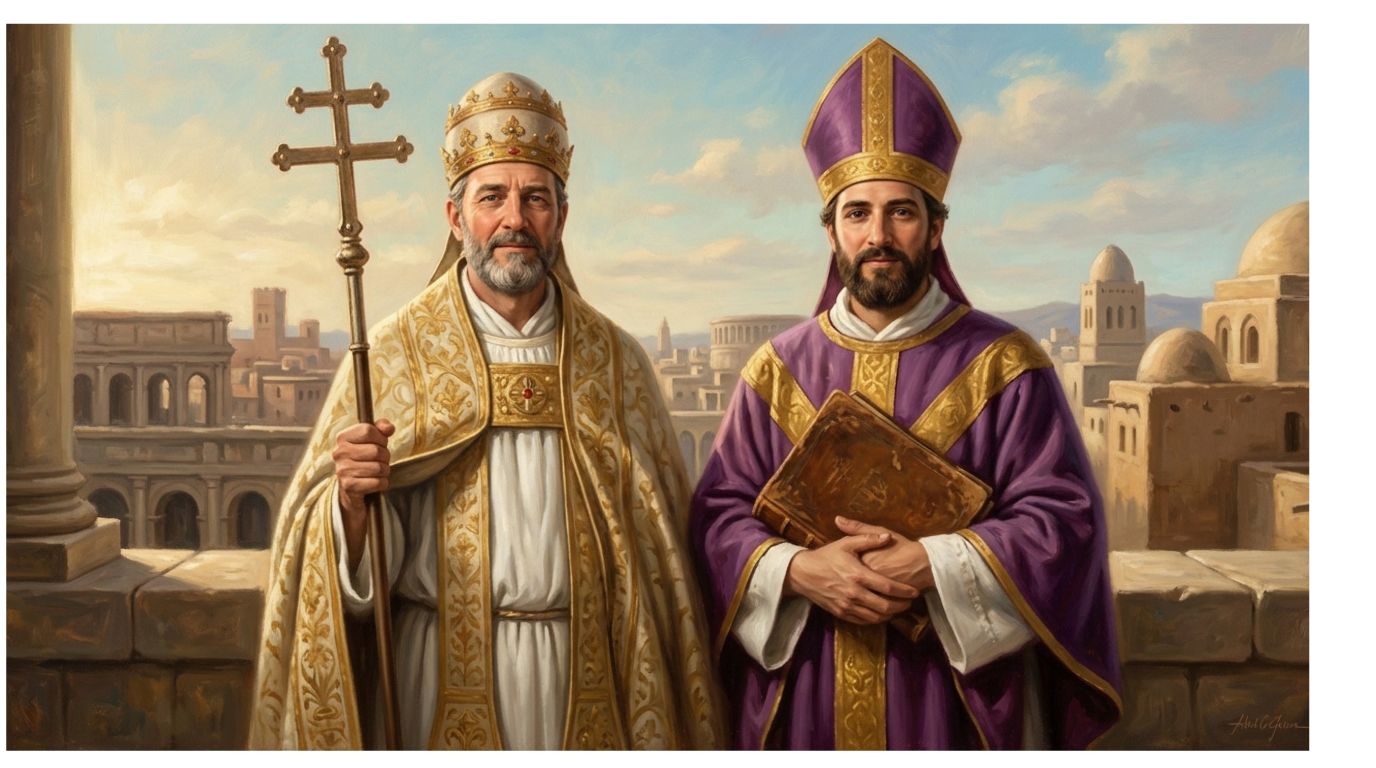
Saints Cornelius and Cyprian: A Joint Feast Celebrated on September 16
The Catholic Church honours Saints Cornelius and Cyprian together every year on September 16. This shared feast day reflects the extraordinary friendship these two men built during one of Christianity’s most turbulent centuries. Consequently, the Church remembers them jointly within the Roman Canon, naming them side by side during every Mass that uses this ancient prayer. Their bond, forged through crisis and persecution, still offers a powerful example of unity between distant Christian communities. Therefore, understanding their story requires stepping back into the chaos of third-century Rome and Carthage.
Cornelius, likely born into Rome’s noble Cornelii family, became the twenty-first pope in 251. Notably, this election followed an unusually long vacancy, since persecution under Emperor Decius made accepting the papacy an almost certain death sentence. Understandably, few clergy volunteered for such a dangerous role during that period. Once elected, however, Cornelius immediately faced fierce opposition from Novatian, an influential Roman priest who had expected the position himself. Novatian argued that Christians who had renounced their faith under persecution, known as the lapsi, could never receive forgiveness. Cornelius disagreed firmly, insisting instead that genuine repentance and proper penance should reopen the path to reconciliation.
This disagreement quickly escalated into a serious schism within the early Church. Novatian declared himself a rival pope, becoming what historians now call the first recorded antipope. Fortunately, Cornelius convened a synod of bishops, who confirmed his legitimate authority and firmly rejected Novatian’s harsh position. Throughout this difficult period, Cyprian of Carthage stood firmly beside Cornelius, lending crucial support from across the Mediterranean. Their extensive correspondence, much of which survives today, reveals a genuinely warm friendship between two distant church leaders. Sadly, Roman authorities exiled Cornelius to Centumcellae, modern Civitavecchia, in 252. He died there in 253 and his body was later transferred back to Rome, where it now rests within the Catacombs of Saint Callixtus.
Meanwhile, Cyprian’s own path toward sainthood began quite differently. Born around the year 210 into a wealthy pagan family in Carthage, he trained extensively as a skilled rhetorician and lawyer. Remarkably, he did not convert to Christianity until 246, relatively late compared with many other prominent Church Fathers. Nevertheless, his transformation proved swift and total, since he was ordained a priest within a year and consecrated bishop shortly afterwards. As Bishop of Carthage, Cyprian faced the very same lapsi controversy that troubled Cornelius in Rome. During the Decian persecution, he chose to hide rather than seek immediate martyrdom, guiding his congregation covertly through numerous pastoral letters instead. Although critics accused him of cowardice, Cyprian defended his decision as wise, practical shepherding rather than fearful avoidance.
Cyprian’s writings left a lasting mark on Christian theology, particularly his influential treatise titled “The Unity of the Catholic Church.” Within this work, he argued passionately that true unity depends entirely upon the authority of bishops working together. Furthermore, alongside Tertullian, Cyprian helped shape the very foundations of Christian Latin literature. His pastoral letters remain valuable historical sources, offering modern scholars genuine insight into third-century worship and Church discipline. Eventually, persecution returned under Emperor Valerian in 258 and this time, Cyprian chose to accept martyrdom openly. According to tradition, he even gave his executioner twenty-five gold coins before dying bravely in front of his own gathered flock.
Both saints share a lasting connection through the Church’s most ancient Eucharistic Prayer, recited during Mass across the world today. Their names appear together within this prayer, commemorating their shared commitment to unity, mercy and courageous leadership. Beyond this liturgical connection, each saint also received his own particular patronage over the centuries. Believers invoke Cornelius against ear-ache, epilepsy and fever, while farmers historically sought his protection over cattle and livestock. Cyprian, meanwhile, became patron of Algeria and North Africa, honouring his decades of ministry across that region. These patronages, though seemingly unrelated, demonstrate how devotion to these saints spread widely and adapted across different cultures.
Ultimately, the story of Cornelius and Cyprian offers something genuinely relevant for believers navigating conflict and division today. Rather than choosing rigid harshness or reckless disregard for discipline, both men pursued a balanced path rooted in mercy. Their friendship, sustained through letters across considerable distance, also demonstrates how genuine unity can transcend geography entirely. Therefore, modern Christians facing disagreement within their own communities might find real encouragement in this ancient partnership. For readers wishing to explore further Church history, additional details remain available through the Vatican’s official archives, alongside earlier articles published on this website concerning other martyred saints and their feast days.



Leave a Reply