
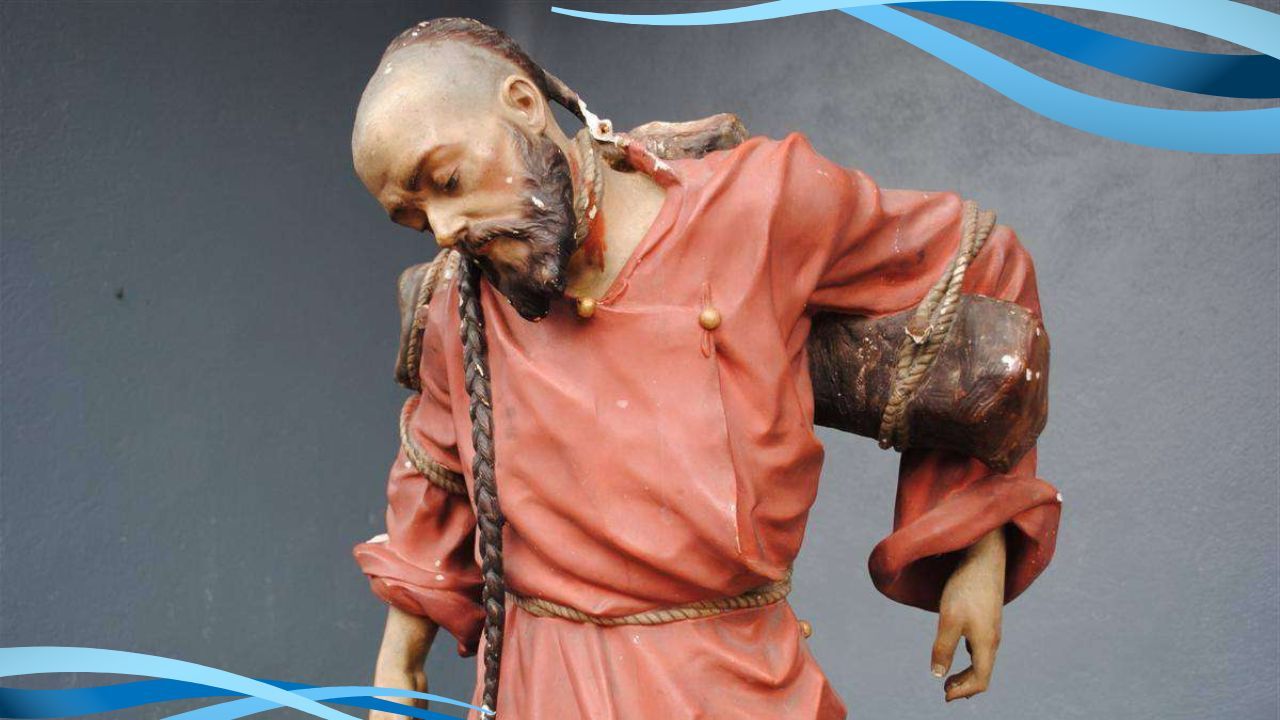
Image Credit: Portrait of Saint John Gabriel Perboyre, Congregation of the Mission archives, public domain (replace with your preferred licensed image before publishing)
Saint John Gabriel Perboyre’s Feast Day and Early Vocation
The Church remembers Saint John Gabriel Perboyre every year on September 11. He was born on January 6, 1802, in Montgesty, a small town near Cahors in southern France. Remarkably, his family produced three Vincentian missionaries and two Daughters of Charity, so faith shaped his upbringing entirely. Interestingly, his path to priesthood began almost by accident. When his younger brother Louis entered seminary, John Gabriel simply accompanied him to help him settle in. However, that short visit revealed an unexpected calling. Consequently, he decided to remain and pursue the priesthood himself.
At the time, France was still recovering from the upheaval of the Revolution. Churches lay damaged and many communities lacked proper spiritual guidance. Therefore, priesthood appeared to Perboyre not as a modest career, but as a genuine calling towards heroism. His parents, though surprised, supported his decision wholeheartedly. Moreover, his uncle’s own missionary background likely reinforced this growing sense of vocation. In 1818, he joined the Congregation of the Mission, founded by Saint Vincent de Paul to serve the poor and train future clergy.
Between 1818 and 1835, Perboyre worked as a missionary within his native France. First, he trained as a novice, then studied diligently before his ordination in 1826. Afterwards, he took responsibility for forming young seminarians himself. Everything changed, however, when tragedy struck his brother Louis, who died at just twenty-four while travelling to serve in China. Moved by grief and conviction, John Gabriel volunteered to take his brother’s place.
He arrived in China in August 1835, entering a world still largely misunderstood by Europeans. After settling in Macau, he journeyed for eight months by boat, foot and horseback to reach Henan province. Quickly, he mastered enough Chinese to begin ministering to local Christian communities. Later, he transferred to Hubei, where intense spiritual struggle accompanied his tireless pastoral work. In one letter, he admitted feeling far from extraordinary, asking instead for personal conversion and humility.
By 1839, growing persecution and the outbreak of the Opium War created a dangerous climate for missionaries. On September 15, that year, soldiers captured Perboyre after a frightened catechumen revealed his hiding place. Thus began a gruelling series of trials across several Chinese cities. During interrogation, he endured beatings, suspension by his thumbs and repeated demands to renounce his faith. Nevertheless, he refused every time, famously declaring he would rather die than deny Christ.
Disturbingly, his accusers even fabricated claims involving a Chinese woman named Anna Kao. Calmly, Perboyre defended her honour, insisting Christianity respected women rather than exploiting them. During one particularly striking moment, he was forced to wear Mass vestments meant to mock his priesthood. Instead, witnesses were so moved that two Christians present asked for absolution on the spot. Eventually, the Viceroy sentenced him to death by strangulation.
On September 11, 1840, Perboyre was led to a hill known as the Red Mountain alongside seven condemned criminals. There, executioners tied him to a post shaped like a cross before strangling him. Many observers later noted striking parallels between his death and Christ’s own Passion. His body eventually returned to France, though tradition holds that his heart remained in China.
Pope Leo XIII beatified him on Novembern10, 1889, recognising decades of quiet devotion following his death. Later, Pope John Paul II canonised him on June 2, 1996, cementing his place among the Church’s recognised martyrs. Today, Saint John Gabriel Perboyre stands as a powerful symbol of missionary courage and unwavering faith. His witness continues inspiring Vincentian communities and Catholics worldwide who serve amid hardship and persecution.
For further verification, consult Vatican News and Catholic Online.



Leave a Reply