
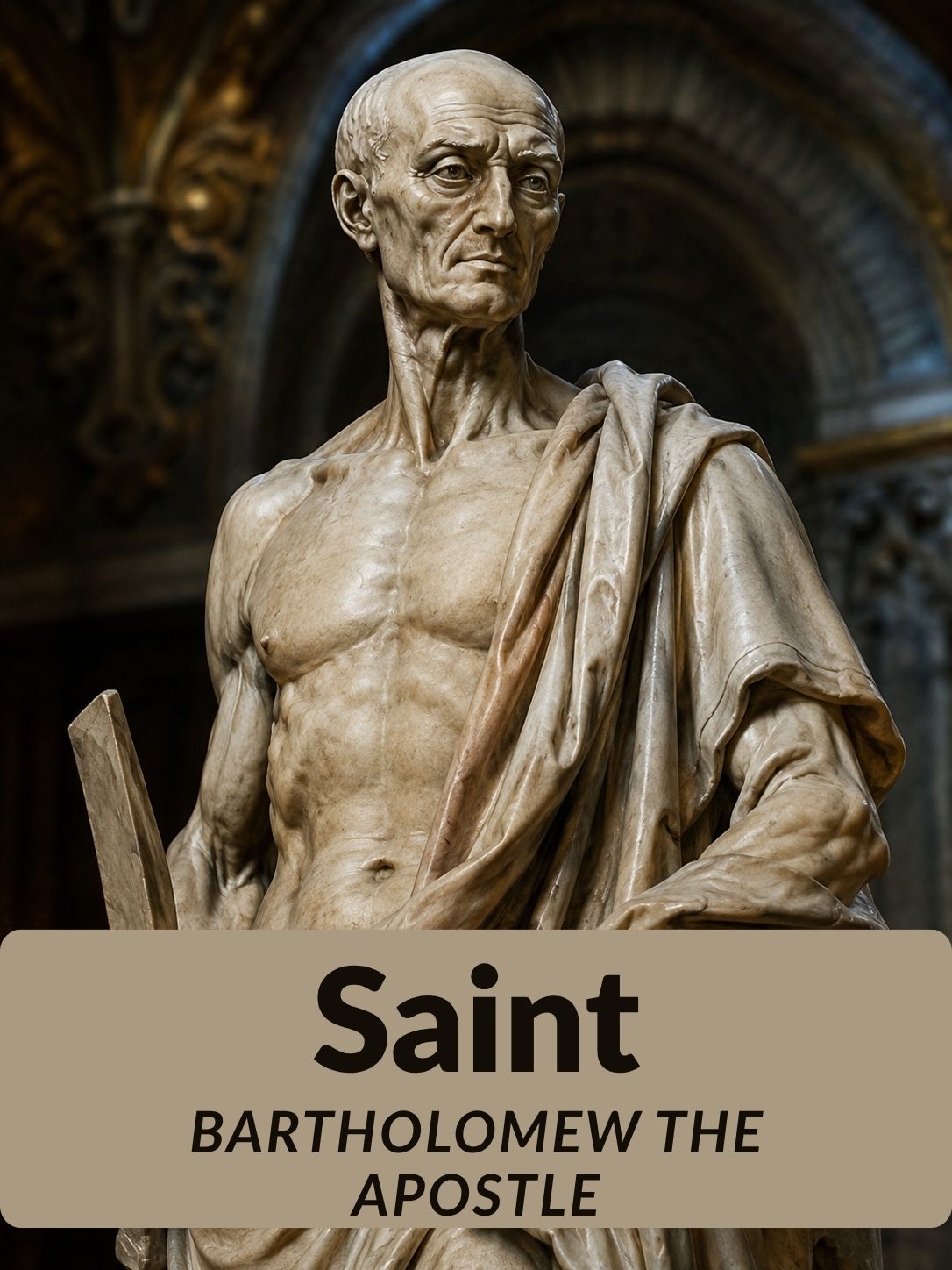
The Twelve’s Most Mysterious Missionary
Saint Bartholomew the Apostle remains one of the most intriguing figures among Jesus’s original twelve followers. Scripture says remarkably little about him directly, yet tradition fills the gaps with dramatic tales of distant missions and a gruesome death. His story blends historical fact with centuries of devoted legend, making him one of Christianity’s most fascinating apostles.
Saint Bartholomew’s Feast Day Falls on 24 August
The Roman Catholic Church celebrates Saint Bartholomew’s feast day on 24 August every year. Anglican churches mark the same date with their own festival, while Eastern Orthodox Christians honour him separately on 11 June and again on 25 August. The Coptic Orthodox Church commemorates his martyrdom on the first day of the Coptic calendar, which currently falls near 11 September. Clearly, devotion to this apostle spans nearly every branch of Christianity.
Who Was Saint Bartholomew in the New Testament?
The three Synoptic Gospels and the Acts of the Apostles all list Bartholomew among the Twelve Apostles. His name actually functions as a patronymic, meaning “son of Tolmai” in Aramaic. Because of this, most scholars today believe Bartholomew was actually Nathanael, the man described in John’s Gospel. Jesus famously called Nathanael an “Israelite… incapable of deceit,” a rare compliment that hints at Bartholomew’s honest character.
Beyond these brief mentions, the New Testament offers almost nothing else about him personally. This scarcity of detail encouraged centuries of storytelling, much of which later shaped how Christians remember him today.
Missionary Journeys Across Three Continents
Tradition sends Saint Bartholomew on an impressively long journey. Early Church historian Eusebius of Caesarea claimed the apostle travelled to India, leaving behind a copy of Matthew’s Gospel. Other traditions place him in Mesopotamia, Parthia, Lycaonia and Ethiopia. Scholars have long debated these claims, since ancient writers sometimes confused India with Arabia or Ethiopia when describing distant missions.
Alongside the apostle Jude Thaddeus, Bartholomew reportedly brought Christianity to Armenia during the first century. This mission proved historically significant, since Armenia became the first nation to adopt Christianity officially in 301. Consequently, both apostles now serve as patron saints of the Armenian Apostolic Church and tradition even names Bartholomew its second Catholicos-Patriarch.
The Brutal Martyrdom of St Bartholomew
Christian tradition describes several versions of Bartholomew’s death, though most agree he died violently in Armenia. According to the most common account, he converted King Polymius to Christianity, which enraged the king’s brother, Prince Astyages. Fearing political backlash, Astyages ordered Bartholomew flayed alive and then beheaded.
Historians note that no Armenian king named Polymius appears in official records, so some scholars question this story’s accuracy. Other versions name the king as Agrippa or Sanatruk instead. Regardless of these discrepancies, his flaying became the defining image associated with St Bartholomew across centuries of Christian art.
Relics and Enduring Veneration
According to sixth-century writer Theodorus Lector, Emperor Anastasius I sent Bartholomew’s body to Daras in Mesopotamia around 507. Later legends claimed his relics miraculously washed ashore on the Italian island of Lipari. From there, church officials transferred a significant portion of his remains to Benevento in 838, where they still rest today. In 983, Emperor Otto II gave additional relics to Rome, where they remain enshrined at San Bartolomeo all’Isola.
This particular Roman church stands on the former site of an ancient medical temple, and this connection eventually linked Bartholomew’s name with hospitals and healing.
Patronage and Artistic Legacy
Because of his gruesome martyrdom, St Bartholomew became patron saint4 of tanners, leatherworkers, bookbinders, butchers and several other trades connected with skin and hide. Renaissance and Baroque artists frequently depicted him holding his own flayed skin, most famously in Michelangelo’s Last Judgement inside the Sistine Chapel. Painters such as Jusepe de Ribera and sculptors like Marco d’Agrate also created striking, anatomically detailed works based on his story.
His legacy even extended into English culture through the historic Bartholomew Fair, held annually in London from medieval times. Playwright Ben Jonson later immortalised this fair in his 1614 comedy of the same name.
Why St Bartholomew Still Inspires Believers
St Bartholomew’s blend of scriptural mystery and vivid tradition continues fascinating historians and believers alike. His willingness to travel vast distances and face brutal persecution reflects the apostolic courage that shaped early Christianity’s spread. For readers wanting to explore more apostolic feast days, our Catholic Saints archive offers further reading.
Every 24 August, Christians worldwide pause to remember an apostle whose faith carried him to the ends of the known world.

Leave a Reply