
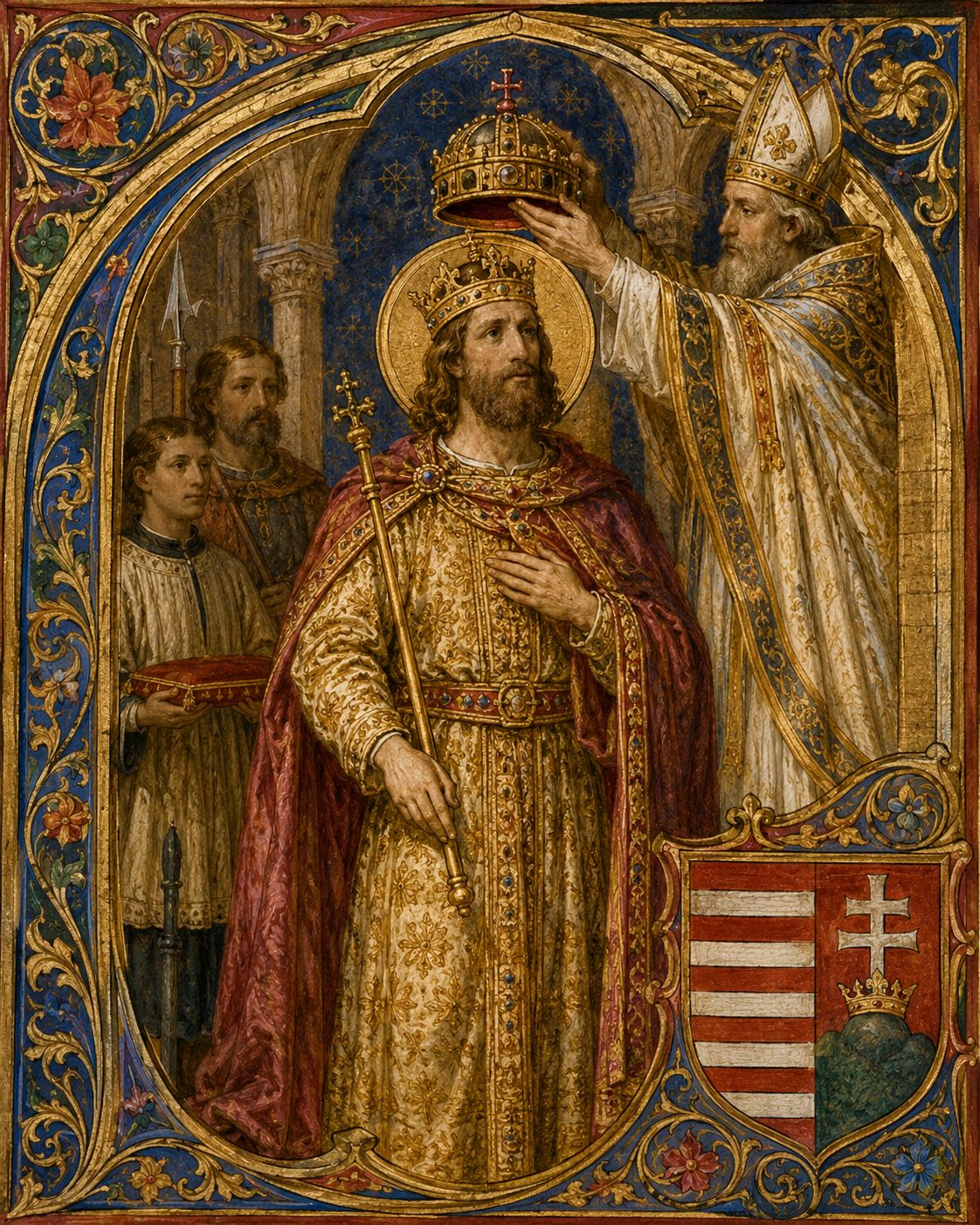
Saint Stephen of Hungary transformed a loose confederation of pagan tribes into a lasting Christian kingdom and his achievement still shapes national identity centuries later. Born under a pagan name, he rose through conflict and diplomacy to become the first crowned King of Hungary. His reign combined military conquest, Church building and careful statesmanship in equal measure. This piece traces his rise to power, his reforms and the sainthood that followed his death.
Saint Stephen of Hungary’s Feast Day Falls on 16 August
The Catholic Church honours Saint Stephen of Hungary on 16 August across the wider Church calendar, marking the day immediately following his death in 1038. Hungary itself, however, celebrates his feast on 20 August, commemorating the day his relics were translated and this date doubles as State Foundation Day nationally. Pope Innocent XI originally extended his cult to the whole Church in 1686, setting his feast for 2 September before the 1969 calendar reform moved it closer to his actual death date.
From Pagan Prince to Christian Ruler
Stephen was born around 975 in Esztergom, given the pagan name Vajk, the son of Grand Prince Géza and his wife Sarolt. Around 995, he married Gisela of Bavaria, establishing Hungary’s first royal connection to a major Western European dynasty. When Géza died in 997, Stephen succeeded him as grand prince, though tradition favoured his older relative Koppány instead. Stephen defeated Koppány decisively in battle with support from German knights and native lords, securing his hold over the throne through considerable bloodshed.
Saint Stephen of Hungary’s Coronation and Reforms
On either Christmas Day in the year 1000 or New Year’s Day in 1001, Stephen received a crown sent by Pope Sylvester II, formally becoming Hungary’s first king. He quickly established an archbishopric at Esztergom, along with several additional bishoprics and Benedictine monasteries, ensuring the Hungarian Church developed independently from the Holy Roman Empire. Stephen also organised his kingdom into counties governed by royal officials, creating an administrative framework that endured for centuries. His legal code enforced Christian practice directly, prescribing penalties for those who neglected confession or ignored feast days.
Military Campaigns and Consolidation
Stephen spent much of his reign unifying the Carpathian Basin through a series of difficult military campaigns. He captured his own uncle, Gyula the Younger, forcibly converting his territory to Christianity and he later crushed the so-called Black Hungarians after their pagan rebellion. Hungary fought wars against Poland and Bulgaria during the 1010s, while maintaining generally peaceful relations with the Holy Roman Empire through his brother-in-law, Emperor Henry II. When Emperor Conrad II invaded in 1030, Stephen’s forces used scorched-earth tactics to repel the attack entirely, later securing favourable peace terms the following year.
Personal Tragedy and Succession Crisis
Stephen outlived every one of his children and the 1031 hunting accident that killed his only surviving son, Emeric, devastated him profoundly. Because his cousin Vazul was suspected of favouring paganism, Stephen instead nominated his Venetian nephew, Peter Orseolo, as heir, a decision that led to Vazul’s blinding and years of civil war following Stephen’s death. Stephen died on 15 August 1038 and was buried in his newly built Basilica at Székesfehérvár, dedicated to the Virgin Mary.
Canonization and the Holy Dexter
Pope Gregory VII canonised Stephen in 1083, alongside his son Emeric and Bishop Gerard of Csanád, following reported healing miracles at his opened tomb. Remarkably, Stephen’s right hand remained perfectly preserved after his death, and this relic, known as the Holy Dexter, still receives veneration today at St. Stephen’s Basilica in Budapest. Stephen also left behind a book of moral guidance for his son, known as the Admonitions, which insisted that a Christian king must protect and support the Church above all else.
A Legacy That Still Defines a Nation
Saint Stephen of Hungary remains one of history’s most significant “confessor kings,” canonised not through martyrdom but through decades of faithful governance. His memory has inspired everything from medieval chronicles to Beethoven’s King Stephen Overture, composed for Pest’s theatre inauguration in 1812. Today, the Church honours him as patron of Hungary, stonemasons, and children suffering from serious illness. Readers exploring nearby August feasts can browse the complete August Saints calendar for more.


Leave a Reply