
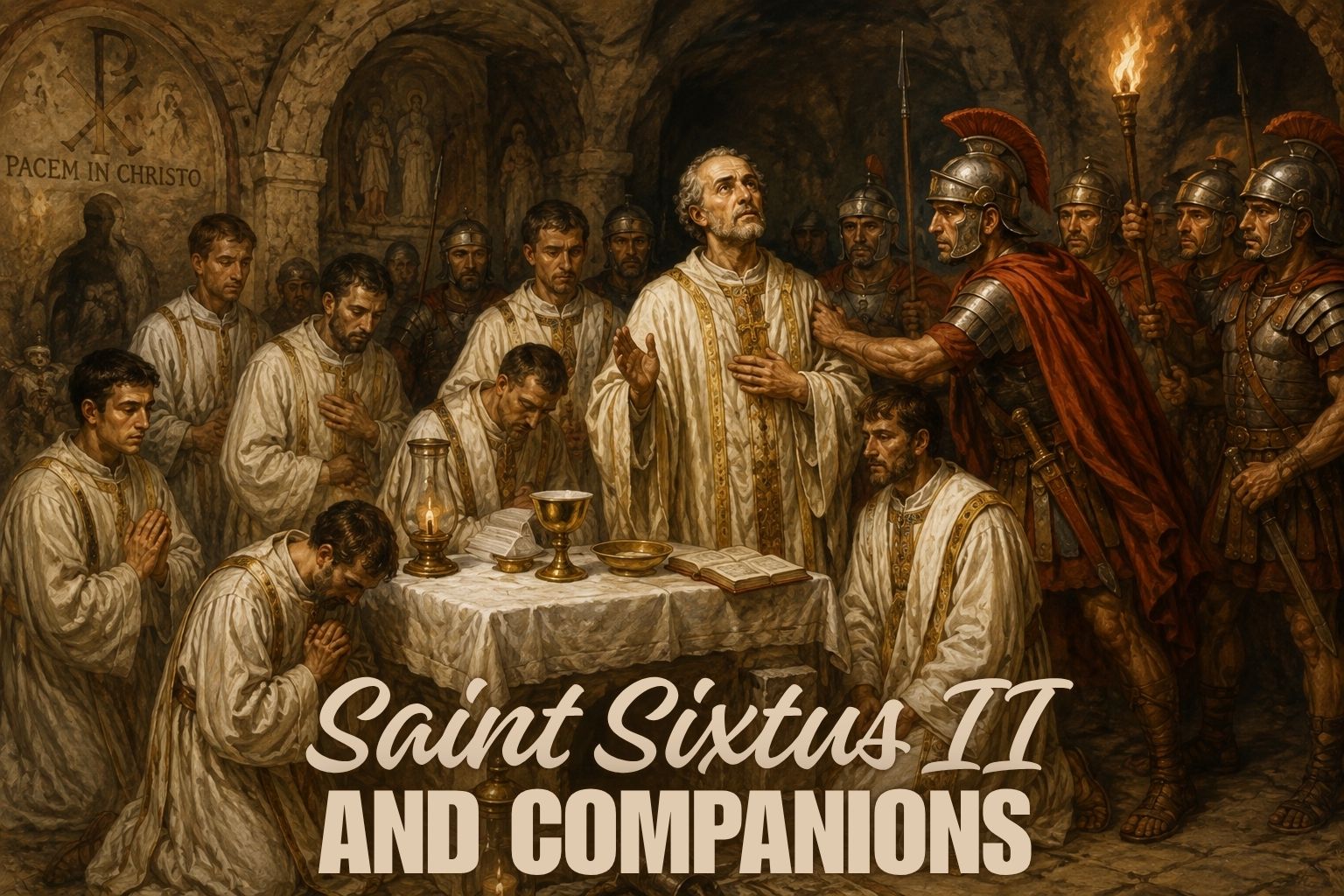
Saint Sixtus II and Companions represent one of the most dramatic group martyrdoms of the early Church, cut down together while celebrating Mass underground. Their deaths marked a turning point during one of Rome’s harshest anti-Christian persecutions. Because their story unfolds across a single violent night, it captures both the danger early Christians faced and the courage that carried them through it.
Saint Sixtus II and Companions Are Honored Every August 7
The Catholic Church celebrates the feast of Saint Sixtus II and Companions every year on August 7. Their actual martyrdom occurred one day earlier, on August 6, 258, during the reign of Emperor Valerian. Because Sixtus is also formally named in the Roman Canon of the Mass, his memory has remained part of Catholic worship continuously since the early centuries of the Church.
A Greek Pope in a Dangerous Era
Sixtus II was born in Greece and elected pope on August 31, 257, succeeding Pope Stephen I. He quickly earned a reputation for pastoral gentleness during an already tense period for Roman Christians. Emperor Valerian had initially tolerated Christian communities, but his policy shifted sharply within a year of Sixtus’ election. Valerian issued a harsh new decree ordering that bishops, priests, and deacons be executed immediately, without any trial, while also banning Christian gatherings at cemeteries altogether.
Arrested While Celebrating Mass
Despite the danger, Sixtus continued gathering the faithful in secret, often celebrating the Eucharist within Rome’s catacombs. On August 6, 258, Roman soldiers discovered him presiding over Mass in the cemetery of Callistus, likely drawn by the sound of prayer echoing through the underground passages. According to a later epitaph written by Pope Damasus, Sixtus offered himself first to the soldiers rather than allow harm to come to his congregation. Soldiers seized him along with six deacons who stood beside him: Januarius, Vincentius, Magnus, Stephanus, Felicissimus, and Agapitus.
Saint Sixtus II and Companions Face Execution Together
Roman authorities executed all seven men that same day, giving the feast its title honoring Sixtus and his companions. The faithful buried Sixtus afterward in the Crypt of the Popes within the Catacombs of Callixtus, and they laid the six deacons to rest nearby in the Catacombs of Praetextatus. Roman officials temporarily spared Lawrence, a seventh deacon present that night, since they believed he could lead them to the Church’s financial resources. According to tradition, Sixtus had already predicted that Lawrence would follow him in martyrdom within days. Roman authorities fulfilled this prophecy when they executed Lawrence on August 10, just four days later.
A Name Preserved in the Church’s Central Prayer
The Church added Sixtus’s name to the Roman Canon before the seventh century ended. The Roman Canon is the Church’s oldest Eucharistic Prayer. Priests still recite his name there alongside other early sainted popes today. Pope Damasus I honored his tomb with a written epitaph a century after his death. This epitaph praised Sixtus’s courage before the soldiers who came for him. This lasting inclusion in the Church’s central liturgical prayer offers rare and compelling evidence. It shows how deeply his martyrdom shaped early Christian memory.
The Wider Persecution Under Valerian
Sixtus’s death came during a broader wave of violence targeting Christian leadership specifically. Valerian’s edict aimed to dismantle the Church by eliminating bishops, priests, and deacons before ordinary believers. Roman authorities killed more than a dozen popes in the third century, and Sixtus was among them. Saint Cyprian, his North African contemporary, reportedly learned of the martyrdom before facing his own execution.
Why Their Story Still Resonates
Saint Sixtus II and Companions remind believers that faithful leadership sometimes demands the highest possible cost. Their willingness to continue gathering in prayer despite direct threats to their lives has inspired Christians for over seventeen centuries. For more on the broader persecution under Valerian, Britannica’s overview of Emperor Valerian offers helpful historical context. Readers exploring nearby August feasts can browse the complete August Saints calendar for more, including the story of Saint Lawrence, whose own martyrdom followed just days later.




Leave a Reply