
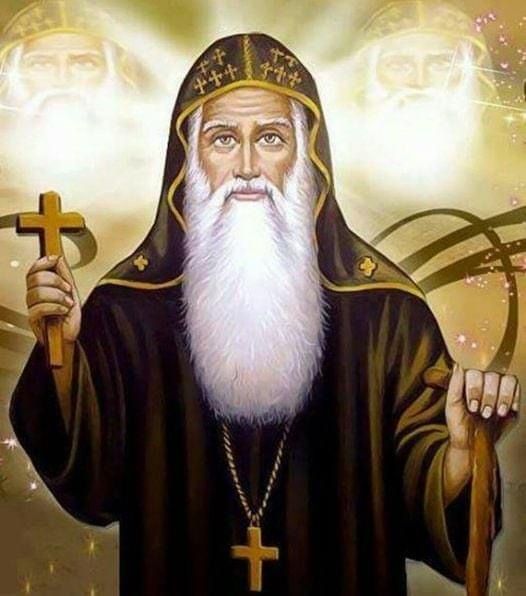
Saint Pachomius the Great: Father of Communal Monasticism
Feast Day: May 9
Lived: c. 292–346
Patronage: Spiritual fathers, abbots, monks, nuns, cooperative work, Egypt
Early Life and Conversion
Pachomius was born around the year 292 in the Upper Egyptian village of Esna, near Thebes, to pagan parents. Little is known of his childhood except that he was not raised in the Christian faith. His early life took a decisive turn when he was conscripted into the Roman army at the age of twenty, around 312, during the reign of Emperor Constantine. At that time, Egypt was still recovering from the Great Persecution under Diocletian, and the military needed soldiers for campaigns along the Nile and the southern frontier.
The experience that changed Pachomius forever occurred during his military service. While stationed in Thebes, he and his fellow conscripts were treated with unexpected kindness by local Christians who brought them food, drink, and comfort. Pachomius was astonished by this charity. He had never encountered such selfless love from strangers, and he asked who these people were. When told they were Christians, he resolved that if he ever escaped the army, he would serve God in the same manner. This encounter planted the seed of his conversion.
His release from military service came soon after, possibly through an amnesty or the completion of his term. Rather than returning to secular life, Pachomius sought out a hermit named Palamon, who lived near his native village. Palamon was an anchorite, one of the solitary desert monks who had begun to populate the Egyptian wilderness in the late third century. Under Palamon’s guidance, Pachomius learned the austere practices of desert asceticism: fasting, manual labour, night vigils, and constant prayer. He remained with Palamon for seven years, proving his vocation through rigorous discipline and obedience.
The Vision of Communal Life
Around the year 320, Pachomius experienced a vision that altered the course of Christian spirituality. An angel appeared to him and commanded him to establish a monastery where monks would live together in community rather than in isolation. The angel gave him a specific rule of life: the monks were to eat together, work together, pray together, and hold all things in common. This was not merely an organizational innovation. It was a spiritual insight that communal living could be a more perfect form of asceticism than solitude, because it required the monk to die to self not only through fasting and prayer but through patience, charity, and submission to others.
Pachomius obeyed immediately. He founded the first monastery on the east bank of the Nile at a place called Tabenna, near modern-day Nag Hammadi. The initial community was small—perhaps a dozen monks—but it grew rapidly. Pachomius organized the monastery with a clarity that had never been seen before. He assigned each monk to a house of twenty to forty brothers, under a housemaster. Several houses formed a monastery, under an abbot. Multiple monasteries eventually formed a federation, all following the same rule.
The Pachomian system was revolutionary. Unlike the solitary hermits who wandered the desert or lived in scattered cells, Pachomius’s monks lived in ordered compounds with walls, gates, and designated spaces for prayer, work, meals, and sleep. They wore a common habit. They ate a common diet, adjusted according to fasting seasons. They performed manual labour—weaving baskets, making mats, cultivating gardens—not only for subsistence but as a form of prayer. Pachomius insisted that work was as holy as contemplation, a teaching that would influence Christian spirituality for centuries.
The Rule of Saint Pachomius
Pachomius composed the first written monastic rule in Christian history. Earlier hermits had lived by oral tradition and personal example. Pachomius codified his vision into a document that governed every aspect of monastic life: the hours of prayer, the discipline of fasting, the procedures for admitting novices, the governance of the abbot, the care of the sick, the reception of guests, and the handling of disputes.
The rule was strict but not harsh. Novices underwent a three-year probation before full admission, during which their patience and obedience were tested. Once admitted, monks took vows of poverty, chastity, and obedience. They were forbidden to possess private property, even a spare tunic. They were required to confess their thoughts to their superiors, an early form of spiritual direction that emphasized interior transparency.
Yet Pachomius also built mercy into the system. The rule provided for infirmaries where sick monks could rest and receive better food. It allowed for variations in fasting according to age and health. It instructed abbots to govern with love rather than fear, modeling themselves on Christ the Good Shepherd. Pachomius himself was known for his gentleness. When monks failed, he wept for them rather than rebuked them harshly.
The rule was originally composed in Coptic, Pachomius’s native language. It was later translated into Greek by Saint Jerome, who visited the Pachomian monasteries in Egypt around 386 and was deeply impressed by their order and holiness. Through Jerome’s Latin translation, the Pachomian rule influenced the development of Western monasticism, including the Rule of Saint Benedict, which owes significant debts to Pachomius’s organizational genius.
Expansion and Influence
By the time of Pachomius’s death in 346, the Pachomian federation had grown to nine monasteries for men and two for women, with several thousand monks and nuns. The women’s communities were founded under the direction of Pachomius’s sister, Mary, who became the first abbess of a Pachomian convent. This parallel development of male and female monasticism, governed by the same rule and spiritually united, was another of Pachomius’s innovations.
The monasteries stretched from Upper Egypt to the Delta, forming a network of spiritual centers that transformed the Egyptian countryside. Bishops and clergy visited for retreat. Pagans converted upon seeing the monks’ charity. The poor received alms. Travelers found hospitality. The monastery became, in Pachomius’s vision, a city of God in the wilderness, a foretaste of the heavenly Jerusalem where all live in peace and common purpose.
Pachomius’s influence extended far beyond Egypt. Saint Athanasius, the great defender of Nicene orthodoxy, visited the Pachomian communities and praised their discipline. Saint Basil the Great, the father of Eastern monasticism, studied Pachomius’s rule and adapted its principles for his own ascetic writings. John Cassian, who brought Egyptian monasticism to Gaul, preserved Pachomian teachings in his Conferences. Even Benedict of Nursia, though writing a century later and in a different cultural context, incorporated Pachomian structures into his rule, which would become the foundation of Western monastic life.
Death and Legacy
Pachomius died on May 9, 346, during an epidemic that swept through the monasteries. He was approximately fifty-four years old. According to his earliest biographer, he fell ill while visiting the monastery at Phbow, one of the largest in the federation. Knowing his end was near, he called the monks together and gave them his final instructions: to preserve unity, to love one another, to obey their superiors, and to remain faithful to the rule he had received from the angel.
His body was returned to Tabenna and buried with honour. His successor, Petronius, and later the great abbot Horsiesios, preserved and expanded the federation. Though the Pachomian communities eventually declined in the face of Arab invasions and the rise of other monastic traditions, their influence never disappeared. The cenobitic model—monks living in community under a rule and an abbot—became the dominant form of religious life in both East and West.
Pachomius is honoured as a saint in the Catholic Church, the Eastern Orthodox Church, the Oriental Orthodox Churches, and the Anglican Communion. His feast day is celebrated on May 9. He is recognized as the founder of cenobitic monasticism, the communal form of religious life that made possible the great monastic civilizations of medieval Europe and the enduring spiritual traditions of Eastern Christianity.
Why Saint Pachomius Matters Today
The modern world has forgotten how to live in community. Individualism, isolation, and digital fragmentation have replaced the human bonds that Pachomius considered essential to the spiritual life. His insistence that monks eat, work, and pray together was not mere discipline. It was a recognition that holiness is forged in relationship, that the self is purified not by escaping others but by submitting to them in love.
Pachomius also offers a model of integrated spirituality. He did not separate contemplation from action, prayer from labour, the spiritual from the material. The monk who wove baskets in the morning and stood in choir at night was performing a single vocation. This wholeness challenges the modern tendency to compartmentalize faith into Sunday worship and weekday indifference.
Finally, Pachomius reminds us that great movements begin with obedience to small promptings. An angel’s word, a stranger’s kindness, a resolve made in youth—these were the seeds from which thousands of monasteries grew. The Church still lives in the shade of the tree he planted.
Prayer to Saint Pachomius
Saint Pachomius, father of monks and architect of community, you taught that holiness is not found in isolation, but in the patient love of brothers and sisters bound by a common rule. Teach us to seek God not only in solitude, but in the daily encounters that try our charity. Help us to work with reverence, to pray with attention, and to live with others in the peace of Christ. Through Jesus Christ our Lord, who lives and reigns with the Father and the Holy Spirit , one God, forever and ever. Amen.

Leave a Reply