
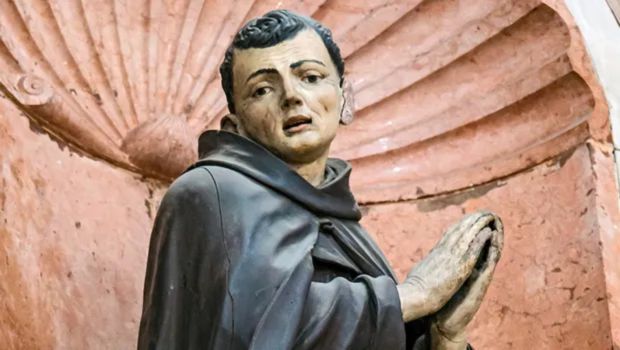
Image Credit: Aleteia
St. Paschal Baylon: The Shepherd Who Became Patron of Eucharistic Devotion
St. Paschal Baylon stands as one of the most beloved Franciscan mystics in Catholic history. This humble lay brother transformed from an illiterate peasant shepherd into the patron saint of Eucharistic congresses and associations. His deep reverence for the Blessed Sacrament defined his life. His courageous defense of the Real Presence against Protestant opposition marked his legacy. Today, Catholics remember him on May 17, honoring a saint who found heaven in the simplest of duties.
Early Life Among the Flocks
Paschal entered the world in 1540 at Torre Hermosa, a village in the Aragon region of Spain. His birth carried divine timing. He arrived on Whitsunday, the feast of Pentecost. His parents christened him Pascua in honor of this sacred day. The name itself means “Passover” or “Easter,” foreshadowing his future spiritual mission.
His family belonged to the peasant class. Poverty shaped his early years. Young Paschal laboured as a shepherd for his father. He tended flocks across the Spanish countryside. Long hours in the fields cultivated his contemplative spirit. Solitude became his first monastery. The open sky became his chapel.
Accounts from this period reveal extraordinary traits. Paschal performed miracles even as a youth. His austerity set him apart from other shepherd boys. While his companions played, he prayed. While others sought comfort, he embraced hardship. These early disciplines prepared him for his future vocation.
One challenge marked his young adulthood. Paschal could not read. Formal education remained beyond his reach. Yet determination conquered this obstacle. He taught himself to read. This self-education opened the door to spiritual literature. It prepared him for the intellectual demands of religious life.
The Vision That Changed Everything
Divine intervention redirected Paschal’s path. He received a vision. The message came clear and urgent. He must enter a nearby Franciscan community. This call demanded immediate response. Paschal obeyed without hesitation.
In 1564, he joined the Franciscan lay brothers of the Alcantarine reform. This branch followed the strict observance promoted by St. Peter of Alcantara. The reform emphasized poverty, simplicity, and rigorous penance. It attracted souls hungry for authentic Franciscan living.
Paschal did not seek prestigious positions. He desired only to serve. The community assigned him the role of doorkeeper. This humble duty became his lifelong vocation. He spent most of his religious life greeting visitors, managing the monastery entrance, and attending to practical needs.
The doorkeeper’s role offered unique spiritual opportunities. Paschal encountered countless souls. He served the poor who sought alms, welcomed pilgrims who needed shelter and bore witness through quiet example rather than grand gestures.
A Mystic in Work Clothes
Paschal’s spiritual life transcended his humble station. He practiced rigorous asceticism. His penances exceeded what his rule required. Fasting, vigils, and physical mortification characterized his daily routine. Yet these disciplines never soured his disposition. Joy radiated from his presence.
The Blessed Sacrament captured his heart above all else. Paschal displayed a profound love for the Eucharist. This devotion went beyond mere sentiment. It consumed his prayer life. It animated his every action. The tabernacle became his constant destination.
His contemporaries noticed this singular focus. Fellow friars observed him spending hours before the monstrance. Visitors caught him in ecstatic prayer. The Host held his complete attention. Christ’s Real Presence satisfied his deepest longings.
Courage in the Face of Heresy
Paschal’s devotion faced its greatest test in France. The community sent him on a mission across the border. France in the late 16th century simmered with religious conflict. Calvinism had gained significant ground. Catholic doctrine faced aggressive challenge.
During this mission, Paschal encountered a Calvinist preacher. The man publicly denied the Real Presence. He mocked the Catholic belief that Christ’s body and blood truly exist in the Eucharistic elements. This heresy struck at the heart of everything Paschal cherished.
The humble doorkeeper responded with unexpected boldness. He defended the doctrine of the Real Presence. His arguments drew from Scripture and tradition. His conviction outweighed his lack of formal theological training. The Calvinist preacher found himself matched by this uneducated friar.
The confrontation escalated. Other Calvinists grew irate at Paschal’s defense. Threats followed. Physical danger loomed. Yet Paschal stood firm. He would not compromise the truth he knew in his bones. Christ was truly present in the Eucharist. No threat could shake this certainty.
His courage impressed witnesses. A simple lay brother had faced down learned heretics. His love for the Blessed Sacrament proved stronger than fear. This episode became a defining moment in his biography. It demonstrated that mystical union with Christ produces natural fortitude.
Final Years and Canonization
Paschal returned to his ordinary duties after the French mission. The doorkeeper resumed his post. His prayer life deepened. His reputation for holiness spread beyond his monastery walls. Pilgrims sought his counsel. The sick requested his prayers.
Death came in 1592. Paschal died at a friary in Villareal, Spain. His passing drew immediate veneration. The faithful recognized his sanctity. Miracles multiplied at his intercession. The Church moved swiftly toward official recognition.
Pope Alexander VIII canonized him in 1690. This formal declaration confirmed what the people of God had long known. Paschal Baylon was a saint. His life of humble service and Eucharistic devotion merited universal honor.
Later popes expanded his patronage. In 1897, Pope Leo XIII issued a significant declaration. He named Paschal patron of all eucharistic confraternities and congresses. This designation connected him permanently to the Church’s public worship of the Blessed Sacrament. Eucharistic congresses, those large gatherings of faithful for adoration and catechesis, now carried his patronage.
The twentieth century brought liturgical changes. Since 1969, his veneration has been limited to local calendars. The universal Church no longer requires his feast in the Roman Calendar. However, particular Franciscan communities and Spanish dioceses continue to celebrate him with proper solemnity. His cult remains robust in his native land.
Legacy for Today’s Catholic
Paschal Baylon offers a timeless model for contemporary believers. His life demonstrates that holiness requires no prestigious position. A doorkeeper can become a mystic. A shepherd can become a saint. The key lies in loving Christ above all things.
His Eucharistic devotion speaks directly to modern Catholics. In an age of doubt and distraction, Paschal’s single-minded focus on the Real Presence challenges lukewarm faith. He invites the faithful to rediscover the treasure hidden in every tabernacle.
His courage in defending doctrine inspires catechists and evangelists. One need not possess advanced degrees to share the faith. Authentic love for Christ provides the necessary eloquence. The Holy Spirit supplies the words when human wisdom falls short.
On May 17, the Church remembers this Franciscan brother. Catholics seeking to deepen their Eucharistic devotion find in him a powerful intercessor. Those facing opposition for their faith discover a courageous companion. And every humble laborer learns that sanctity blooms in the most ordinary soil.
Leave a Reply