
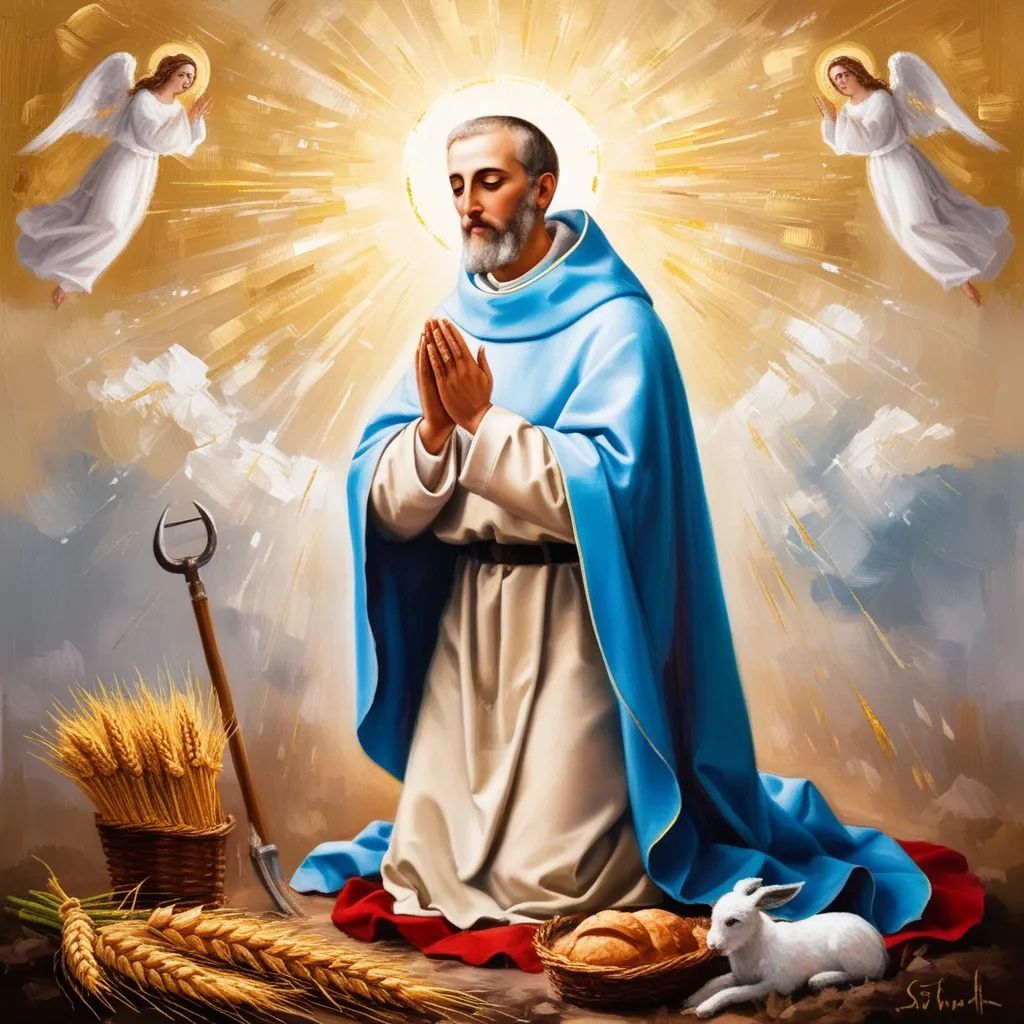
Image Credit: Saint Ways
Saint Isidore: From Humble Labourer to a Saint
Saint Isidore the Farmer is one of the Catholic Church’s most beloved saints of ordinary life and honest labor. Known for his prayerful life, love for the poor, and miracles linked to his farm work, Saint Isidore became a model of holiness in ordinary life. Though neither a priest nor scholar, his humble faith made him the patron saint of farmers and rural communities worldwide.
Saint Isidore, also known as Isidore the Laborer or San Isidro Labrador, was born around the year 1070 in Madrid, Spain, to poor but deeply religious parents. Baptized Isidore in honor of Saint Isidore of Seville, one of Spain’s most respected saints. During Isidore’s lifetime, Spain experienced political and religious tensions as Christian kingdoms reclaimed territories previously ruled by Muslim leaders. Despite these changes, Isidore lived a quiet and humble life focused on work, family, and prayer.
From an early age, Isidore worked as a farm laborer in the service of a wealthy landowner named Juan de Vargas. He spent most of his life tilling fields and caring for crops on farmland outside Madrid. Though poor himself, Isidore became known for his extraordinary generosity toward the needy. He frequently shared his meals and belongings with beggars and hungry travelers, trusting that God would always provide for his family.
Saint Isidore the Farmer married María Torribia, who is popularly known in Spain as Santa María de la Cabeza – a marriage marked by faith, charity, and devotion to God. Together, they had one son. According to tradition, a dramatic miracle occurred when their child accidentally fell into a deep well. In desperation, the couple prayed fervently to God. The water in the well reportedly rose miraculously, lifting the child safely to the surface. In gratitude for this divine intervention, Isidore and María later chose to live lives of great spiritual discipline and dedication to prayer.
Saint Isidore became widely admired not only for his kindness but also for his unwavering devotion to God. Each morning before going to work, he attended Mass and spent time in prayer. Some fellow workers complained to their employer that Isidore often arrived late to the fields because of his religious practices. However, when the landowner investigated, he reportedly witnessed angels ploughing the fields while Isidore prayed nearby. According to tradition, heavenly assistance allowed his work to be completed despite the time he devoted to worship.
Many other miracles became associated with Isidore during his lifetime. One story recounts how he showed mercy to a flock of starving birds during a harsh winter. While transporting wheat to a mill, he noticed pigeons scratching desperately for food in the frozen ground. Though mocked by others, Isidore emptied part of his sack of grain to feed them. Miraculously, when he arrived at the mill, the sack remained full, and the wheat produced more flour than expected.
Another famous account tells of Isidore’s wife preparing food for hungry visitors. Because Isidore regularly brought poor people home for meals, María kept a pot of stew constantly cooking over the fire. One day, after serving almost all the guests, she thought there was no food left but, on checking the Pot again, there was enough stew to feed everyone. This miracle reflected the couple’s deep trust in God’s providence and their commitment to caring for the poor.
Isidore was also remembered for his compassion toward animals and his respect for creation. Stories of divine intervention frequently surrounded his work, emphasizing the belief that God blessed his humility and sincere faith. His life demonstrates that holiness could be achieved not only in monasteries or churches but also through ordinary labour performed with love and devotion.
After decades of faithful service, Saint Isidore died on May 15, 1130, near his birthplace in Madrid. Devotion to him spread rapidly among ordinary people, especially farmers and rural communities who saw in him a model of Christian life rooted in prayer and honest work.
His body was found incorrupt after heavy rains exposed his tomb. Many miracles were later linked to his intercession, including healings and extraordinary events involving members of the Spanish royal family. Tradition also says he appeared to Alfonso VIII of Castile before the Battle of Las Navas de Tolosa in 1212 and revealed a hidden path that helped secure victory.
The growing devotion to Saint Isidore eventually led to official recognition by the Church. He was beatified in 1619 by Pope Paul V and canonized in 1622 by Pope Gregory XV. Canonized alongside several major saints, including Saint Ignatius of Loyola, Saint Francis Xavier, Saint Teresa of Ávila, and Saint Philip Neri.
Today, Saint Isidore remains one of the most honoured patron saints of agriculture and rural life. He is the patron saint of farmers, labourers, peasants, and rural communities across the world. He officially became the patron of the National Catholic Rural Life Conference in the United States in 1947.
Festivals, processions, and field blessings celebrate his feast day across Spain, the Philippines, Latin America, and beyond, especially in Madrid where annual festivities honour his holy life.
Isidore’s story reminds believers that sainthood is not only for theologians, missionaries, or clergy. Through prayer, humility, charity, and honest work, ordinary people can grow close to God and become instruments of His grace in the world.



Leave a Reply