
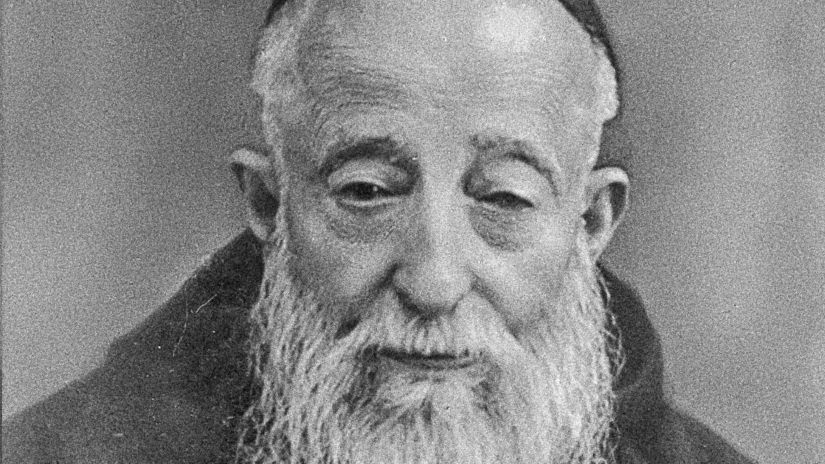
Image Credit: Catholic Journal
Saint Leopold Mandic: The Apostle of Confession and Unity
Saint Leopold Mandic is remembered as one of the Church’s greatest ministers of mercy and reconciliation. Despite living with physical disabilities and fragile health throughout his life, he became renowned for his compassion in the confessional, his devotion to Christian unity, and his unwavering trust in God. Known as the “Apostle of Confession” and the “Apostle of Unity,” Saint Leopold dedicated his life to bringing souls closer to Christ through kindness, patience, and understanding.
Saint Leopold was born Bogdan Ivan Mandić on May 12, 1866, in Herceg Novi, located in the Bay of Kotor in present-day Montenegro. He was the youngest of twelve children born to Petar Antun Mandić and Dragica Carević. His family came from noble Croatian roots but later experienced financial hardship, which helped them develop sympathy for the poor and suffering.
From childhood, Bogdan faced many physical challenges. He was born with weak health and grew to a height of only about 1.35 meters. He also struggled with a speech impediment, poor eyesight, stomach problems, arthritis, and a clumsy walk. Though these difficulties could have discouraged him, they instead deepened his humility and spiritual strength. His personal suffering made him especially compassionate toward people burdened by pain, weakness, and sin.
As a young boy, Bogdan felt drawn to religious life and dreamed of becoming a missionary. In 1882, at the age of sixteen, he entered the Capuchin seminary in Udine, Italy. Upon joining the Capuchin Franciscans, he received the religious name Leopold. Two years later, he entered the friary at Bassano del Grappa, where he continued his formation and professed his vows.
Leopold had a strong desire to serve Christians in Eastern Europe and hoped to work toward reconciliation between the Catholic and Orthodox Churches. During this period, Croatian Bishop Josip Juraj Strossmayer promoted efforts aimed at fostering unity among Christians, a vision that deeply inspired Leopold. He constantly prayed and worked for the healing of divisions between East and West, making him a spiritual pioneer of modern ecumenism.
Leopold was ordained a priest in Venice on September 20, 1890, at the age of twenty-four. However, because of his poor health and physical limitations, his superiors believed missionary work abroad would be too difficult for him. Though disappointed, Leopold accepted their decision with obedience and humility, trusting that God had another mission prepared for him.
That mission would eventually unfold in Padua, Italy, where he spent most of his priestly life. Beginning in 1906, Father Leopold devoted himself almost entirely to hearing confessions. For thirty-four years, he spent countless hours each day in a tiny confessional room welcoming sinners, comforting the troubled, and offering spiritual guidance.
People from all walks of life came to him seeking forgiveness and peace. His gentle manner and extraordinary compassion distinguished him from many confessors of his time. Some fellow friars even criticized him for being too kind and merciful toward penitents. Yet Leopold believed deeply in the limitless mercy of God. Rather than harsh judgment, he treated people with patience, understanding, and fatherly tenderness.
His confessional became a place of healing for countless souls. Many described feeling transformed after speaking with him because he listened carefully and offered encouragement instead of condemnation. Through this ministry, Saint Leopold became widely known as the “Apostle of Confession.”
During World War I, Father Leopold faced additional hardships. Because he refused to renounce his Croatian nationality, Italian authorities considered him politically suspicious and imprisoned him for a period during the war. He was later sent to southern Italy. Despite these difficulties, he remained faithful to both his heritage and his vocation.
In addition to hearing confessions, Saint Leopold showed remarkable love for children, the poor, and the sick. He supported orphanages and cared deeply for vulnerable families. He was especially compassionate toward expectant mothers and defended the dignity of unborn children long before pro-life advocacy became widely discussed in society.
Leopold also had a profound devotion to the Blessed Virgin Mary, whom he affectionately called “my holy boss.” He faithfully prayed the Rosary, celebrated Mass daily, and spent long hours in prayer before the Eucharist. Beyond the confessional, he visited hospitals, nursing homes, and the homes of the sick throughout Padua, bringing comfort and spiritual encouragement wherever he went.
As he grew older, his health continued to decline. Eventually, he developed cancer of the esophagus. Even while suffering intensely, he continued serving others for as long as possible. On July 30, 1942, while preparing for liturgical prayers, he suddenly collapsed. Fellow friars carried him to his cell and administered the last rites.
As the friars gathered around him, they prayed and sang the Marian hymn “Salve Regina.” When they reached the words, “O clement, O loving, O sweet Virgin Mary,” Saint Leopold peacefully died at the age of seventy-six.
One remarkable event associated with Saint Leopold occurred shortly after his death during the bombings of World War II. Every other part of the Church he resided was destroyed but his tiny Cell remains intact.. Leopold predicted this, while the buildings might be destroyed, his little cell would remain as a monument to God’s mercy.
Devotion to Saint Leopold grew rapidly after his death because many people considered him a living example of divine mercy. Pope Paul VI beatified him on May 2, 1976. Later, Pope John Paul II canonized him on October 16, 1983.
Today, Saint Leopold Mandic is honoured as a powerful model of mercy, humility, and reconciliation. Though physically weak in the eyes of the world, his spiritual strength transformed countless lives. His example reminds Christians that holiness is found not in worldly greatness, but in faithful service, compassion, and complete trust in the mercy of God.

Leave a Reply