
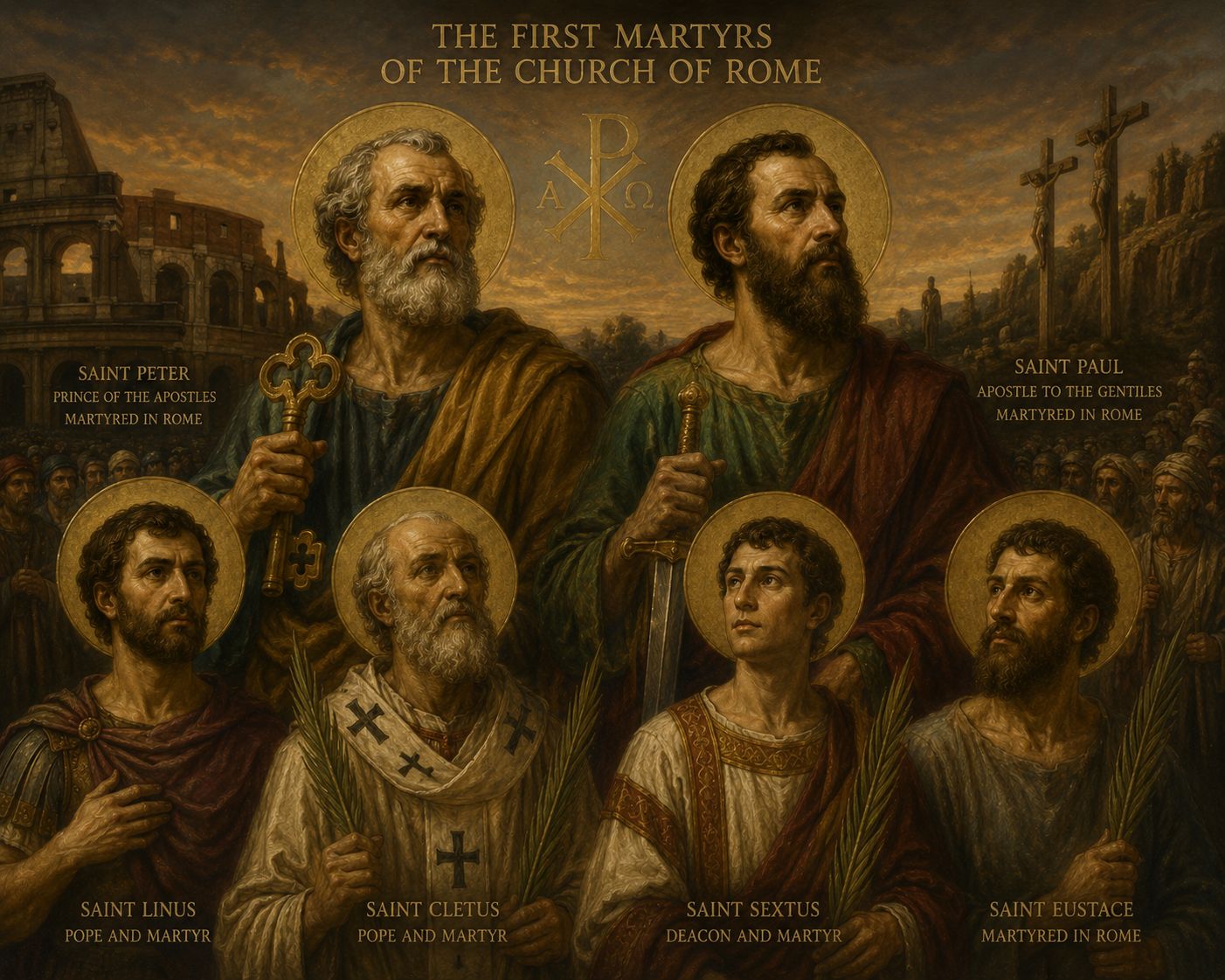
Image Credit: AI Generated
The First Martyrs of Rome: The Blood That Planted Faith in the Eternal City
The First Martyrs of Rome represent Christianity’s earliest collective witness to the point of death. When Emperor Nero needed scapegoats for the Great Fire of 64 AD, he turned on a small, obscure religious community. Their brutal executions were intended to entertain and terrify. Instead, they became the seed from which the Church in Rome would grow to transform an empire.
The Feast Day of the First Martyrs of Rome
The Church commemorates the First Martyrs of Rome on June 30, placing their memorial immediately after the solemnity of Saints Peter and Paul. This liturgical positioning is deeply intentional. Just as Peter and Paul represent the apostolic foundation of the Roman Church, these anonymous martyrs represent the faithful community that received their teaching and sealed it with blood. The Orthodox Church also honours them on June 30, preserving this memory across the East-West divide that would later separate the traditions.
A Community Born in Conflict
Christianity arrived in Rome remarkably early. Within a dozen years after Jesus’s death, believers were gathering in the imperial capital. These were not converts of Paul, who had not yet visited when he wrote his Epistle to the Romans around 57 AD. Instead, they were likely Jewish believers who had traveled from Palestine or Gentile God-fearers attracted to the synagogue who then embraced the gospel.
Rome’s Jewish community was substantial and well-established. Among them were Priscilla and Aquila, tentmakers from Pontus whom Paul later met in Corinth. They had been expelled from Rome when Emperor Claudius ordered all Jews to leave the city around 49 AD. Suetonius records that this expulsion resulted from disturbances between Jews and followers of “Chrestus”—likely a Roman misunderstanding of “Christus.” When Claudius died in 54 AD, Jews began returning, and the Christian community grew with them.
Paul addressed this mixed community of Jews and Gentiles in his letter, expressing his desire to visit and encourage them. He could not have imagined that within seven years, many of these same believers would face the most horrific persecution the ancient world had yet devised.
The Great Fire and Nero’s Scapegoats
In July of 64 AD, Rome burned. The city was largely constructed from wooden tenements, so fires were common. Yet this conflagration was catastrophic, consuming vast districts over six days. Rumors spread that Emperor Nero himself had orchestrated the blaze to clear land for his extravagant Golden House. Desperate to deflect blame, Nero accused the Christians.
The historian Tacitus provides our most reliable account. He writes that many Christians were put to death, “not so much for the crime of firing the city, as for hatred against mankind.” The punishments Nero devised were calculated for maximum horror and public entertainment.
Christians were sewn into animal skins and torn apart by dogs. Others were crucified. Most horrifically, some were coated with flammable materials and set ablaze as human torches. Nero offered his own gardens for these spectacles and staged shows in the circus. He mingled with the crowd disguised as a charioteer or stood elevated on his car, watching the suffering he had orchestrated.
Tacitus records that even Romans, hardened by decades of gladiatorial brutality, felt compassion. These victims were not being punished for the public good. They were being destroyed to satisfy one man’s cruelty. Their dignity in suffering, their fervor even to the end, failed to provide the diversion Nero sought. Instead, something unexpected happened.
The Seed of Faith
The martyrs’ deaths had precisely the opposite effect from what Nero intended. Rather than extinguishing this new faith, the spectacle of Christians singing hymns while burning alive, of mothers embracing children as dogs tore at their flesh, of ordinary people facing torture with supernatural peace—these scenes converted spectators. Tacitus himself notes that the persecution gave rise to a feeling of compassion, but it also gave rise to something more profound: respect, curiosity, and eventually conversion.
The faith was firmly planted in the Eternal City. These early Christians were disciples of the apostles, recipients of the same teaching that Peter and Paul would soon seal with their own blood. Their martyrdom created a continuous thread of witness from the apostolic generation through the persecutions that would recur under Domitian, Trajan, Marcus Aurelius, Decius, and Diocletian.
Peter and Paul were probably among these victims. Tradition holds that both apostles died during Nero’s persecution, Peter by crucifixion and Paul by beheading. Their deaths elevated the status of the entire Roman Christian community, connecting these anonymous martyrs to the apostolic foundation of the Church.
Veneration and Liturgical Reform
The Church of Santi Protomartiri a Via Aurelia Antica in Rome stands as a permanent memorial to these first witnesses. The name “Protomartyrs”—first martyrs—reflects their unique status as the initial collective sacrifice in the city that would become Christianity’s heart.
This feast entered the General Roman Calendar through the 1969 liturgical reforms. Previously, dozens of relatively minor Roman martyrs occupied individual feast days throughout the year. Many of these had scant historical evidence, though they benefited from immemorial tradition. The reformers created this single commemoration to honour all early Roman martyrs collectively, decluttering the calendar while preserving their memory.
The reform also served deeper theological purposes. By placing this feast within the octave of Peter and Paul, it emphasizes the connection between apostolic foundation and martyr witness. It also allows greater celebration of ferias—ordinary days—partially enacting the Second Vatican Council’s call for the Proper of Time to take precedence. All the early Roman martyrs retain their places in the Martyrology and can be celebrated in local calendars or privately unless impeded by greater observances.
The Piazza of the Protomartyrs
Vatican City itself preserves their memory through the Piazza of the Protomartyrs. This space within the world’s smallest sovereign state connects the papal presence to the earliest Christian blood shed in Rome. It reminds every pilgrim that Saint Peter’s Basilica, the heart of Catholic Christianity, stands upon ground sanctified not only by Peter’s cross but by the anonymous suffering of ordinary believers.
The Enduring Witness of the First Martyrs
The First Martyrs of Rome speak powerfully to contemporary Christianity. In an age when faith is often comfortable and privatized, they remind us that the gospel was originally proclaimed at tremendous cost. Their anonymity is itself significant. We know Peter and Paul by name; we know their stories, their writings, their theological contributions. These martyrs remain nameless, yet their collective witness was equally essential.
Their story also challenges simplistic narratives about persecution. Nero did not attack Christians because they threatened his political power. They were a tiny, marginal community. He attacked them because they were convenient, because their strangeness made them plausible scapegoats, because their refusal to participate in imperial cult rendered them suspicious. Their “crime” was ultimately their otherness, their insistence on a loyalty that transcended Caesar.
Yet their response to persecution transformed the empire itself. Within three centuries, Constantine would legalize Christianity. Within four, it would become the state religion. The blood of these first martyrs, mingled with that of Peter and Paul, proved indeed the seed of the Church.
Modern Christians facing persecution in various parts of the world—whether from authoritarian governments, religious extremists, or social hostility—can find in these Roman martyrs both solidarity and hope. Their witness declares that suffering for Christ is not defeat but victory, not isolation but communion with the great cloud of witnesses that surrounds the faithful.
The Church’s placement of this feast on June 30, immediately after Peter and Paul, creates a powerful triptych. On June 29, we honour the apostles who brought the faith to Rome. On June 30, we honour the community that received, preserved, and died for that faith. Together, they form the complete picture of Christian mission: proclamation and reception, leadership and followership, apostolic word and martyr witness.



Leave a Reply