
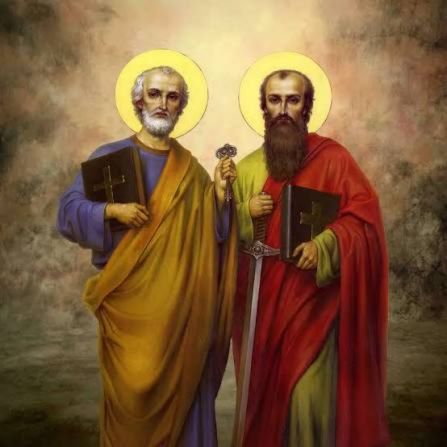
Image Credit: Images of St. Peter and St. Paul – Catholic Online; mosaic details from the Basilica of San Vitale, Ravenna; frescoes from traditional Christian iconography.
Saints Peter and Paul: The Two Apostles Who Built the Church in Blood and Truth
Saints Peter and Paul stand as the twin pillars upon which Christianity rests. One was a rough Galilean fisherman called from his nets; the other was a brilliant Pharisee struck down on a dusty road. Together, they transformed a small Jewish movement into a universal faith that would conquer the Roman Empire and reshape human civilization. Their shared feast day celebrates not their similarities but their complementary witness to Christ.
The Feast Day of Saints Peter and Paul
The Church commemorates Saints Peter and Paul on June 29, a solemnity that honours their martyrdom in Rome. Augustine of Hippo captured its significance perfectly: “One day is assigned for the celebration of the martyrdom of the two apostles. But those two were one.” Though they died on different days, their blood mingled in the same city, sealing their eternal unity. The Church also remembers Peter on February 22 (the Chair of Saint Peter) and November 18, while Paul’s conversion is celebrated on January 25 and his shipwreck on February 16.
Peter: From Fisherman to Rock
Simon was born in Bethsaida, near the Sea of Galilee, and worked the waters of Lake Gennesareth alongside his brother Andrew. Their lives revolved around nets, boats, and the daily catch. Everything changed when Jesus approached their boat and asked Simon to put out a little from shore. After teaching the crowds, Jesus commanded him to lower his nets into deep water. Despite a night of empty labour, Simon obeyed. The resulting catch was so enormous that the nets began tearing.
Falling to his knees, Simon cried, “Leave me, Lord; I am a sinful man.” Jesus responded with words that would define history: “Do not be afraid; from now on it is people you will be catching.” Immediately, Simon left everything and followed.
Jesus later renamed him Peter—meaning “rock”—and declared, “You are Peter, and on this rock I will build my church.” This confession at Caesarea Philippi established Peter’s foundational role. Yet this same Peter would walk on water only to sink in fear, draw his sword to defend Jesus only to deny him three times before a cock crowed.
The resurrection restored what sin had broken. By the Sea of Galilee, Jesus asked Peter three times, “Do you love me?” Each affirmation healed a denial, and each command—”Feed my lambs… Tend my sheep… Feed my sheep”—restored his leadership. Peter became the unquestioned head of the apostles, appointing Matthias to replace Judas, preaching at Pentecost, and performing the first apostolic miracles.
His mission extended to the Gentiles when he baptized Cornelius the centurion, though he later wavered at Antioch, requiring Paul’s public correction. Imprisoned by Herod Agrippa, Peter escaped miraculously through angelic intervention, only to face his final trial in Rome.
Paul: From Persecutor to Apostle
Saul of Tarsus was everything Peter was not. A Roman citizen by birth, he studied under Gamaliel, the most celebrated Jewish teacher of his age. He was a Pharisee of Pharisees, zealous for the law, and he hated the Jesus movement with passionate intensity. He presided over Stephen’s stoning and received authorization to hunt Christians in Damascus.
His conversion remains one of history’s most dramatic moments. On the road to Damascus, a blinding light struck him down. A voice demanded, “Saul, Saul, why do you persecute me?” When Saul asked who spoke, the reply came: “I am Jesus, whom you are persecuting.” Blinded and broken, he was led into the city, where Ananias restored his sight and baptized him.
Immediately, Paul began preaching that Jesus was the Messiah, confounding Jews who remembered him as their persecutor. He withdrew to Arabia for reflection, then returned to Damascus, barely escaping death. Three years later, he visited Jerusalem, meeting Peter and James for fifteen days. Fourteen years after that, Barnabas brought him to Antioch, where the church first called followers “Christians.”
Paul undertook three monumental missionary journeys across Asia Minor, Macedonia, and Greece. He established churches in Corinth, Ephesus, Philippi, and Thessalonica, then wrote letters that would become Scripture. His theological vision was revolutionary: Gentile converts needed neither circumcision nor the Mosaic law. Salvation came through faith in Christ alone, uniting Jews and Gentiles in one body.
His journey to Rome began with arrest in Jerusalem, followed by a harrowing sea voyage. Shipwrecked on Malta, he survived a viper’s bite and healed the islanders. Reaching Rome, he spent two years under house arrest, preaching freely. Released briefly, he traveled to Spain and the East before returning to Rome for his final imprisonment.
Martyrdom in the Eternal City
Both apostles converged on Rome, the empire’s heart, where their preaching threatened established powers. Nero’s persecution after the Great Fire of 64 claimed them both.
Peter was crucified on Vatican Hill, upside down at his own request, feeling unworthy to die as his Lord had died. His remains were buried nearby, where Constantine later built the Basilica of Saint Peter. In 1968, Pope Paul VI announced that bones discovered beneath the basilica’s altar likely belonged to the apostle. Pope Francis later displayed these relics publicly and shared fragments with the Orthodox Patriarch of Constantinople as a gesture of unity.
Paul, as a Roman citizen, was beheaded at the Aquae Salviae on the Via Laurentina. Legend says his severed head bounced three times, creating springs at each spot—hence the church of San Paolo alle Tre Fontane. His body was buried on the Via Ostiensis, where the Basilica of Saint Paul Outside the Walls now stands. A marble sarcophagus inscribed “Paulo Apostolo Mart” was discovered in 2002, and radiocarbon dating of bone fragments confirmed they belonged to a first-century man.
The Legacy of the Two Apostles
Saints Peter and Paul left complementary legacies that shape Christianity to this day. Peter established the Church’s visible structure, the apostolic succession that connects believers to Christ through bishops. Paul developed its theological vocabulary, articulating justification by faith, the unity of Jew and Gentile, and the body of Christ. Together, they ensured that Christianity would be both institutionally rooted and intellectually profound.
Peter’s symbols—the keys, the inverted cross, the boat—reflect his role as heaven’s gatekeeper and fisher of souls. Paul’s symbols—the sword, the scroll—represent his martyrdom and his letters that continue instructing the Church. In art, Peter appears as the older, stockier figure with white hair; Paul is balding with a longer beard and intense gaze.
Their influence extends beyond Christianity. Islam recognizes Paul as a follower of Jesus, though some traditions criticize his theological innovations. The Bahá’í Faith honors Peter’s primacy while seeing Paul as instrumental in spreading the gospel. Even secular historians acknowledge that without these two men, Western civilization would be unimaginably different.
The Church of England, the Lutheran Churches, and the Eastern Orthodox all celebrate these apostles with festivals, though with varying emphases. The Orthodox venerate Peter as “Coryphaeus” or choir-director, and Paul as the “Apostle to the Gentiles.” Catholics see Peter as the first pope, establishing the papal succession that continues today.
In an age of division, the unity of Peter and Paul offers a powerful model. They were not alike—one was uneducated, the other a scholar; one was impulsive, the other methodical; one was a Jewish traditionalist, the other a radical innovator. Yet they served the same Lord, built the same Church, and poured out their blood in the same city. Their shared feast reminds us that diversity within unity is not a weakness but the Church’s very strength.

Leave a Reply