
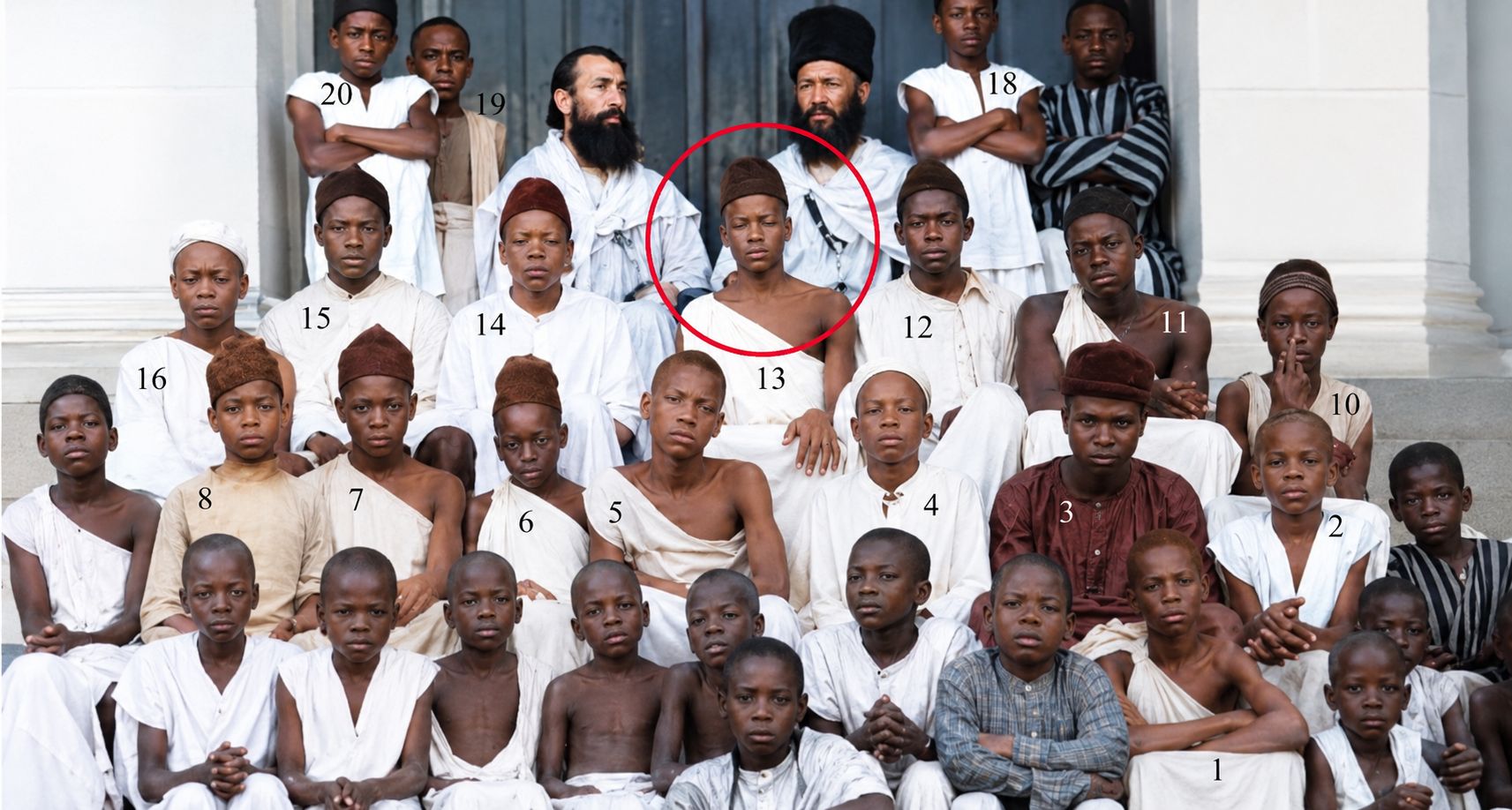
Image Credit: AI modified historical photograph of the Martyrs of Uganda
Saint Charles Lwanga and Companions: The Martyrs of Uganda Who Died Singing
When Faith Confronted a Tyrant
Some stories make you wonder what you’d do in the same situation. This is one of them.
In the late 19th century, a small group of Catholic missionaries arrived in the Kingdom of Buganda—modern-day Uganda. The White Fathers, as the Society of Missionaries of Africa was known, had barely unpacked before something remarkable happened. Their earliest converts didn’t just receive the faith; they started teaching it themselves. Within six years, a community of 200 Christians had formed at the court of King Mwanga II, and these new believers were instructing others the missionaries couldn’t even reach.
Then everything exploded.
King Mwanga wasn’t just any ruler. He was violent, paranoid, and a predator who used his power to abuse the young boys and men who served as his pages. When the Christians at court began protecting these vulnerable servants from the king’s advances, they signed their own death warrants. What followed remains one of the most vivid martyrdom accounts in modern Church history.
Joseph Mukasa Balikuddembe: The First of the Martyrs of Uganda to Fall
The Christian community’s leader was Yozefu Mukasa Balikuddembe (#3), a 25-year-old Catholic who served as chief steward of Mwanga’s court. He was the kind of man who couldn’t stay silent when he saw evil.
When Mwanga ordered the killing of Anglican Bishop James Hannington and his companions, Mukasa confronted him directly. He condemned the murders and demanded the king change his ways. Mwanga had always liked Joseph, but this public challenge crossed a line. The king struck him with a spear, then ordered his execution.
The executioners tried to tie Joseph’s hands. He stopped them with words that still echo: “A Christian who gives his life for God is not afraid to die.” He forgave Mwanga completely, made one final plea for the king’s repentance, and was beheaded and burned on November 15, 1885.
His death could have shattered the community. Instead, it galvanized them.
Charles Lwanga Steps Forward
Kaeoli Lwanga (#13, circled in the photograph), a member of the Baganda tribe born around 1860, took over leadership of the court Christians. He also inherited Joseph’s protective role, shielding the young pages from Mwanga’s predation. For six months, an uneasy calm settled. Perhaps Mukasa’s dying plea had touched something in the king. Perhaps Mwanga simply needed time for his rage to rebuild.
Either way, the explosion came in May 1886.
Mwanga called a page named Mwafu and asked why he’d been absent. When Mwafu admitted he’d been receiving religious instruction from Dionizio Ssebuggwawo (#8), the king’s fury erupted. He had Dionizio brought before him and personally killed him, thrusting a spear through his throat. Then Mwanga sealed the royal compound and summoned his executioners.
That night, knowing exactly what was coming, Charles Lwanga baptized four catechumens in secret. One of them was Kizito (#18), just thirteen years old. The next morning, Mwanga assembled his entire court. He separated the Christians from the rest with a simple command: “Those who do not pray stand by me, those who do pray stand over there.”
Fifteen boys and young men—all under 25—stood apart. Mwanga asked if they were Christians and intended to remain so. Their answer was unanimous and unwavering: “Yes.”
The Road to Namugongo
The condemned group faced a 37-mile trek to the execution site at Namugongo. They went bound and brutalized, yet their spirit baffled everyone who saw them.
The chief executioner begged his own son, Muggaga (#19), to escape and hide. Muggaga refused. As the prisoners passed the White Fathers’ mission, Father Lourdel watched thirteen-year-old Kizito laughing and chatting with his companions. The priest nearly fainted at their courage.
Three of the faithful were killed along the road. Ponsiano Ngondwe (#6), Atanasi Bazzekuketta (#9), and Gonzaga Gonza (#11) were murdered on the march, never reaching Namugongo.
A Christian soldier named Yakobo Buuzabalyawo (#7) was brought separately before the king. When condemned, he said simply: “Goodbye, then. I am going to Heaven, and I will pray to God for you.” As he passed Father Lourdel, James lifted his tied hands toward heaven and smiled. “Why are you so sad? This is nothing to the joys you have taught us to look forward to.”
Andrea Kaggwa (Kahwa) (#2), a chief who had converted his wife and many others, goaded his hesitant executioners: “Don’t keep your counsellor hungry—kill me.” Matia Kalemba Mulumba (#16), an assistant judge, was cut into pieces and left to die on the road. It took him at least three days. When a tormentor mocked that his God would surely rescue him, Matia replied: “Yes, God will rescue me. But you will not see how he does it, because he will take my soul and leave you only my body.”
The Fire at Namugongo
The survivors reached Namugongo and spent seven days in prison. On June 3, 1886, they were brought out, wrapped in reed mats, and placed on a massive pyre.
Muggaga died first. His father, the chief executioner, had tried one last time to change his mind. When that failed, he ordered his own son killed. Then the flames consumed the rest—thirteen Catholics and eleven Protestants. They died calling on Jesus, proclaiming: “You can burn our bodies, but you cannot harm our souls.”
Charles Lwanga was separated from the others for a private execution, following royal custom. As the flames rose around him, he spoke to the Guardian of the Sacred Flame: “It is as if you are pouring water on me. Please repent and become a Christian like me.”
Mbaaga Tuzinde (#5) was clubbed to death for refusing to renounce Christianity. His body was thrown into the furnace to burn with the others.
Remembering Each Name of the Martyrs of Uganda
The photograph above gives faces to these martyrs. Look at them again:
- Mukasa Kiriwawanvu (#1)
- Andrea Kaggwa (Kahwa) (#2)
- Yozefu Mukasa Balikuddembe (#3)
- Anatori Kiriggwajjo (#4)
- Mbaaga Tuzinde (#5)
- Ponsiano Ngondwe (#6)
- Yakobo Buuzabalyawo (#7)
- Dionizio Ssebuggwawo (#8)
- Atanasi Bazzekuketta (#9)
- Adolfu Mukasa Ludigo (#10)
- Gonzaga Gonza (#11)
- Ambrozio Kibuuka (#12)
- Kaeoli Lwanga (#13)
- Akileo Kiwanuka (#14)
- Bruno Sserunkuma (#15)
- Matia Kalemba Mulumba (#16)
- Luka Baanabakintu (#17)
- Kizito (#18)
- Muggaga (#19)
- Gyaviira (#20)
These weren’t abstract saints. They were young men with names, families, and futures ahead of them. Kizito was thirteen. Lwanga was about 26. They had crushes and rivalries, hopes and fears, just like any young people. Yet when the moment came, they chose faith over survival, purity over power, heaven over an earthly king’s favor.
The Church That Wouldn’t Die
The White Fathers were expelled from Uganda, but the faith they planted proved indestructible. Without priests, liturgy, or sacraments, the Ugandan Christians carried on alone. They translated and printed the catechism in their own language, gave secret instruction and preserved what had been given to them at such terrible cost.
When the missionaries finally returned after Mwanga’s death, they found 500 Christians and 1,000 catechumens waiting. The seed had fallen into the ground and died, exactly as Christ promised. And it had borne fruit beyond imagining.
Canonization and Enduring Legacy
Pope Paul VI canonized Charles Lwanga and his companions on October 18, 1964, during the Second Vatican Council. In a historic gesture, Paul VI became the first reigning pope to visit sub-Saharan Africa when he traveled to Uganda in July 1969, including a pilgrimage to Namugongo.
The Basilica of the Uganda Martyrs now stands at the execution site, drawing pilgrims from across the continent and beyond. The Brothers of St. Charles Lwanga, founded in 1927, continue his work educating disadvantaged youth. In Detroit, Michigan, St. Charles Lwanga Parish serves the African American community, keeping his legacy alive in urban America.
Why Their Story Still Matters
The Uganda Martyrs demolish the comfortable myth that persecution belongs to ancient history. These men died in 1886—during the lifetime of people who knew people who remembered it. Their youth matters too: teenagers and young adults who chose Christ when everything was on the line.
Charles Lwanga’s particular witness resonates in an age that desperately needs it. He protected vulnerable boys from sexual exploitation, knowing it would cost him everything. He baptized in secret when danger loomed and walked to his death with a prayer for his murderer on his lips.
Their feast day is June 3—the anniversary of the Namugongo fire. When you hear their names, remember that Christianity isn’t a Western import or a colonial relic in Africa. It’s blood-bought, Spirit-breathed, and deeply indigenous. These martyrs weren’t imitating European saints. They were becoming African ones.
And they were laughing on the way to death. That detail stays with me. Thirteen-year-old Kizito, chatting and joyful, bound for execution. Yakobo Buuzabalyawo, smiling at his grieving priest. These weren’t stoics numbing themselves to pain. They were Christians who had grasped something so real, so beautiful, that even flames couldn’t touch it.
The Uganda Martyrs remind us that persecution isn’t past tense. Christians still die for their faith today—in Nigeria, North Korea, the Middle East, and beyond. Their intercession is worth requesting, not as a distant historical memory, but as brothers who understand exactly what modern martyrs face.
St. Charles Lwanga and companions, pray for us. Pray for courage when comfort tempts us to compromise, for joy when suffering surrounds us, for Africa, for her Church, and for all who still stand before tyrants with nothing but faith and a smile.
Leave a Reply