
Understanding the Feast of the Exaltation of the Cross: History and Meaning
Every year, on September 14, Christians around the world observe the Feast of the Exaltation of the Holy Cross. This celebration honours two significant historical events tied to the relic of Christ’s Cross. Firstly, it recalls Saint Helena’s discovery of the True Cross in Jerusalem around 326. Secondly, it commemorates the later recovery of that same relic from Persian captivity. Consequently, this feast weaves together loss, triumph and profound spiritual meaning. Interestingly, both Catholic and Orthodox traditions continue observing this ancient celebration with great reverence today.
Saint Helena, mother of Emperor Constantine, travelled to Jerusalem determined to locate sites connected with Christ’s Passion. According to tradition, she demolished a pagan temple believed to stand above the crucifixion site. During subsequent excavations, workers reportedly uncovered three separate crosses buried nearby. Naturally, determining which cross belonged to Christ posed an immediate challenge. Tradition holds that Bishop Macarius of Jerusalem devised a test involving a dying woman. When she touched one particular cross, she was miraculously healed instantly. Therefore, this cross was identified as the True Cross of Christ.
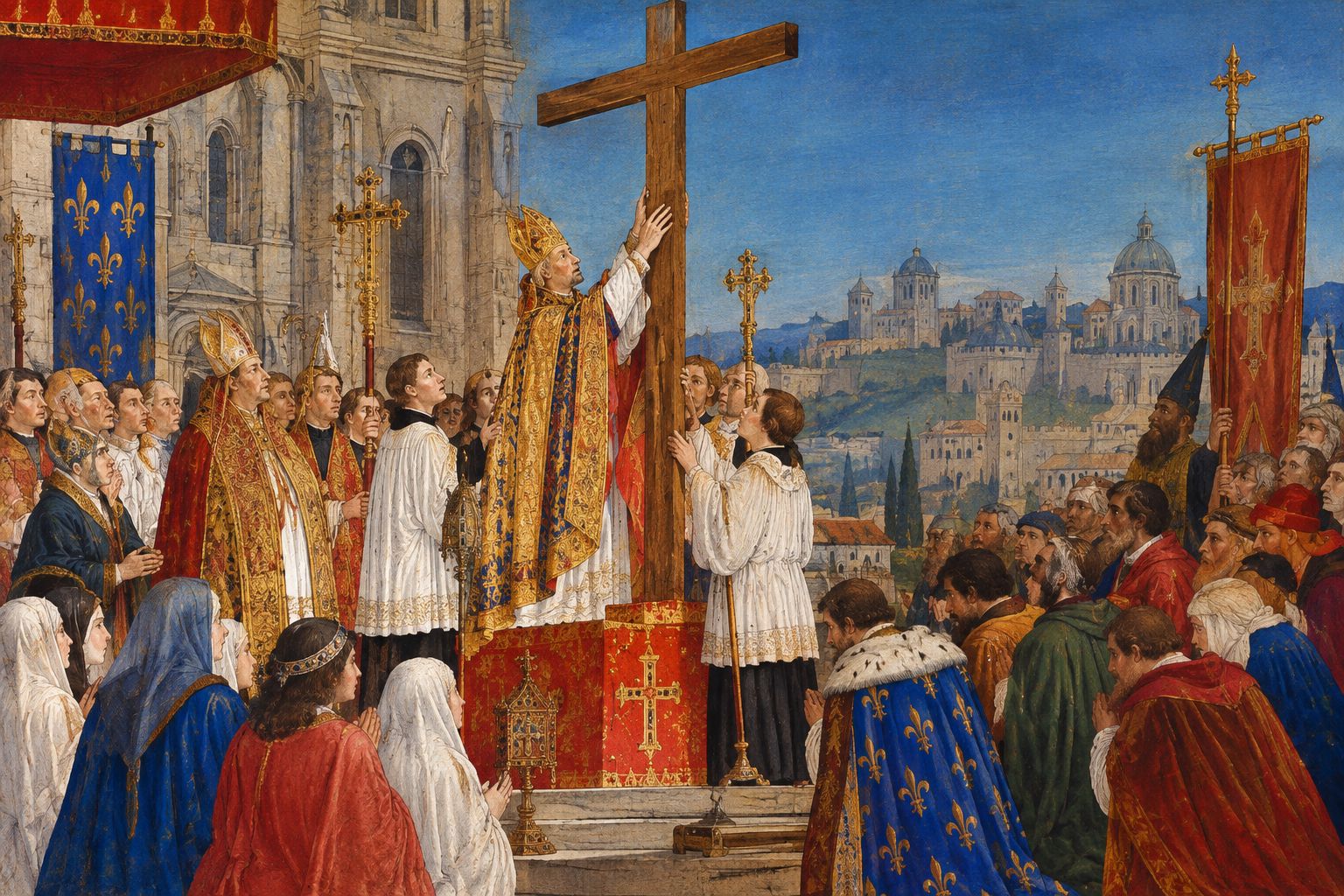
Afterwards, Constantine ordered construction of a magnificent basilica over the sacred site. The Church of the Holy Sepulchre was solemnly dedicated on September 13, 335. The very next day, clergy publicly elevated the Cross before gathered crowds. As a result, this moment established September 14 as an annual day of veneration. Gradually, the celebration spread beyond Jerusalem, eventually becoming universal across Christendom by roughly 720.
However, the Cross’s story did not end peacefully. In 614, Persian forces under King Khosrow II conquered Jerusalem and seized the sacred relic. Consequently, the Cross remained in Persian hands for approximately fourteen years, causing deep sorrow among Christians. Eventually, Emperor Heraclius defeated the Persian armies and recovered the treasured relic. According to popular tradition, he intended to carry the Cross triumphantly on his own back into Jerusalem. Surprisingly, he found himself unable to proceed while wearing his royal garments and crown. Patriarch Zacharias advised him to remove these symbols of power and dress instead in humble, penitential clothing. Once he did so, he successfully carried the Cross into the Church. This dramatic episode became permanently woven into the feast’s rich symbolism.
Theologically, the feast carries meaning far beyond these historical events alone. The Cross, originally an instrument of execution, became instead a powerful symbol of salvation. Just as Adam’s disobedience once brought sin into the world, Christ’s sacrifice on the Cross reversed that ancient wound. Therefore, believers view the Cross not as shameful, but as glorious and life-giving. Many parishes mark the day with special hymns, prayer, and public veneration of crucifixes.
During liturgical celebrations, priests often elevate a crucifix before the congregation, echoing that original moment in Jerusalem. Meanwhile, worshippers frequently kiss or bow before the Cross as an act of devotion. Furthermore, some communities incorporate this feast into broader autumn traditions, including specific blessings or shared meals. Ultimately, these practices help believers connect personally with centuries of unbroken Christian devotion.
Today, the Feast of the Exaltation of the Holy Cross remains a moment for deep reflection. It invites Catholics to consider suffering, redemption and hope intertwined within a single sacred symbol. Moreover, it reminds believers that history and faith often intersect in unexpected, powerful ways. As autumn approaches each year, this feast offers a timely opportunity for renewed devotion and gratitude.



Leave a Reply