
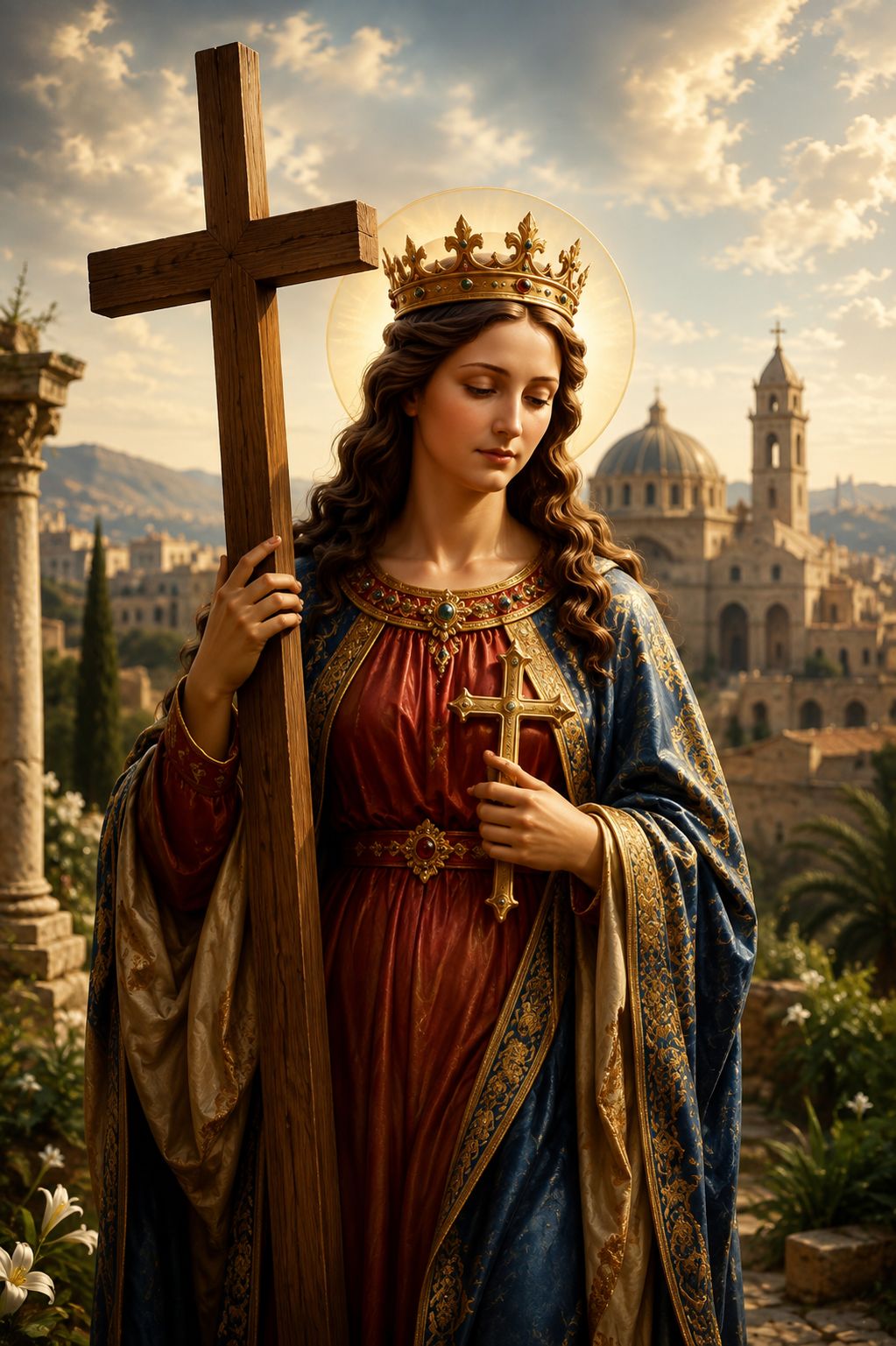
Saint Helena rose from remarkably humble beginnings to become one of the most influential women in early Christian history. Born into poverty, she eventually wielded the full resources of the Roman imperial treasury as mother to Emperor Constantine. In her final years, Saint Helena used that extraordinary position to search the Holy Land for relics connected to Christ’s Passion. This piece traces her rise from obscurity, her pilgrimage to Jerusalem and the enduring legend of her greatest discovery.
Saint Helena’s Feast Day Falls on 18 August
The Catholic Church honours Saint Helena every year on 18 August, marking her death around the year 330. She is remembered today as patroness of new discoveries, a fitting title given her role in uncovering some of Christianity’s most treasured relics. Eastern Christians pair her feast with that of her son, celebrating both Constantine and Helena together on a separate date in late May.
From Stable Maid to Empress
Helena was likely born around 250 in Drepanum, a town in Bithynia later renamed Helenopolis in her honour. Saint Ambrose famously described her simply as a good stable maid, reflecting her genuinely modest origins. Despite this humble background, she married the Roman officer Constantius Chlorus and around 274 the couple welcomed their only son, Constantine. Constantius later divorced Helena around 292 as his political ambitions grew, choosing instead to marry into a more advantageous imperial family.
A Son’s Enduring Loyalty
Constantine never abandoned his mother, even after his father’s calculated rejection of her. Following Constantius’s death in 308, Constantine assumed the imperial throne and immediately recalled Helena to the royal court. He granted her the title Augusta, ordered coins minted bearing her likeness, and commanded that the entire empire honour her accordingly. Through her son’s growing embrace of Christianity, Helena herself developed a deep and genuine Christian faith.
Grief That Deepened Her Devotion
Helena’s later years were marked by profound family tragedy. In 326, Constantine ordered the execution of his own son Crispus, followed shortly afterward by the death of his wife Fausta, amid accusations that still remain debated by historians today. These devastating losses plunged the imperial court into deep sorrow. Rather than retreating from public life, Helena responded by intensifying her religious devotion, setting out soon afterward on her historic pilgrimage to the Holy Land.
Saint Helena’s Journey to Jerusalem
Around 326, by then in her eighties, Helena travelled to Jerusalem with the full backing of imperial resources and a team of architects and advisers. She found the city still recovering from destruction inflicted generations earlier under Emperor Titus. On the site believed to mark Christ’s crucifixion, Emperor Hadrian had built a temple dedicated to Venus roughly two centuries before. Helena ordered this pagan temple demolished, initiating a lengthy excavation beneath the rubble.
Discovering the True Cross
According to tradition, workers eventually unearthed three separate wooden crosses buried at the site. Unsure which one had held Christ, Helena reportedly brought a dying woman to touch each cross in turn. The woman felt nothing from the first two, but recovered instantly upon touching the third, which Helena then declared the True Cross. Constantine ordered the Church of the Holy Sepulchre built at that very spot, a building that remains one of Christianity’s most sacred pilgrimage sites today. Modern historians generally treat this specific discovery as legendary rather than verifiable history, even while acknowledging Helena’s genuine and extensive building programme across the Holy Land.
Churches, Relics, and Lasting Monuments
Beyond the True Cross itself, Helena’s journey produced lasting architectural achievements, including the Church of the Nativity in Bethlehem and the Church of Eleona on the Mount of Olives. The theologian Theodoret of Cyrus later wrote that Helena also recovered nails used in the crucifixion, which Constantine reportedly had fitted into his helmet and his Horse’s bridle. When Helena returned to Rome in 327, she brought fragments of the True Cross with her, storing them within her own palace chapel. That building later became the Basilica of Santa Croce in Gerusalemme, where visitors can still view relics attributed to her discovery today.
Death and Enduring Legacy
Saint Helena died around 330, reportedly with her devoted son by her side and was buried in a mausoleum outside Rome. Her sarcophagus survives today within the Vatican’s Pio-Clementine Museum. Beyond her famous discoveries, Helena earned a reputation for extensive charity, regularly assisting the poor and donating generously to churches throughout her travels. For further reading on the historical debate surrounding her discoveries, Britannica’s overview of the True Cross offers additional context. Readers exploring nearby August feasts can browse the complete August Saints calendar for more.





Leave a Reply