
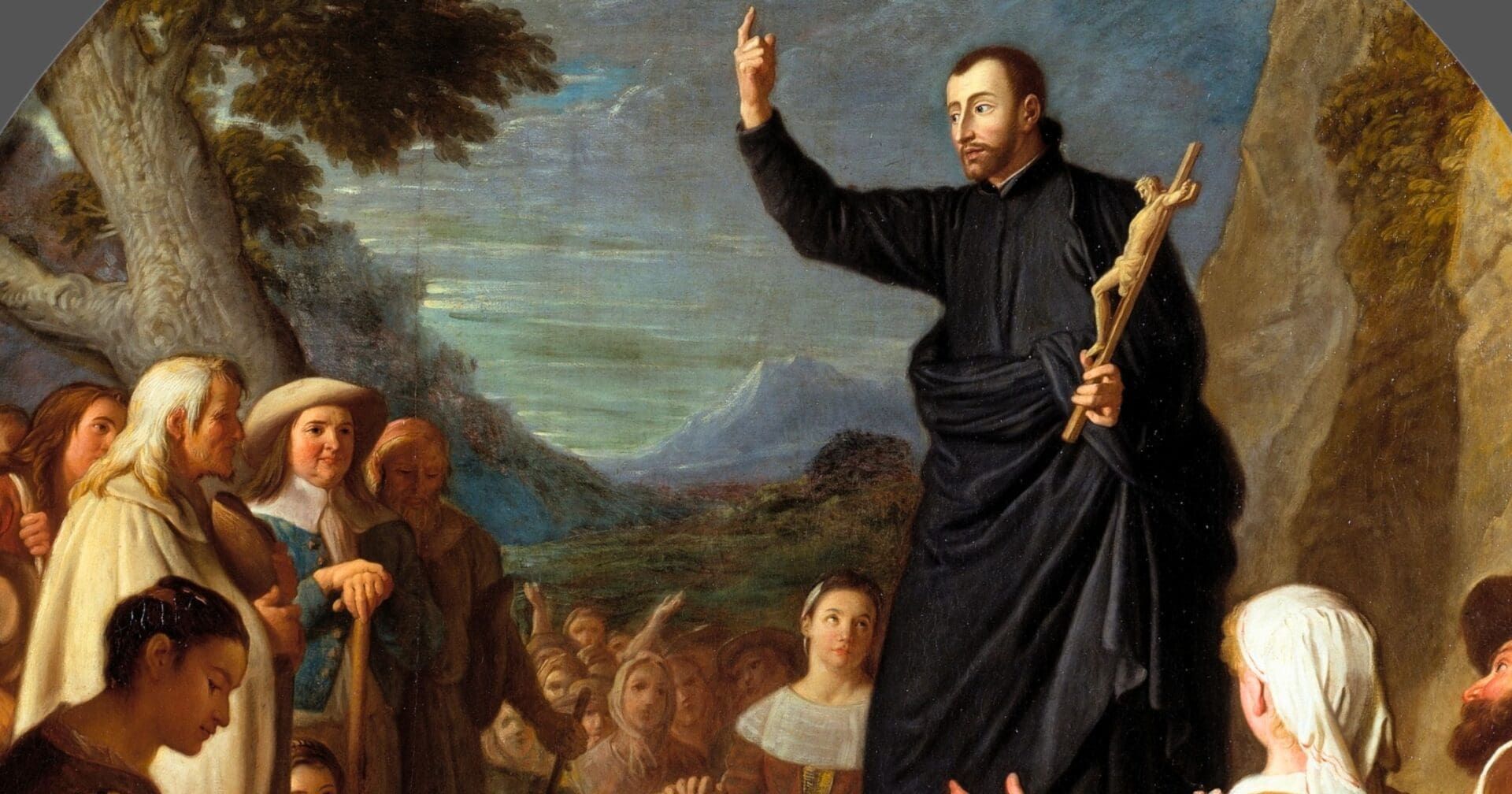
Image Credit: U Catholic
Saint John Francis Regis: The Jesuit Who Preached Until His Voice Failed
Feast Day: June 16
The Church remembers Saint John Francis Regis on June 16, a feast that honors one of the most tireless missionaries in Jesuit history. He lived only 43 years, yet his impact across southern France was so extraordinary that Pope Clement XII canonized him less than a century after his death.
A Childhood Marked by Holy Terror
Jean-François Régis was born on January 31, 1597, in Fontcouverte, a village in the Languedoc region of southern France. His father, Jean Régis, had recently been ennobled for service during the Wars of the League. His mother, Marguerite de Cugunhan, came from a noble family. They were distinguished among local aristocracy for their virtue.
When Francis was five, something happened that would shape his entire life. He overheard his mother speaking about the horror of eternal damnation. The little boy fainted. That discourse made a lasting impression on his tender heart, instilling a holy fear that would mature into fervent love.
As a child, he showed no interest in typical amusements. At school, he refused to join companions in innocent diversions. His first master was morose and hasty, making the modest, bashful child suffer considerably. Francis bore everything without complaint. When the Jesuits opened a college at Béziers, he was among the first to enroll, drawn by the professors’ reputation.
His gravity deepened with age. He avoided the beautiful walks crowded by schoolfellows. He hoarded time like treasure, scarcely allowing necessary relaxation. Sundays and holidays he divided between pious reading and church devotions. Often he was found in a chapel, bathed in tears before Jesus Christ.
Initially, his conduct made him a target for ridicule. However, his constancy eventually transformed mockery into veneration. Six of the most fervent students joined him in shared lodgings, forming an informal seminary. They looked upon him as their living rule, honoring him as a saint and spiritual master.
From Novice to Priest
At 18, Francis fell dangerously ill. His patience and piety moved everyone who visited. After recovery, he made a spiritual retreat to discern his vocation. He felt a strong impulse to labor for souls in the Society of Jesus. His confessor confirmed this as God’s call.
On December 8, 1616, he entered the Jesuit novitiate at Toulouse with great joy. Here, undivided between study and prayer, he pursued close union with God. His punctuality in small duties raised them to great value. He laid foundations for virtues that would distinguish his entire life: humility, contempt of the world, charity to the poor, and zeal for God’s glory.
The humblest tasks delighted him. He waited at table, cleaned the house, made beds, and dressed the sores of the poorest, most loathsome hospital patients. He saw Jesus Christ in these afflicted members. Meanwhile, he was austere toward himself, leading companions to remark that he was his own eternal persecutor.
After two years, he made his vows in 1618. He finished rhetoric at Cahors, then taught at Billom, Auch, and Puy-en-Velay. While teaching, he studied philosophy at Tournon. He combined academic work with frequent visits to the Blessed Sacrament, pious reading, and holy recollection. His superiors attested they never observed the slightest breach of college duty, earning him the name “angel of the college.”
He undertook catechetical instruction for servants and the poor, distributing college alms. On Sundays and holidays, he preached in nearby villages, summoning children to catechism with a little bell. The township of Andance, under his particular care, was completely transformed. Drunkenness, licentiousness, and swearing disappeared. Sacramental practice was restored. He established the Confraternity of the Blessed Sacrament, drawing up rules that would spread to other places.
Ordination and the Plague
In 1628, Regis began theology at Toulouse. He made such progress that, out of fear of applause, he affected simplicity and pretended ignorance. When ordered to prepare for holy orders in 1630, he felt a struggle between humble terror and glowing zeal. Seeing God’s will in his superiors’ command, he calmed his fears.
He was ordained in 1630, at age 33. He celebrated his first Mass with such tender devotion and continuous tears that those present wept uncontrollably. They thought him more angel than man at the altar.
That same year, Toulouse suffered a violent plague. Francis pressed urgently for permission to serve the sick. In 1631, after completing his studies, he made his tertianship. During this period, he visited his hometown to settle family affairs. He spent the time visiting the poor and sick, catechizing children every morning, and preaching twice daily. He begged for the poor through the streets, followed by crowds of them and children, carrying straw, beds, and necessities on his shoulders. Soldiers insulted him. Brothers and friends remonstrated bitterly. He rejoiced in these humiliations, answering that they befitted a minister of the Gospel.
Ten Years of Apostolic Fire
The final decade of Regis’s life was an explosion of missionary energy. His superiors, recognizing his vocation and talents, assigned him solely to missions. He began in Languedoc, continued through the Vivarais, and ended in the Velay, where Le Puy served as capital.
He spent summers in cities and towns, since farmers were occupied with tillage. Winters he consecrated to villages and countryside. At Montpellier in 1631, he opened his mission by instructing children and preaching on Sundays and holidays. His discourses were plain and familiar, closing with moral exhortations delivered with such vehemence that his voice and strength sometimes failed him. Both preacher and audience were often dissolved in tears.
He never refused the rich, yet he always said they would never lack confessors. The poor were his share and delight. He spent mornings in the confessional, at the altar, or in the pulpit. Afternoons he devoted to hospitals and prisons, sometimes forgetting meals. He begged door-to-door for the poor, procured physicians for the sick, and dressed their most loathsome sores himself. When children laughed at him carrying bundles of straw, he answered: “With all my heart; we receive a double advantage when we purchase a brother’s relief with our own disgrace.”
He established an association of gentlewomen to assist prisoners. He converted Huguenots and many lewd women. When told that prostitutes’ repentance was seldom sincere, he replied: “If my labors hinder one sin, they will be well bestowed.”
Conflict and Miracles
Toward winter, he went to Sommiers, twelve miles from Montpellier. With incredible labor, he declared war against vice and ignorance. He penetrated the most inaccessible places; undeterred by weather rigors, lived chiefly on bread and water; sometimes a little milk, abstaining from Fish, Meat, Eggs and wine. He allowed very little rest on hard benches or floors, wearing a hair shirt.
With a crucifix in hand, he stopped enraged soldiers from plundering a church. He demanded and obtained restitution of plundered goods from a Calvinist officer, without mentioning the indignities he had suffered.
The Vivarais had been Calvinism’s center in France for fifty years, marked by horrible wars and desolation. In 1633, the pious bishop of Viviers drew Regis into his diocese. The count de la Mothe Brion, formerly a worldly man, was so moved by Regis’s unction that he devoted himself to fasting, prayer, and alms. This nobleman greatly assisted the saint’s holy enterprises.
At Puy, Regis reformed negligent pastors, converted lewd women, and brought a Calvinist lady of great reputation to the faith. However, amid these successes, accusations arose. He was called a disturber of family peace, a violent man whose invectives spared no one. The bishop defended him until, wearied by repeated complaints, he wrote to Regis’s superior to recall him. Summoning the saint, he gave a severe reprimand, saying he must dismiss him.
Regis, who had neglected all self-justification, answered with such humility and unfeigned love of humiliations that the prelate was charmed. Undeceived by others regarding him, the bishop praised him publicly and continued his employment until early 1634. Regis departed loaded with letters of highest commendation.
He wrote earnestly to the Jesuit general, requesting mission to the Hurons and Iroquois in Canada. He received a favorable answer. However, at the count de la Mothe’s request, he returned to Viviers in early 1635 to labor among Calvinists. He endured incredible hardships in the highest mountains, once snowbound for three weeks, lying on bare ground, eating black bread, drinking water, with astonishing voluntary mortifications.
The count was so edified that he founded a perpetual mission for two Jesuits at Cheylard, giving sixteen thousand livres and his fine house for their residence. Regis made successful missions at Privas and St. Aggreve, a mountainous, savage place and nest of heresy. There, receiving a box on the ear from a lewd company, he replied: “I thank you; if you knew me, you would judge that I deserve much more.” His meekness overcame their obstinacy.
At Fay and neighboring places in 1636, miracles accompanied his preaching. A fourteen-year-old boy named Claudius Sourdon, blind for six months with excessive pain, recovered sight immediately after Regis prayed. A forty-year-old man, blind eight years, was restored by the sign of the cross. These miracles opened the mission with wonderful concourse and fruit.
Final Years and Death
The four remaining years were spent in the Velay. Winters in villages, summers in Puy. The bishop used his counsels and ministry to reform the flock. He preached first in the Jesuits’ church, then moved to St. Peter le Monstiers when crowds overflowed. His audience usually numbered four or five thousand. His provincial wept throughout entire sermons.
He formed associations of virtuous ladies to relieve the poor and prisoners. In times of need, God miraculously multiplied stored corn three times. Juridical processes confirmed these miracles with fourteen credible witnesses during his canonization.
Regis longed for Canadian mission, but his General refused. He imputed this to his sins, continued his exhausting labors until pneumonia struck and he died on December 31, 1640, at Lalouvesc in Ardèche, age 43.
Legacy and Canonization
Pope Clement XI beatified Regis on May 18, 1716. Pope Clement XII canonized him on April 5, 1737. Jacopo Zoboli’s famous painting of his death, preserved in the Gesù Church in Rome, commemorated the occasion.
He is patron of lacemakers, medical social workers, and illegitimate children. Pope John Paul II, in a 1997 letter to the Bishop of Viviers, honored him as a “lofty figure of holiness” for the modern Church.
His name lives across the world: Regis University in Colorado, Regis High School in New York City, numerous schools worldwide, and the St. Regis Mohawk Reservation, honoring his respect for native inhabitants. Lakes, mountains, hotels, and streets bear his name.
Saint John Francis Regis, pray for us. Pray for missionaries who exhaust themselves for souls, for social workers serving the marginalized. Pray for converts from error and sinners from vice. And pray for the courage to rejoice in humiliation when it serves our brothers’ relief.





Leave a Reply