
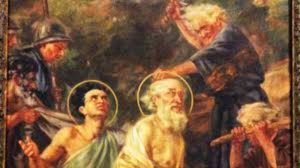
Image Credit: America Needs Fatima
Saints Marcellinus and Peter: Martyrs Who Turned Their Prison into a Pulpit
Two Names in the Eucharistic Prayer
If you have ever paid close attention during Mass, you have heard their names. Right there in the first Eucharistic Prayer—the Roman Canon—among the roll call of martyrs, you’ll find Marcellinus and Peter. Most of us do not know much about them. The historical record is thin. Yet the Church has never forgotten these two men, and their story carries a punch that still lands hard today.
What we do know comes pieced together from scattered sources: a pope’s personal testimony, ancient martyrologies, catacomb inscriptions, and a legendary account that may blend history with pious imagination. Together, they paint a portrait of two ordinary Christians who turned their darkest hour into their greatest witness.
Who Were They?
Marcellinus served as a priest. Peter worked as an exorcist—a recognized ministry in the early Church, not the Hollywood spectacle we imagine, but the prayerful liberation of those tormented by evil. Both lived in Rome during the late 3rd and early 4th centuries, when being Christian wasn’t just unfashionable; it could get you killed.
Their moment came during the Diocletianic Persecution, the most systematic and brutal assault on Christianity the Roman Empire ever launched. Emperor Diocletian, once relatively tolerant, reversed course around A.D. 303. Churches were demolished. Scriptures burned. Christians stripped of legal rights. The pressure mounted until confessing Christ became, quite literally, a death sentence.
Marcellinus and Peter were arrested. They landed in prison awaiting execution. For most people, that would be the end of the story—a quiet, desperate wait for the inevitable.
Not for these two.
Evangelists Behind Bars
According to the ancient passio—the legendary account of their martyrdom—Marcellinus and Peter saw their imprisonment not as defeat but as opportunity. They began talking to their jailer. Then his family. Then anyone who would listen.
The results were staggering. Their jailer, a man named Artemius, converted to Christianity. So did his wife Secunda (sometimes called Candida) and their daughter Paulina. The prison had become a church. The condemned men had become its pastors.
This wasn’t unusual for early Christians. Tertullian famously observed that “the blood of martyrs is the seed of the Church.” Marcellinus and Peter lived that truth in real time. They weren’t planning escape. They were planning conversions.
The Executioner’s Conversion
Pope St. Damasus I, who served from A.D. 366 to 384, claimed something remarkable. He said he heard the full story directly from the executioner himself—the very man who killed Marcellinus and Peter.
According to Damasus, the magistrate Severus (or Serenus) ordered the execution carried out in a remote, overgrown location about three miles from Rome. The reason was brutally practical. Other Christians had been retrieving and venerating martyrs’ bodies. By choosing an obscure spot—described as a thicket choked with thorns, brambles, and briers—the authorities hoped to prevent any such devotion.
Here’s where the story turns almost defiantly hopeful. Marcellinus and Peter weren’t distressed by this indignity. They reportedly helped clear the spot where they would die. Imagine that: two men, about to be beheaded, calmly pulling weeds and cutting brush to prepare their own execution site. Their peace must have been unmistakable. Their joy, inexplicable by any standard except faith.
They were beheaded and left in that wilderness.
But the authorities hadn’t counted on two women: Lucilla and Firmina. Guided by what the sources call “divine revelation,” they located the bodies. They gave Marcellinus and Peter proper burial near the remains of St. Tiburtius, along the Via Labicana. That site would become the famous Catacombs of Marcellinus and Peter, a place of pilgrimage for centuries.
And the executioner? He became a Christian too. The man who swung the sword against these martyrs eventually knelt before the God they served. Pope Damasus heard his testimony personally. It’s one of those details that feels almost too good to be true—yet the Church has preserved it for sixteen centuries.
From Hidden Graves to Imperial Honor
The early Christian community didn’t forget. The Martyrologium Hieronymianum, one of our oldest records of martyred saints, lists Marcellinus as priest and Peter as exorcist, noting their burial “at the two laurel trees” on the Via Labicana. Their feast day: June 2.
By the 7th century, pilgrims were visiting their tomb. The Liber Pontificalis records that Emperor Constantine the Great—yes, the same Constantine who legalized Christianity—built a basilica over their remains. An earlier structure erected by Pope Damasus himself had been destroyed by Gothic invaders, so Constantine replaced it with something grander. That’s the kind of veneration these two obscure martyrs commanded.
Their names entered the Ambrosian liturgy. They found permanent place in the Roman Canon, the Eucharistic Prayer used at Mass. Think about that: nearly every Catholic priest who has ever celebrated the traditional Latin Mass, and many who celebrate the ordinary form, has spoken their names aloud at the altar. Marcellinus and Peter. Two men whose historical footprints are faint, whose spiritual impact is incalculable.
Relics and a Complicated Journey
Their physical remains traveled almost as far as their spiritual influence.
In the 9th century, relics associated with Marcellinus and Peter made their way to Germany. Pope Gregory IV sent them to Einhard, Charlemagne’s biographer and a notable churchman. Einhard first installed them at Strasbourg, then moved them to Michelstadt, and finally to what became Seligenstadt, where he built a church in their honor and served as its first abbot.
The story gets murkier—and more human—here. Another version claims Einhard’s servant Ratleic acquired the relics through a Roman deacon named Deusdona, a man with a reputation as a “relics-swindler and thief.” The bones allegedly protested their first placement, demanding relocation to Seligenstadt, where they proceeded to work miracles. Modern scholars like Agostino Amore suspect the whole translation may have been fraudulent, given Deusdona’s character.
Whether the relics are entirely authentic or partially pious fiction, the devotion they inspired was genuine. Cremona Cathedral in Italy also claims relics of the two saints, housed in a sarcophagus in one of its transepts. Multiple places, multiple claims—typical of popular saints in an era when relics were spiritual currency.
What Their Story Teaches Us
Marcellinus and Peter left no writings. They founded no religious order. They performed no recorded miracles during their lifetimes. Yet their legacy persists in ways that dwarf more famous names.
They remind us that ordinary ministries matter profoundly. A priest saying Mass. An exorcist praying over the afflicted. These aren’t dramatic roles. They’re faithful ones. And faithfulness, in the right moment, becomes heroic.
They demonstrate that our worst circumstances can become our best opportunities. Prison, execution, obscurity—none of it stopped their evangelization. In fact, those very conditions made their witness more compelling. Who converts their jailer? Who wins over their executioner? Only people so saturated with Christ that their circumstances become irrelevant.
They show us that hidden fidelity bears public fruit. Marcellinus and Peter weren’t seeking fame. They were seeking faithfulness. Yet their names ring out at every Mass, their basilica still stands in Rome, and their feast day continues after seventeen centuries.
Celebrating Their Feast
The Church remembers Sts. Marcellinus and Peter on June 2. It’s a quiet feast, overshadowed by bigger names and flashier stories. But maybe that’s appropriate. These two men lived quiet lives of service before their dramatic death. Their witness didn’t depend on crowds or recognition.
When you hear their names at Mass next time, pause for a moment. Think of a priest and an exorcist in a Roman prison, talking to their jailer about Jesus, what about two women trudging through brambles to recover bodies the empire wanted forgotten. Think of an executioner laying down his sword and picking up faith.
The Church survives on stories like these. Not because they’re spectacular, but because they’re true. Marcellinus and Peter didn’t need to be extraordinary men. They just needed to be faithful ones. And in God’s economy, that’s always enough.

Leave a Reply