
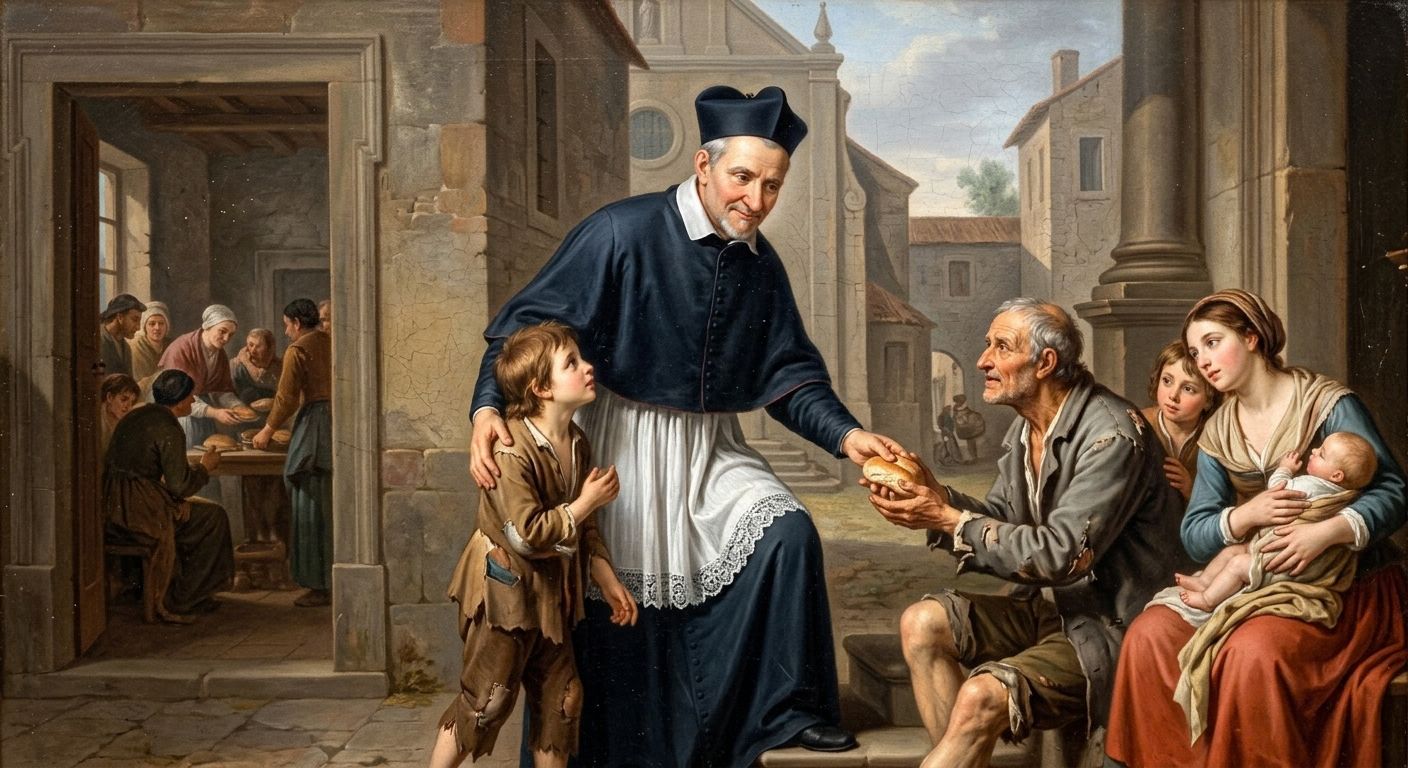
Patron of Charitable Societies and the Poor
The Church honours Saint Vincent de Paul annually on September 27, marking the date of his death in 1660. Believers widely recognise him as the patron of charitable societies, reflecting his extraordinary lifelong dedication toward serving the poor. Consequently, his name still appears today across countless hospitals, food pantries and parish charity groups worldwide. Furthermore, his remarkable journey from peasant poverty toward founding two major religious communities remains genuinely inspiring. Therefore, exploring his biography helps explain why organised Catholic charity owes him such an enormous historical debt.
Vincent de Paul was born on April 24, 1581, within the small village of Pouy, southwestern France. His parents, Jean de Paul and Bertrande de Moras, worked as humble peasant farmers raising six children together. Recognising his obvious intelligence, his father arranged for his education under the Franciscan friars stationed at Dax. Afterwards, Vincent briefly studied at Spain’s University of Saragossa, before eventually completing further theological studies at Toulouse. Remarkably, he received ordination as a priest in 1600, at just 19 years old.
Around 1605, while travelling by sea, Vincent reportedly fell captive to Barbary pirates operating along the Mediterranean coastline. Consequently, he endured approximately two years of genuine slavery within Tunis, before eventually managing his escape. Although historians still debate certain details surrounding this dramatic episode, his biographer Pierre Coste defended its overall historical accuracy. Afterwards, Vincent travelled toward Rome for additional study, before finally settling permanently within Paris itself. There, he became closely connected toward the influential Gondi family, serving initially as their household chaplain.
Madame de Gondi’s generous financial support eventually enabled Vincent to pursue increasingly ambitious charitable and missionary projects. In 1618, he met Saint Francis de Sales, whose writings profoundly shaped his own developing spiritual outlook. Consequently, Vincent began organising structured confraternities specifically dedicated toward assisting impoverished families across rural French villages. This charitable groundwork eventually led, in 1625, toward founding the Congregation of the Mission, later called the Vincentians. Based initially at the Saint-Lazare priory, these missionary priests earned the alternative nickname Lazarists throughout France.
Vincent’s charitable ambitions, however, extended considerably beyond ordained clergy alone toward involving dedicated laywomen as well. Working closely alongside Louise de Marillac, he established the Daughters of Charity in 1633. Unlike traditional cloistered religious orders, these women actively served directly within hospitals, orphanages and overcrowded French prisons. Consequently, this innovative approach represented a genuinely significant departure from typical 17th-century religious life for women. At the height of his charitable operations, Vincent reportedly organised daily meals feeding approximately 16 thousand impoverished people throughout Paris.
Beyond direct charitable relief, Vincent also worked tirelessly toward reforming French clergy formation during a genuinely turbulent religious period. He developed early seminary structures, helping train priests toward higher standards of pastoral care and theological understanding. Additionally, he firmly opposed the spreading Jansenist heresy, defending instead God’s universal desire toward saving every human soul. Furthermore, Vincent extended particular compassion toward galley slaves, abandoned infants and prisoners, groups largely ignored by wider society. Consequently, historians frequently credit him with transforming France’s entire approach toward organised, systematic charitable care.
As Vincent approached death, he endured considerable physical suffering, having lived faithfully through nearly eighty demanding years. He died peacefully within his chair on September 27, 1660, having received the Last Sacraments beforehand. Pope Benedict XIII beatified him in 1729, before Pope Clement XII formally canonised him in 1737. Today, the Vincentian order Vincent founded continues operating actively, with nearly 4000 members serving across 86 countries. Interestingly, the well-known Saint Vincent de Paul Society was actually founded later, in 1833, by Blessed Frédéric Ozanam.
Consequently, many people mistakenly assume Vincent personally established this particular lay charitable organisation bearing his own name. Nevertheless, Ozanam explicitly named his society after Vincent, honouring his enduring inspiration toward organised Catholic charity work. Today, believers invoke Vincent as patron toward charitable societies, hospitals, volunteers and prisoners, reflecting his genuinely broad legacy. He famously summarised his entire life’s philosophy simply: “I belong to God and to the poor.” Consequently, this single phrase continues capturing his remarkable, singular devotion toward humble, practical Christian service.
Ultimately, Saint Vincent de Paul’s story demonstrates how genuine holiness often emerges through consistent, practical care toward society’s most vulnerable members. Rather than pursuing personal comfort or recognition, he consistently prioritised feeding, housing and educating those experiencing genuine hardship. For readers wishing to explore further charitable history, additional detail remains available through Britannica and the Vincentian Family’s official website, alongside earlier articles published on this website concerning other celebrated champions of Catholic charity.







Leave a Reply