
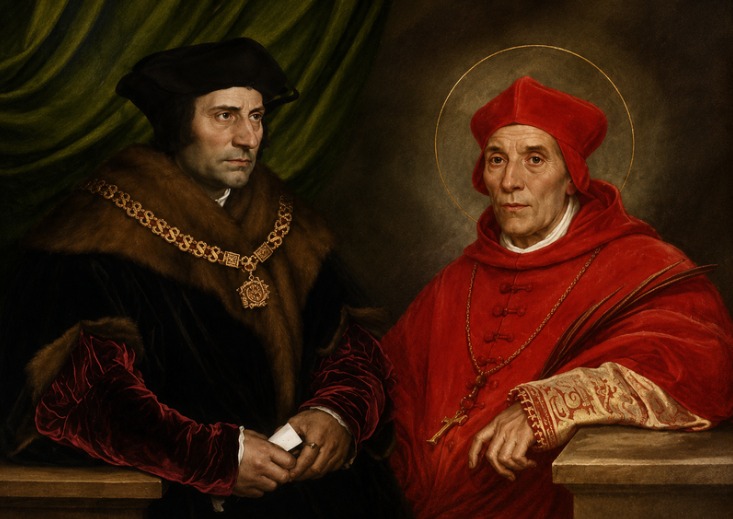
Saints Thomas More and John Fisher: Martyrs of Unshakeable Conscience
On June 22, the Catholic Church celebrates two remarkable English saints whose lives intertwined through friendship, shared convictions, and ultimate martyrdom. Saints Thomas More and John Fisher represent the highest ideals of integrity, learning, and spiritual courage in the face of tyrannical power.
The Feast Day of Saints Thomas More and John Fisher
The Church marks June 22 as the shared feast day of these two martyrs. This date honors the day John Fisher died by execution in 1535, while Thomas More followed him to martyrdom just two weeks later on July 6. Their joint commemoration reminds believers that faithfulness to conscience transcends even the threat of death.
Pope Pius XI canonized both saints together on May 19, 1935, recognizing them as representatives of numerous Catholic martyrs who suffered during England’s religious upheaval. Their beatification had occurred decades earlier on December 29, 1886, under Pope Leo XIII.
Early Life and Formation of Thomas More
Thomas More entered the world in London on February 7, 1478. His father, Sir John More, established himself as a prominent lawyer and judge during the reign of Edward IV. Young Thomas benefited enormously from his father’s connections and commitment to education.
Tragedy marked Thomas’s childhood profoundly. His mother, Agnes Graunger, passed away as did three of his siblings who died within their first year. Such loss was tragically common in fifteenth-century England, yet these hardships seemed to deepen young Thomas’s spiritual awareness.
In 1490, Thomas became a household page to John Morton, Archbishop of Canterbury and Lord Chancellor. This Renaissance figure ignited Thomas’s passion for learning and public service. Two years later, Thomas entered Oxford University, where he mastered Latin and Greek before transitioning to legal studies in London. By 1502, he earned approval to practice law.
Thomas experienced a profound spiritual crisis between 1503 and 1504 when he lived beside a Carthusian monastery. The monks’ disciplined piety attracted him intensely, and he participated regularly in their spiritual exercises. Ultimately, however, Thomas discerned that God called him to serve within the secular world rather than through monastic enclosure.
The Scholar Bishop: John Fisher’s Rise
John Fisher emerged from different circumstances, born in Beverley, Yorkshire, in 1469. His father, Robert Fisher, worked as a prosperous mercer before dying when John was merely eight years old. Despite this loss, John’s mother recognized his exceptional intellectual gifts and supported his education at Cambridge University.
John arrived at Cambridge in 1482, barely thirteen years old. The university had stagnated academically, but Fisher helped transform it entirely. He earned his Bachelor of Arts in 1487 and proceeded to Master of Arts in 1491. That same year, he received papal dispensation for early priestly ordination and became a fellow of his college.
Fisher’s connection to Lady Margaret Beaufort, mother of Henry VII, proved transformative. As her confessor, he channeled her generous endowments into founding St John’s College and Christ’s College at Cambridge. He also established the Lady Margaret Professorship of Divinity and attracted the renowned scholar Erasmus to teach there. In 1504, Fisher became both Bishop of Rochester and Chancellor of Cambridge University, positions he held until his death.
Public Service and Spiritual Depth
Thomas More married Jane Colt in 1505, enjoying a genuinely happy union that produced four children. After Jane’s death in 1511, Thomas quickly married Alice Harpur Middleton, a wealthy widow with whom he had no children but whom he treated with respect. Thomas distinguished himself as an extraordinarily devoted father who insisted his daughters receive educations equal to his son. His children became celebrated for their academic achievements.
More’s political career advanced steadily. He entered Parliament in 1504, represented London by 1510, and became a Privy Counselor in 1514. Henry VIII took particular notice of Thomas, knighting him in 1521 and appointing him Under-Treasurer of the Exchequer. By 1529, Thomas reached the pinnacle of English government as Lord Chancellor.
Meanwhile, John Fisher built his reputation as England’s most formidable theologian. He published extensive works against Martin Luther’s teachings, earning recognition as the first Catholic thinker to identify “faith alone” as Protestantism’s foundational error. Some scholars believe Fisher ghostwrote Henry VIII’s Defence of the Seven Sacraments, which earned the king the title “Defender of the Faith.”
The Crisis of Conscience
Everything changed when Henry VIII sought to annul his marriage to Catherine of Aragon. Thomas More initially supported the king in other matters, but he refused to sign a 1530 letter requesting papal annulment. This marked his first break with Henry’s policies.
John Fisher became Catherine’s most outspoken defender. He appeared personally before the legates’ court, declaring himself ready to die for marriage’s indissolubility. Henry responded with fury, composing a lengthy Latin rebuttal to Fisher’s arguments.
The situation deteriorated rapidly. When Henry purged clergy loyal to Rome, Thomas recognized that the king intended to sever England from the Catholic Church. In 1532, Thomas resigned as Lord Chancellor, citing failing health. Henry accepted the resignation but viewed it as disloyalty.
In 1533, Thomas refused to attend Anne Boleyn’s coronation, sending only a congratulatory letter. This absence enraged Henry, who interpreted it as undermining his authority over church and state.
Imprisonment and Trial
On April 13, 1534, officials ordered Thomas More to swear an oath acknowledging Anne as queen, Henry’s self-granted annulment, and the king’s supremacy over the church. Thomas accepted Henry’s marriage but refused to recognize his ecclesiastical authority. This refusal led immediately to Tower imprisonment.
John Fisher had already suffered imprisonment since April 1534 for refusing the oath of succession. Unlike other bishops, he would not acknowledge Henry and Anne’s children as legitimate heirs. In May 1535, Pope Paul III made Fisher a cardinal, hoping to soften Henry’s treatment. Instead, Henry declared he would send Fisher’s head to Rome rather than allow the cardinal’s hat to enter England.
Both men faced rigged trials. Thomas appeared before a court including Anne Boleyn’s father, brother, and uncle. Despite brilliant self-defense, dubious witnesses perjured themselves, and the jury convicted him in fifteen minutes. The court sentenced him to hanging, drawing, and quartering.
Fisher’s trial occurred on June 17, 1535, before seventeen commissioners including Thomas Cromwell. The sole testimony came from Richard Rich, the same man who would later perjure himself against Thomas More. The jury found Fisher guilty of treason for denying Henry’s ecclesiastical supremacy.
Martyrdom and Legacy
Henry commuted Thomas’s sentence to beheading, perhaps feeling some residual affection for his former friend. On July 6, 1535, Thomas mounted the scaffold with characteristic wit, joking that he needed help ascending but would manage his own descent. His final words remain immortalized: “I die the king’s good servant, but God’s first.”
John Fisher met his end on June 22, 1535, at Tower Hill. The government rushed his execution before June 24, fearing public sympathy if he survived until his patronal feast day, the Nativity of Saint John the Baptist. Fisher died with calm dignity, profoundly moving witnesses. His body was treated with shocking disrespect, thrown naked into a rough grave before later interment beside Thomas More in St. Peter ad Vincula chapel.
Posthumous examination revealed that Thomas More wore a hair shirt beneath his elegant exterior, a hidden sign of lifelong penance and devotion. Both men demonstrated that authentic faith requires integrating public integrity with private spiritual discipline.
Today, Saints Thomas More and John Fisher inspire lawyers, politicians, civil servants, and anyone facing difficult moral choices. Thomas serves additionally as patron of adopted children and troubled marriages, while John Fisher remains patron of the Diocese of Rochester, New York. Their combined legacy reminds us that conscience, properly formed, deserves our ultimate loyalty even when power demands our capitulation.




Leave a Reply