
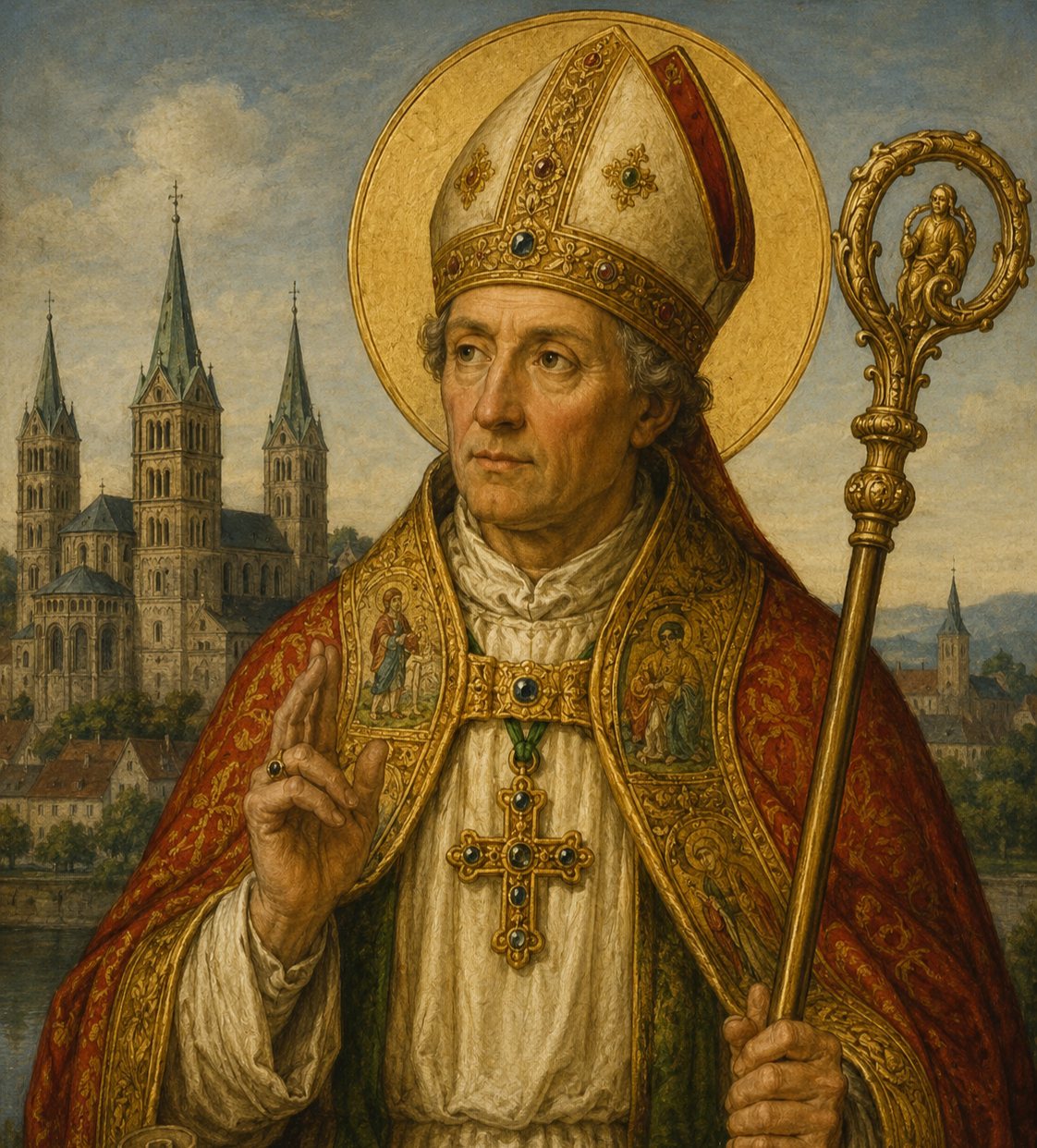
Saint Otto of Bamberg: Bishop and Apostle of Pomerania
Saint Otto of Bamberg holds a rare place among medieval churchmen: a nobleman who became a court official, then a bishop, and finally a missionary remembered as the “Apostle of Pomerania.” Born around 1060 in the Swabian region of what is now Germany, he spent his early career serving emperors before spending his later years converting an entire pagan region through patience rather than force. Because his story touches on politics, diplomacy, and evangelization all at once, Saint Otto of Bamberg offers a fuller picture of medieval Church life than most single-category saints can provide.
Saint Otto of Bamberg’s Feast Day Falls on July 2
The universal Church keeps the feast of Saint Otto of Bamberg on July 2, even though he actually died on June 30, 1139. This is the date recorded in the Roman Martyrology, and it remains the standard feast day used worldwide. That said, local calendars vary: the Archdiocese of Bamberg itself honors him on September 30, while certain dioceses in northwestern Poland mark his feast on July 1 instead. This spread of dates across three separate days reflects how far his influence reached, since his work touched Germany, Rome, and Poland alike.
From Swabian Nobility to the Imperial Court
Otto was born into a noble Swabian family that held estates in the Jura mountains. Since his older brother stood to inherit the family’s land, Otto instead pursued a path within the Church, and he likely received his early education at Hirsau Abbey or one of its affiliated houses. His noble background proved useful almost immediately. In 1082, when Princess Judith of Swabia married the Polish Duke Władysław I Herman, Otto traveled with her to Poland as her chaplain, a posting that gave him his first real exposure to Polish court life. Nine years later, in 1091, he entered the service of Emperor Henry IV directly, and by 1101 he had risen all the way to imperial chancellor, a role that included overseeing construction of Speyer Cathedral.
Saint Otto of Bamberg’s Principled Rise to Bishop
In 1102, Emperor Henry IV named Otto Bishop of Bamberg. Rather than accept consecration from a bishop of questionable standing, however, Otto insisted on receiving it directly from the pope, a bold move given the tense politics of the Investiture Controversy then dividing emperors and popes across Europe. He therefore traveled to Rome, and Pope Paschal II consecrated him on May 13, 1106. Once in office, Otto rebuilt Bamberg’s cathedral after a serious fire, strengthened its cathedral school, and founded more than thirty monasteries and hospitals throughout his territory. He also restored the Monastery of Saint Michael following an earthquake around 1117. Despite his elevated position, Otto lived simply and used his personal wealth to support the poor.
A Key Diplomat Behind the Concordat of Worms
Saint Otto of Bamberg’s talents extended well beyond his diocese. During the long-running Investiture Controversy, he balanced loyalty to the emperor with fidelity to the pope more skillfully than almost anyone else of his era. At the Congress of Würzburg in 1121, his negotiating helped produce the peace agreement that became the Concordat of Worms the following year, finally resolving the dispute over who held the right to appoint bishops. His influence reached individuals as well as institutions: around 1112, Otto personally clothed Hildegard of Bingen as a nun at Disibodenberg Abbey, years before she became one of the era’s most celebrated mystics. In the 1130s, he also mediated tensions between Emperor Lothair of Supplinburg and the rising Hohenstaufen family.
The Missionary Triumph That Earned Him the Title Apostle of Pomerania
The achievement that defines Saint Otto of Bamberg most, though, is his peaceful conversion of Pomerania. Earlier missionary efforts by Polish rulers and by the Spanish bishop Bernard had failed, largely because those missions relied on force or arrived without resources. When Duke Bolesław III of Poland asked Otto for help in 1124, Otto took a different approach entirely. He traveled with twenty clergy, a large retinue of servants, sixty warriors supplied by Bolesław, and ample provisions, signaling clearly that he sought no material gain from the local population. Acting as an official papal legate, he visited Pyrzyce, Kamień, Szczecin, and Jomsborg, baptizing more than 22,000 people and establishing eleven churches along the way.
When old pagan customs resurfaced after his return in 1125, Otto went back to Pomerania in 1128, this time with backing from Duke Wartislaw I. At the Diet of Usedom, he won over the local nobility and sent priests from Bamberg to serve the new Christian communities there. Jurisdictional disputes between Magdeburg and Gniezno prevented him from consecrating a bishop for the region himself, so that honor eventually went to his former companion, Adalbert of Pomerania, in 1140.
Legacy and Canonization of Saint Otto of Bamberg
Saint Otto of Bamberg died on June 30, 1139, and was buried at Michaelsberg Abbey in Bamberg. Pope Clement III canonized him in 1189, just fifty years later. Three separate biographies from his own era preserved his memory, written by Wolfger of Prüfening, Ebo of Michelsberg, and Herbord of Michelsberg. Today, the Church recognizes him as patron of the Archdiocese of Bamberg and co-patron of the Archdiocese of Berlin and the Diocese of Stettin-Kammin, and believers still invoke him for protection against fever and rabies. For readers curious about other missionary saints from the same month, see Blessed Junipero Serra, or explore the full list of July saints and feast days. For deeper historical background, the Encyclopaedia Britannica entry on Otto of Bamberg offers further reading.





Leave a Reply