
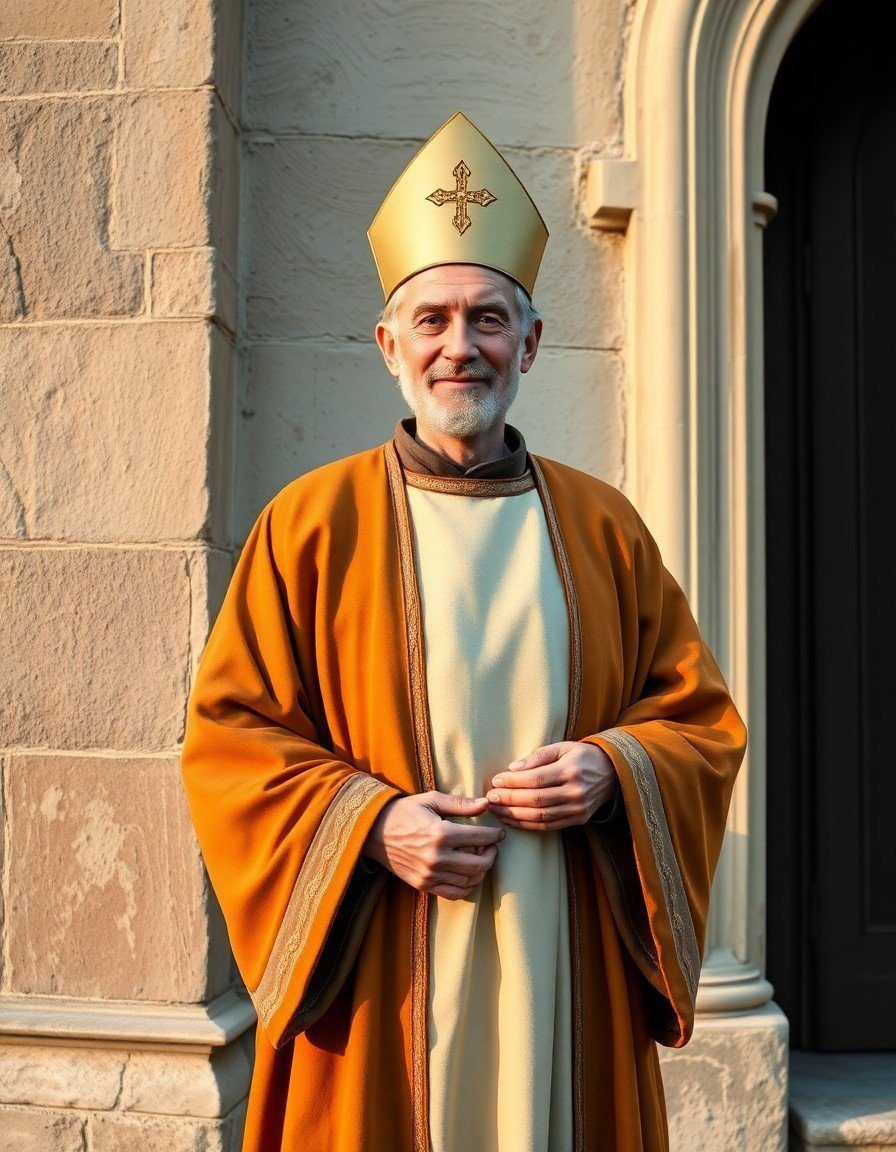
Image credit: VIA Bible
Saint Landericus of Paris: The Bishop Who Built a Hospital for the Poor
Saint Landericus of Paris, also known as Saint Landry, spent his life doing exactly what his title suggests: serving the poor with genuine sacrifice. As Bishop of Paris from 650 to 661, he became so devoted to the needy that he gave away nearly everything he owned. Consequently, his story stands today as one of the earliest and most striking examples of Christian charity applied to public healthcare.
Saint Landericus of Paris’ Feast Day
The Church honours Saint Landericus of Paris every year on June 10, the date now associated with his memory following his death around 661. Both the Roman Catholic Church and the Orthodox Church recognize him as a canonized saint, and his feast continues to appear in the Paris Breviary through a dedicated liturgical office.
From Royal Clerk to Bishop of Paris
Before entering church leadership, Landry served as chief clerk of the Royal Chancery, a position that placed him at the center of political and administrative life in seventh-century France. In 650, however, his path changed dramatically when he succeeded Bishop Audobertus and became Bishop of Paris. Almost immediately, his new role would test the depth of his compassion.
A Famine That Revealed His Character
Shortly after Landry took office, a severe famine struck the region between 650 and 651. Rather than simply issuing prayers or appeals, Saint Landericus of Paris responded with direct action. He sold every personal possession he owned to help feed starving families throughout his diocese. Yet even that sacrifice was not enough. When the proceeds still fell short, he made the extraordinary decision to sell sacred vessels and furniture belonging to the Church itself, prioritizing hungry people over material treasures.
Founding the First Hospital in Paris
Beyond the famine, Landry noticed a deeper, ongoing problem. At the time, sick members of the poor typically relied on small hostels that depended entirely on unpredictable charitable donations. Because this arrangement left many people without reliable care, Landry decided to build something far more permanent: the city’s first true hospital, dedicated to St. Christopher. Over time, this institution grew into the renowned Hôtel-Dieu de Paris, a hospital that would go on to serve the city for centuries and remains one of the oldest hospitals in the world.
Supporting the Church’s Growth
While Landry focused heavily on physical needs, he never neglected spiritual ones either. He welcomed the Benedictine Order into his diocese, encouraging them to establish the Abbey of Saint-Denis. In 653, alongside twenty-three fellow bishops, he signed the foundation charter granted by King Clovis II to the abbey, formally exempting it from episcopal jurisdiction. In addition, tradition credits him with building the original church of Saint-Germain-l’Auxerrois, which later became the official parish church of the kings of France.
Before his death, Landry also commissioned the monk Marculfus to compile a collection of ecclesiastical formulas, a scholarly project that helped preserve important religious and legal traditions of the era.
Burial, Relics, and Miracles
After his death around 661, the Church buried Saint Landericus of Paris at Saint-Germain-l’Auxerrois, where a chapel bearing his name still holds most of his relics today. However, two of his bones were later given to the parish of Saint-Landry in 1408, a church that originally began as a small chapel near the saint’s own house of prayer.
Over time, believers attributed several miracles to his intercession. One especially memorable account, recorded in Jacobus de Voragine’s The Golden Legend, describes a man named Raoul Gracard who suffered from a severely swollen head and was mistaken for a leper by his community. According to the account, after the man confessed his sins, received penance, and devoutly kissed a cloth associated with the saint, he returned home and found himself completely healed.
A Legacy That Crossed the Atlantic
Saint Landericus of Paris’ influence eventually reached far beyond France. Saint Landry Catholic Church in Opelousas, Louisiana, is dedicated to him, complete with a statue behind the Altar and a stained-glass window honouring his memory. Because of this connection, the surrounding civil parish, Saint Landry Parish, also carries his name today. Even Paris’ very first dock, Port St-Landry, once bore tribute to him as well.



Leave a Reply